-
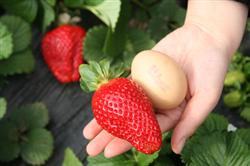
Strawberry Summer Pest and Disease Control Methods and Precautions
Applying Boron and Iron Fertilizer Can Improve Strawberry Quality. Strawberries are currently being marketed in large quantities, but as strawberries grow and fruits are harvested, farmers neglect the application of micronutrient fertilizers, and combined with unreasonable fertilization, this causes a deficiency of trace elements needed for strawberry growth, especially with boron and iron deficiency symptoms being particularly obvious, which has already affected strawberry yield...
-
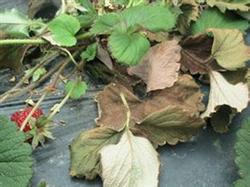
How to prevent and control strawberry Fusarium wilt? A detailed guide to practical management measures
Strawberry Fusarium wilt is a soil-borne fungal vascular wilt disease, and it can occur generally from the seedling stage through the harvest stage. Control methods: 1. Strengthen cultivation management. Drain promptly after rain. When diseased plants are found, pull them out promptly and destroy them in a centralized manner, spray chemicals to sterilize, and at the same time add Xinguozhimou (New High Lipid Film) to enhance the effectiveness of the pesticide. 2. Flowering and fruiting...
-
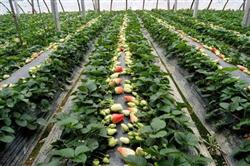
What are the harmful effects of continuous cropping of greenhouse strawberries? A detailed explanation of prevention and control techniques
1. Harmful effects of continuous cropping of greenhouse strawberries 1.1 Causes long-term accumulation of pathogenic microorganisms. Planting strawberries continuously on the same plot of land causes obvious changes in the soil microbial community, and suddenly, suddenly nematodes and pathogenic bacteria multiply in large numbers, leading to major outbreaks of pests and diseases. 1.2 Causes imbalance of strawberry nutrients...
-
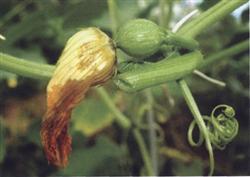
What fungicides are effective for controlling flower rot in pumpkins?
Symptoms: Also known as fruit rot. It commonly occurs in open fields and protected cultivation, and is especially severe in protected cultivation. In recent years, the damage has been on the rise, reducing yields by about 30%. When it attacks pumpkins, melons, and watermelons, it is called flower rot or fruit rot; when it attacks bottle gourd and zucchini, it is called brown rot, commonly known as rotten eggs. Flower rot attacks pumpkin flowers and young fruits, and diseased fruits become...
-
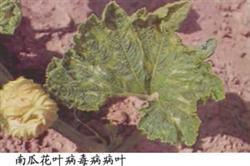
What pesticide is effective for controlling pumpkin mosaic virus disease?
Symptoms: Mainly manifested as uneven chlorophyll distribution, with yellow patches or mottled mosaic of alternating light and dark areas on the leaf surface, sometimes with increased chlorophyll concentration along the leaf veins, forming alternating dark green bands; in severe cases, the leaf surface becomes uneven and bumpy, with the veins wrinkled and deformed. Generally, symptoms on new leaves are more obvious than on old leaves. In severe cases, the stems and vines and terminal leaves become twisted and shrunken....
-
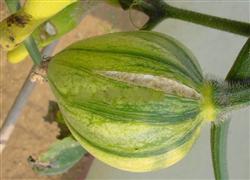
Causes of Pumpkin Fruit Cracking and Control Methods
Main symptoms: Fruit cracking occurs in both young and mature pumpkins, producing longitudinal, transverse or diagonal cracks on the fruit surface. The cracks vary in depth and width; severe cracks can reach deep into the flesh, exposing the seeds, and the injured surfaces of the cracks become suberized; minor cracks are only small fissures. If young fruit cracks, by the time the pumpkin matures it generally becomes severe...
-
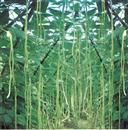
Greenhouse Bean Disease Prevention and Control Methods and Key Technical Points
I. Symptoms of bean rust: It mainly affects the leaves, and in severe cases also affects the petioles and pods. In the early stage of the disease, small pale yellow spots appear on the underside of the leaves, later turning rusty brown, raised and forming small pustule-like blisters, then expanding into uredinia, and after the epidermis ruptures, reddish-brown powder is released. This is the urediniospore. II. Bean powdery mildew...
-
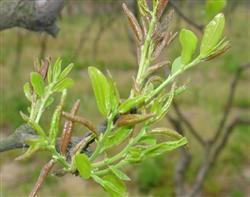
What are the control methods for the jujube gall midge, a pest of jujube trees?
This insect, commonly known as the jujube leaf maggot, is found in jujube-growing areas across the country, where its larvae damage the tender leaves, flower buds and young fruit of jujube trees. Damaged tender leaves curl into a tube shape, turn purplish red, become hard and brittle, and soon blacken and wither. Once flower buds are damaged they cannot open, and they turn yellow and drop off. Damaged young fruit cannot develop and grow properly; at about the size of a soybean they turn yellow and drop off...
-
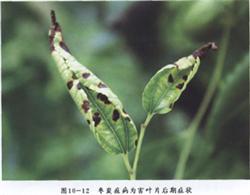
How to prevent and control jujube anthracnose? Sharing practical methods
1. Symptoms: Infected fruit first shows red-brown spots, after which the lesions gradually enlarge, surrounded by a pale yellow halo; finally the lesion color turns dark brown, slightly sunken but then expanding slowly, and the lesion shapes are diverse, including round, oval or spindle-shaped. The flesh inside the lesion gradually changes from green to brown, becomes necrotic,...
-
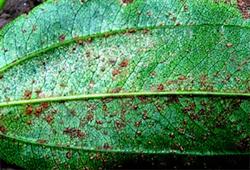
Identification and Control Methods of Jujube Rust Disease Explained in Detail
(1) Symptoms: Jujube rust disease only damages the leaves. In the early stage, pale green small spots are scattered on the underside of the leaves, later gradually becoming raised and dark yellow, which are the uredinia of the pathogen. The uredinia are irregular in shape and mostly occur on both sides of the midrib, at the leaf tip and base. After the surface of the lesion ruptures, yellow urediniospores are scattered. On the upper side of the leaf, corresponding to the uredinia, green...
条件筛选