-
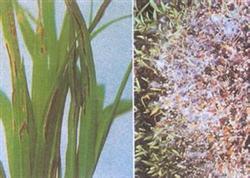
How to prevent and control rice Phytophthora disease? Detailed explanation of control methods
Rice Phytophthora disease: Diseased fields should be drained and dried in time, which can effectively inhibit the spread of the disease. Chemical control should focus on protecting early rice seedlings at the 3-leaf stage. Generally, pesticides should be applied before cold-protection irrigation or after drainage. The pesticides include: 50% carbendazim 1000-fold solution; 50% thiophanate or 50% benomyl 500-fold solution; 40% Phytophthora-killing 500-fold solution....
-
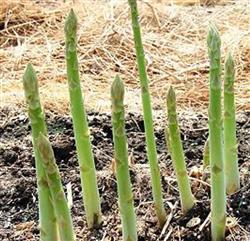
Control Methods for the Asparagus Beetle
It is widely distributed in China, with 3-4 generations per year in Shandong and other places. Adults and larvae feed on the young stems or epidermis of asparagus, causing damage that can lead to deformed shoots or completely defoliated stems, resulting in shortened, deformed or branching shoots with clustered cladodes, and in severe cases the plants dry up and die. [Control Methods] 1. Clean the asparagus field to remove pests: promptly clean the field before winter or in early spring...
-
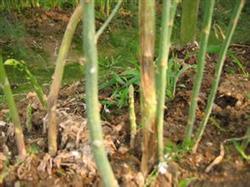
Occurrence Characteristics and Control Methods of Common Asparagus Diseases
I. Asparagus Fusarium Wilt 1. Symptoms. Asparagus fusarium wilt, also known as wilt disease, is a soil-borne disease. Initially, individual plants in the field turn yellow and wilt, and as the disease spreads, the entire plant dies. When young stems are infected, the cladodes and stems turn brown or split longitudinally. Brown lesions can appear on the underground stems and roots of diseased plants, and in later stages the affected parts rot, producing white to pink mold. When young spears are infected, the stems are thin or unable to emerge from the soil.
-
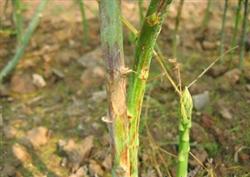
Comprehensive Control Methods and Techniques for Asparagus Pests and Diseases Explained in Detail
For pest and disease control, scientific control measures must be adopted, pollution-free control techniques vigorously promoted, and highly toxic and high-residue pesticides banned, so as to effectively control pest and disease damage while keeping pesticide residues in the product within limits. In control, adopt the measures of "prevention first, comprehensive control" and carry out early prevention in good time. (1) Agricultural...
-
Detailed Explanation of the Harm and Control Methods of Asparagus Pests and Diseases
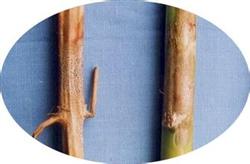
In recent years, the asparagus planting area has been continuously expanding, and the degree of damage from its diseases has also increased accordingly, causing considerable losses to the vast number of asparagus growers. The main asparagus diseases include: stem blight, root rot, brown spot, damping-off, and tip blight. The common diseases in the growth process of asparagus and their control measures are introduced as follows: 1. ...
-
Detailed Explanation of the Grading Standards and Control Methods for Rice Blast
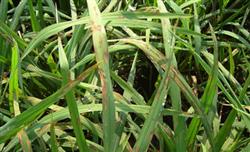
Grading standards Leaf blast: Grade 1 occurs sporadically, and disease can only be seen upon careful investigation. Grade 2 has slightly more incidence, with diseased leaves concentrated in the lower part. Grade 3 has widespread incidence, with diseased leaves concentrated in the middle and lower parts. Grade 4 has relatively severe incidence, with diseased leaves concentrated in the middle and upper parts, and a small number of patches appearing. Grade 5 has severe incidence, with obvious patches...
-
Occurrence of Rice Blast and Rice Planthopper and Their Control Methods
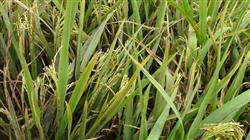
I. OccurrenceRice blast: Rice leaf blast has now appeared in Helan, Qingtongxia and other places. The first appearance date was June 13, about 10 days earlier than last year. Especially after the rainfall on July 7 and 12, the field humidity was relatively high, which was very favorable for the development of leaf blast. A recent general survey in Qingtongxia showed an average diseased field rate of 16.7%, a diseased plant rate of 2.2%, and a diseased leaf rate of 0.68%. In Helan, it occurred sporadically in some drill-seeded fields. Ear-neck blast will appear at the end of July and the beginning of August. The meteorological forecast shows that in August the temperature across the region will be relatively high and precipitation in the irrigation area will be relatively low, which is unfavorable for the occurrence and development of ear-neck blast. It is expected that ear-neck blast will generally occur at a mild-to-moderate level, with moderate to severe occurrence in fields where large areas of susceptible varieties are planted in some localities. Even so, all rice-growing counties still must not take it lightly and should strengthen monitoring. For fields with disease centers, farmers should immediately be organized to spray pesticides to block the disease centers and control the spread of fungal spores. In mid- and late July, general control should be carried out in fields where leaf blast has already occurred and in fields with high density and vigorous growth, to control the development of leaf blast and prevent the occurrence of ear blast. In early and mid-August, fields where ear-neck blast has already occurred should be sprayed promptly to control the spread of the disease. Rice planthopper: A survey in Wuzhong on July 10 found a 42% insect-hole rate; in 50 sweep-net passes, there were 32 adult brown-backed planthoppers, 10 white-backed planthoppers, 37 long-winged forms, and 5 short-winged forms. There were 60 white-backed planthopper nymphs and 151 brown-backed planthopper nymphs. A survey in Qingtongxia on July 10 found 24 insects per 100 hills.
-
Control Methods for the Brown Planthopper Infestation in Rice
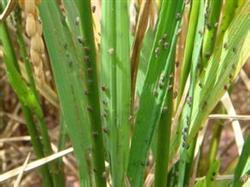
The brown planthopper, also known as the brown rice planthopper, is commonly called ascarid worm, soft-shelled ascarid, yóu worm, and midge. Scientific name Nilaparvata lugens (Stdl), order Homoptera, family Delphacidae. The brown planthopper is one of the major pests of rice in China, causing damage in all major rice-growing regions across the country, north and south, and every year it occurs and causes damage mixed with the white-backed planthopper. The two planthoppers...
-
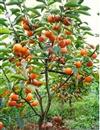
How to prevent and control persimmon tree diseases? These two methods are very practical
The main pests and diseases that persimmon trees are prone to include: persimmon angular leaf spot, circular leaf spot, anthracnose, black spot, leaf blight, powdery mildew, Eumeta variegata, Japanese mealybug, tea tussock moth, Maladera ovata, red wax scale, Homona magnanima, and small black slug moth, etc. Control methods: (1) Remove diseased fallen leaves and burn them; at the early stage of the disease, spray Bordeaux mixture, zineb, carbendazim or any one of these fungicides several times; when powdery mildew is severe, spray triadimefon. (2) Use light traps to kill adult insects; during the larval or nymph stage, spray dichlorvos, trichlorfon, fenitrothion or any one of these insecticides.
-
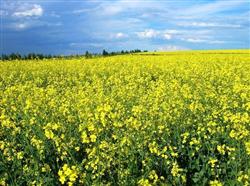
How to prevent and control weeds in rapeseed? Master the occurrence characteristics and control methods
The amount of nitrogen, phosphorus and potassium absorbed by rapeseed is nitrogen greater than potassium, and potassium greater than phosphorus. For every 1000 kg of rapeseed produced, it needs to absorb 2.76 kg of nitrogen, 0.33 kg of phosphorus and 2.06 kg of potassium. The absorption ratio of nitrogen, phosphorus and potassium is 8.38:1:6.24. A deficiency of the trace element boron will produce boron deficiency symptoms. Rapeseed plants...
条件筛选