Occurrence of Rice Blast and Rice Planthopper and Their Control Methods
I. OccurrenceRice blast: Rice leaf blast has now appeared in Helan, Qingtongxia and other places. The first appearance date was June 13, about 10 days earlier than last year. Especially after the rainfall on July 7 and 12, the field humidity was relatively high, which was very favorable for the development of leaf blast. A recent general survey in Qingtongxia showed an average diseased field rate of 16.7%, a diseased plant rate of 2.2%, and a diseased leaf rate of 0.68%. In Helan, it occurred sporadically in some drill-seeded fields. Ear-neck blast will appear at the end of July and the beginning of August. The meteorological forecast shows that in August the temperature across the region will be relatively high and precipitation in the irrigation area will be relatively low, which is unfavorable for the occurrence and development of ear-neck blast. It is expected that ear-neck blast will generally occur at a mild-to-moderate level, with moderate to severe occurrence in fields where large areas of susceptible varieties are planted in some localities. Even so, all rice-growing counties still must not take it lightly and should strengthen monitoring. For fields with disease centers, farmers should immediately be organized to spray pesticides to block the disease centers and control the spread of fungal spores. In mid- and late July, general control should be carried out in fields where leaf blast has already occurred and in fields with high density and vigorous growth, to control the development of leaf blast and prevent the occurrence of ear blast. In early and mid-August, fields where ear-neck blast has already occurred should be sprayed promptly to control the spread of the disease. Rice planthopper: A survey in Wuzhong on July 10 found a 42% insect-hole rate; in 50 sweep-net passes, there were 32 adult brown-backed planthoppers, 10 white-backed planthoppers, 37 long-winged forms, and 5 short-winged forms. There were 60 white-backed planthopper nymphs and 151 brown-backed planthopper nymphs. A survey in Qingtongxia on July 10 found 24 insects per 100 hills.
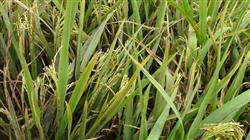
I. Occurrence
Rice blast: Rice leaf blast has now appeared in Helan, Qingtongxia and other places. The first appearance date was June 13, about 10 days earlier than last year. Especially after the rainfall on July 7 and 12, the field humidity was relatively high, which was very favorable for the development of leaf blast. A recent general survey in Qingtongxia showed an average diseased field rate of 16.7%, a diseased plant rate of 2.2%, and a diseased leaf rate of 0.68%. In Helan, it occurred sporadically in some drill-seeded fields. Ear-neck blast will appear at the end of July and the beginning of August. The meteorological forecast shows that in August the temperature across the region will be relatively high and precipitation in the irrigation area will be relatively low, which is unfavorable for the occurrence and development of ear-neck blast. It is expected that ear-neck blast will generally occur at a mild-to-moderate level, with moderate to severe occurrence in fields where large areas of susceptible varieties are planted in some localities. Even so, all rice-growing counties still must not take it lightly and should strengthen monitoring. For fields with disease centers, farmers should immediately be organized to spray pesticides to block the disease centers and control the spread of fungal spores. In mid- and late July, general control should be carried out in fields where leaf blast has already occurred and in fields with high density and vigorous growth, to control the development of leaf blast and prevent the occurrence of ear blast. In early and mid-August, fields where ear-neck blast has already occurred should be sprayed promptly to control the spread of the disease. Rice planthopper: A survey in Wuzhong on July 10 found a 42% insect-hole rate; in 50 sweep-net passes, there were 32 adult brown-backed planthoppers, 10 white-backed planthoppers, 37 long-winged forms, and 5 short-winged forms. There were 60 white-backed planthopper nymphs and 151 brown-backed planthopper nymphs. A survey in Qingtongxia on July 10 found 24 insects per 100 hills.
II. Control Methods
The methods of "simultaneous control of diseases and pests" and "one spray for multiple preventions" can be adopted. Disease-control agents should mainly be broad-spectrum fungicides such as tricyclazole and isoprothiolane, and agents for controlling rice planthopper should mainly be systemic insecticides such as imidacloprid and acetamiprid. In the control of rice planthopper, attention should be paid to the timing and method of application. Apply the pesticide before 10 a.m. or after 4 p.m. when rice planthoppers are active on the upper part of the plants. Spray should reach the lower part of the rice plants as much as possible, with 60 kg of water per mu. For fields with mixed occurrence and relatively severe damage, unified prevention and control should be carried out, giving full play to the role of motorized sprayers and large vehicle-mounted sprayers.