Occurrence Characteristics and Control Methods of Common Asparagus Diseases
I. Asparagus Fusarium Wilt 1. Symptoms. Asparagus fusarium wilt, also known as wilt disease, is a soil-borne disease. Initially, individual plants in the field turn yellow and wilt, and as the disease spreads, the entire plant dies. When young stems are infected, the cladodes and stems turn brown or split longitudinally. Brown lesions can appear on the underground stems and roots of diseased plants, and in later stages the affected parts rot, producing white to pink mold. When young spears are infected, the stems are thin or unable to emerge from the soil.
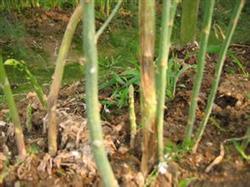
I. Asparagus Fusarium Wilt
1. Symptoms. Asparagus fusarium wilt, also known as wilt disease, is a soil-borne disease. Initially, individual plants in the field turn yellow and wilt, and as the disease spreads, the entire plant dies. When young stems are infected, the cladodes and stems turn brown or split longitudinally. Brown lesions can appear on the underground stems and roots of diseased plants, and in later stages the affected parts rot, producing white to pink mold. When young spears are infected, the stems are thin or unable to emerge from the soil.
2. Pathogen and transmission routes. The pathogen is Fusarium oxysporum f. sp. asparagi. The pathogen overwinters in the soil as chlamydospores. The following year, conidia are produced and spread by rain or irrigation water, entering through wounds and damaging the stems and root system. After infection, large numbers of conidia are produced for secondary infection. In production, excessively wet soil predisposes plants to the disease.
3. Control methods. (1) Seedling beds should not be continuously cropped; implement a 3-4 year rotation. (2) Apply fully decomposed organic fertilizer and use asparagus-specific fertilizer, taking care to prevent root burn or waterlogging. (3) Strengthen management, remove weeds promptly, drain promptly after rain, reduce soil moisture, and prevent moisture retention. (4) In the early stage of the disease, spray or drench with 36% thiophanate-methyl 600x solution, or 50% carbendazim wettable powder 700x solution, or 1:1:160 Bordeaux mixture, or 77% copper hydroxide wettable powder 500x solution for control.
II. Asparagus Root Rot
1. Symptoms. It mainly damages the stem base or roots. The initially affected area turns brown, and the cortex gradually rots, leaving only the epidermis and vascular bundles. White mycelium is present beneath the epidermis. In severe cases, the small roots all rot away, the roots become decayed, and the plant turns yellow, becomes stunted, or wilts and dies. Generally, leaves do not drop, which distinguishes it from fusarium wilt.
2. Pathogen and transmission routes. The pathogen is Fusarium moniliforme. The pathogen can survive on seeds for 2 years. When seeds germinate, conidia germinate and produce germ tubes, which enter young roots through wounds and cause disease.
3. Control methods are the same as for asparagus fusarium wilt.
III. Asparagus Anthracnose
1. Symptoms. It mainly damages stems. Lesions on stems are gray to light brown, spindle-shaped or irregular, and in later stages small black dots appear on the affected parts.
2. Pathogen and transmission routes. The pathogen is a fungus of the genus Glomerella in the subphylum Ascomycotina. The pathogen overwinters as mycelium and conidia on diseased plant residues. The following year from April to June, it spreads via rain. It expands rapidly during rainy seasons, and disease incidence is mild in dry years or years with drought and no rain.
3. Control methods. (1) Promptly remove diseased plant residues at harvest and bury them deep or destroy them. (2) Apply decomposed organic fertilizer. (3) During the disease period, pay attention to drainage after rain, strictly prevent flooding irrigation, and schedule watering in the morning to reduce nighttime dew formation. (4) In the early stage of the disease, spray with 70% mancozeb wettable powder 500x solution, 75% chlorothalonil wettable powder 600x solution, or 80% anthracnose thiram wettable powder 800x solution, spraying once every about 10 days, for 2-3 consecutive treatments, and stop 7 days before harvest.
IV. Asparagus Stem Rot
1. Symptoms. It mainly damages young spears. When young spears are damaged after emerging, water-soaked spots initially appear on the stem surface and gradually expand, then invade the stem, causing the stem tissue to rot and the aboveground part to appear withered. Under high humidity, white mycelium can appear on the stem surface tissue.
2. Pathogen and transmission routes. The pathogen is a species of Pythium, a fungus in the subphylum Mastigomycotina. It overwinters in the soil as mycelium or sclerotia and can survive saprophytically for 2-3 years. The mycelium directly invades the host and spreads through water flow and farm tools. Oversowing and high humidity predispose plants to the disease.
3. Control methods. (1) Use high beds or ridge cultivation, and avoid excessive density. (2) Strengthen field management, drain promptly after rain, and reduce soil moisture. (3) Promptly pull out diseased spears and bury them deep or burn them to reduce inoculum sources. (4) Use drip irrigation or under-film irrigation, and strictly prevent flooding irrigation. (5) In the early stage of the disease, spray or drench with 75% phosethyl-Al mancozeb wettable powder 500x solution, or 64% oxadixyl mancozeb wettable powder 500x solution, or 72% DuPont Curzate wettable powder 800-1000x solution, and stop 3 days before harvest.
V. Asparagus Viral Disease
1. Symptoms: Asparagus viral disease shows no obvious symptoms in the field. Diseased plants grow thin and weak, become curved and yellowed, and yield is significantly reduced.
2. Pathogen and transmission routes. The pathogens include Asparagus virus 1, Asparagus virus 2, and Asparagus virus 3. They are transmitted by seeds, and also by sap, but not by aphids.
3. Control methods. (1) At harvest, pay attention to using cutting knives, and disinfect the knives when necessary to prevent sap transmission. (2) To prevent seed transmission, collect seeds from disease-free plants, and when necessary, use shoot-tip virus elimination technology for detoxification. (3) In the early stage of the disease, spray with 20% duikeding wettable powder 500-600x solution, or 0.5% antivirus agent No. 1 aqueous solution 300-350x solution, 5% junduqing wettable powder 500x solution, or 20% bingduling water-soluble powder 500x solution, spraying once every 7-10 days, for 3 consecutive sprays, and stop 3 days before harvest.