Control Methods for the Brown Planthopper Infestation in Rice
The brown planthopper, also known as the brown rice planthopper, is commonly called ascarid worm, soft-shelled ascarid, yóu worm, and midge. Scientific name Nilaparvata lugens (Stdl), order Homoptera, family Delphacidae. The brown planthopper is one of the major pests of rice in China, causing damage in all major rice-growing regions across the country, north and south, and every year it occurs and causes damage mixed with the white-backed planthopper. The two planthoppers...
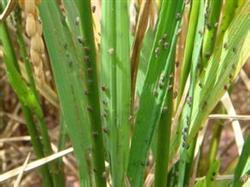
The brown planthopper, also known as the brown rice planthopper, is commonly called ascarid worm, soft-shelled ascarid, yóu worm, and midge. Scientific name Nilaparvata lugens (Stdl), order Homoptera, family Delphacidae. The brown planthopper is one of the major pests of rice in China, causing damage in all major rice-growing regions across the country, north and south, and every year it occurs and causes damage mixed with the white-backed planthopper. The degree of occurrence of the two planthoppers varies by province and region in different years, and the annual area of occurrence and damage is over 200 million mu-times. The brown planthopper has a single feeding habit, damaging only rice and common wild rice.
Damage characteristics: Adults and nymphs gather on the lower part of rice clumps and suck sap; females pierce the leaf sheath and leaf blade with their ovipositor to lay eggs, easily causing the rice plant to lose water or become infected with sheath blight. Excrement often leads to mold growth, affecting rice photosynthesis and respiration, and severely causing the rice plant to wither. Commonly called "mao chuan", "tou ding" or "ta quan". In severe cases, there is no harvest at all.
Morphological characteristics
Adult: There are two types, the macropterous (long-winged) and brachypterous (short-winged) forms. The macropterous form is 4-5 mm long, yellow-brown to dark brown, with an oily luster, and the face has 3 raised longitudinal ridges, with the middle ridge uninterrupted; the female's abdomen is relatively long, ending in a conical shape, while the male's abdomen is shorter and thinner, with the end approximately trumpet-shaped. The brachypterous adult has short wings, and the rest resembles the macropterous form.
Egg: The egg cap is exposed, with 2-3 to 20 eggs per egg mass; within the egg mass, the front ends of the eggs are arranged in a single row, and the rear ends are crowded into a double row. The eggs are slender and slightly curved.
Nymph: There are 5 instars, all resembling the adult in shape. The 1st instar is grayish-white; the 2nd instar is pale yellow-brown, without wing pads, the posterior margin of the metathorax is straight, and there is a pale thick "T"-shaped marking in the center of the dorsal abdomen; the 3rd instar is brown to dark brown, with wing pads appearing, and a pair of triangular markings of white wax powder appears on the back of each of the 3rd segments, resembling 2 white transverse lines. In the 4th-5th instars, the body markings resemble those of the 3rd instar, but the body size increases and the markings become more obvious. The difference from the brachypterous adult is that in the brachypterous form the left and right wings are close together, the wing tips are rounded, the wing spots are obvious, and there are no white transverse stripes on the dorsal abdomen.
Occurrence pattern: In Hainan, there are 12-13 generations per year, with overlapping generations breeding year-round and no overwintering phenomenon. In Guangdong, Guangxi, and southern Fujian, there are 8-9 generations per year, with immigration from March to May; in southern Guizhou, 6-7 generations, with immigration from April to June; in the middle and lower reaches of the Gan River, Guizhou, north-central Fujian, and southern Zhejiang, 5-6 generations, with immigration from May to June; in northern Jiangxi, Hubei, Hunan, Zhejiang, southeastern Sichuan, Jiangsu, and southern Anhui, 4-5 generations, with immigration from early to mid-June to July; in northern Jiangsu, northern Anhui, and southern Shandong, 2-3 generations, with immigration from July to August; in other rice regions further north, 1-2 generations, also immigrating from July to August. In the vast rice-growing regions of China, the main insect source migrates and advances from south to north with the warm, humid air currents each year, with about 5 major migration movements annually, and in autumn it migrates back from north to south. Below 17°C, the egg duration is more than 17 days; at 23-24°C, 9 days; at 27-30°C, 7-8 days. The nymph duration at 24-26°C is 15-16 days. The brachypterous adult is a resident type, while the macropterous form is a migratory type. Shortly after emergence, it has strong flying ability and can migrate with high-altitude horizontal air currents. When migrating north in spring and summer, the flight altitude is 1500-2000 m, and high air humidity favors its migration; the initial flight temperature is about 18.2°C. Adults have an obvious tendency toward tender green rice, and males can mate multiple times. At 24-27°C, mating begins 2-3 days after emergence, with each female laying an average of 200-700 eggs. During the rice growing period, the average lifespan of each generation is 10-18 days, and the field multiplication rate is 10-40 times per generation. Adults and nymphs prefer shady and humid environments and like to inhabit rice plants within 10 cm above the water surface. When the field insect population exceeds 0-4 per clump, uneven distribution occurs, and later the field shows the phenomenon of "ta quan" and death. In the late stage of rice growth, large numbers of macropterous adults are produced and migrate out; the 1st-3rd instars are the key period for wing form differentiation. In recent years, due to changes in farming systems in various rice regions of China, rice varieties have become quite complex, and growth periods overlap, which favors the increase of this pest population and causes severe damage. The suitable temperature for the growth and development of this pest is 20-30°C, with 26°C being optimal. Summers in the Yangtze River Basin are not hot, and relatively high temperatures in late autumn favor its occurrence. When the brown planthopper immigrates, encountering many rainy days and heavy rainfall favors its landing, and it is prone to major outbreaks upon immigration. Shady and humid fields, excessive or over-application of nitrogen fertilizer in production, dense and dark green rice seedlings, and long-term deep water irrigation favor its reproduction, resulting in severe damage. Natural enemies include Anagrus spp. of rice planthopper, Oligosita spp. of brown planthopper, Haplogonatopus spp. of rice planthopper, mermithid nematodes of rice planthopper, Cyrtorhinus lividipennis, and others.
Control methods
(1) Select and promote insect-resistant and high-yielding varieties to prevent the emergence of new biotypes of the brown planthopper. For example, the Chinese hybrid rice Shanyou 6 suffers little damage in areas with brown planthopper biotype I. In addition, insect-resistant varieties such as Xiangzaoxian 1 and 3, Guangyouqing, Qigui Zao 25, Weiyou 35, II You 46, D You 64, Weiyou 64, Nanjing 14, Yangdao 3, Shuiyuan 290, and Xiushui 620 can be selected according to local conditions.
(2) Strengthen field fertilizer and water management. Drain the field appropriately to lower field humidity, avoid excessive application of nitrogen fertilizer, and prevent rice from excessive vegetative growth in the late stage, creating ecological conditions unfavorable for the breeding and reproduction of the brown planthopper.
(3) Protect and utilize natural enemies. There are many species of parasitic and predatory natural enemies of the brown planthopper at various stages. In addition to parasitic wasps, Cyrtorhinus lividipennis, lady beetles, and others, there are also spiders, nematodes, and fungi that have a great inhibitory effect on the occurrence of the brown planthopper. They should be protected and utilized to improve natural control capacity.
(4) Do a good job in forecasting, conduct a good analysis of immigration trends, make unified plans and rational layout during planting, and reduce insect sources.
(5) Chemical control. According to the type of rice variety and the occurrence of planthoppers, adopt the strategy of suppressing the early and controlling the late, or vigorously controlling the main damaging generation. At the peak of nymph hatching to the peak occurrence of 2nd-3rd instar nymphs, promptly spray 2.5% piliya wettable powder or 25% piliuling wettable powder, at 20-30 g per 667 sq m for early rice, early middle rice, and late rice fields, and 50 g for late middle rice fields, or 10% duolaibao suspension concentrate at 50-100 mL, or 10% erbianjing (imidacloprid) wettable powder at 2000 times dilution (10-20 g per 667 sq m mixed with 60 kg water). The control effect is over 90% within 1-30 days, with a residual effect period of 30 days. In addition, using 80% shachongdan powder at 35-40 g gives early control effects superior to those of yechansan, and can also control other pests. It is recommended to apply 20% kangfuduo concentrated soluble concentrate at 6-8 mL per 667 sq m, or 40% miekangling emulsifiable concentrate at 30-40 g, or 10% dagongchen wettable powder at 2 g active ingredient per 667 sq m to control rice planthoppers, and also control leafhoppers and thrips. Alternatively, 75% shimingtè wettable powder (shachongdan + thiazinone) at 650 g/ha can be used to control planthoppers, and also control the striped stem borer, the yellow stem borer, and the rice leaf roller.
Commonly used pesticides: dagongchen, diazinon, piliya, piliuling, duolaibao, imidacloprid, shachongdan, miekangling, shimingtè, thiazinone.