-
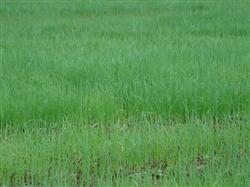
Key Integrated Pest and Disease Control Techniques for Onion Seedlings
I. Selecting Superior Varieties In production, purple-skinned varieties such as Ziyu No. 1, Ziyu No. 2, Zixing, and Shuanghuanhong can be selected. These varieties have the characteristics of strong pungency, high yield, excellent quality, and suitability for export. These varieties generally yield about 5000 kg per mu, and high-yielding plots can reach 7500 kg per mu. II...
-
How to prevent and control watermelon seedling diseases? A detailed guide to integrated control techniques
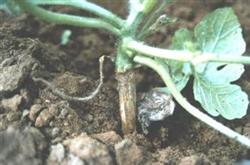
I. Symptoms of the main diseases 1. Damping-off. In the early stage, the root collar of the seedling (the junction of root and stem) develops lesions that look as if scalded by boiling water and become rotten, after which the diseased part turns yellowish-brown, dries out and shrinks; the cotyledons have not yet wilted, but the seedling topples over. Damping-off mostly occurs from the emergence of the cotyledons to the stage when 2 true leaves have flattened out. The disease spreads very quickly; a few days after the appearance of the first diseased plants, seedlings topple over in patches. Under conditions of high temperature and high humidity, the diseased parts of the seedlings and the ground nearby,
-
Detailed Explanation of Key Techniques for Watermelon Vine Pressing and Pruning
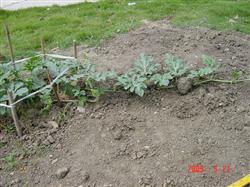
Vine pressing and pruning are major technical steps in watermelon cultivation management. Through vine pressing and pruning, land and light energy can be used effectively, and the growth and distribution of watermelon stems and vines can be regulated and suppressed, thereby improving watermelon quality and yield. 1. Vine pressing Before vine pressing, first lay the seedlings down and mound soil around the root zone. When the seedlings have 5-6 true leaves and are about to begin vining...
-
Key Cultivation and Control Techniques for Major Watermelon Pests and Diseases
Yu Yongjun, a villager from Group 3 of Yuwanggang Village, Qifang Town, Zaoyang City, Hubei Province, once hailed as the "Watermelon King," has through years of practice worked out a good method for making watermelons sweeter, now offered to fellow growers for reference. 1. About 1 week after fruit set, dig a hole 10 cm from the main root, apply 50 g of cake fertilizer per plant, cover with soil and water. This method can make...
-
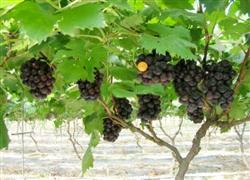
Detailed Explanation of Early-Fruiting Cultivation Techniques for American Black and Red Globe Grapes
I. Orchard Establishment Techniques: 1. Site selection: Grapes are best suited to loose, sandy loam soil rich in organic matter. 2. Trellis selection: To achieve earlier fruiting and increase early-stage yields, a trellis system should be chosen, mainly the single hedge trellis. Row spacing 2-2.5 m, trellis height 2-2.5 m, post spacing 4-5 m, on the posts at 50 cm above ground and then every 40-50 cm upward, stretch one wire each, for a total of 4 wires.
-
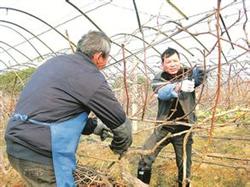
Detailed Explanation of Key Points for Winter Pruning Techniques of Trellis Grapes
Trellis grapes mostly adopt the "dragon bone" pruning method, which can maintain good ventilation and light penetration, strengthen apical dominance, make the tree body robust, and achieve the goal of high quality and stable yield. 1. Retention and pruning of main vines: A single-slope small trellis is more suitable, with the trellis surface inclined toward the south. Munage grapes grow relatively vigorously; according to their characteristics regarding high temperature and sunlight...
-
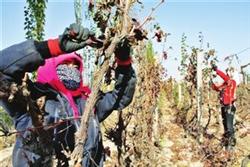
Grape Variety Introduction and Key Points of Pollution-Free Cultivation Techniques
The period for winter pruning of grapes is generally best carried out from early November to mid-February of the following year, that is, from 2 to 3 weeks after leaf fall to 3 to 4 weeks before spring bleeding occurs. Pruning too early will affect the return flow of nutrients, while pruning too late tends to cause bleeding. Bleeding often affects the sprouting of buds and impacts growth and fruiting. Now mainly...
-
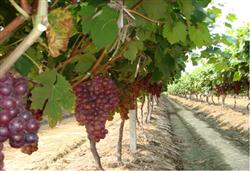
Detailed Explanation of Key Techniques for High-Yield Cultivation of New Grape Varieties
1. Main Characteristics and Traits. First, large clusters and large berries. Takatsuma grape belongs to the large-cluster, large-berry type, with large and compact clusters of conical shape, averaging 600 g per cluster; the berries are large and plump, averaging 17 g per berry, and can reach more than 20 g after flower and fruit thinning, far larger than Red Globe and Black Globe, and comparable to the Ping-Pong grape Fujiminori. Second, good quality...
-
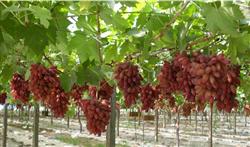
Key Cultivation Techniques for the New Grape Variety Hongru
1. Spacing between plants and rows. In the north, 0.7 x 3 m is commonly used, planting 330 seedlings per mu, or 0.5 x 3 m, planting 440 seedlings per mu. In the south, 0.7 x 3 m is commonly used, planting 330 seedlings per mu, or 0.8 x 3 m, planting 280 seedlings per mu. Given that Hongru has vigorous growth, and to facilitate the production of high-quality fruit, it is recommended to use a trellis-and-canopy training system regardless of whether in the north or the south. ...
-
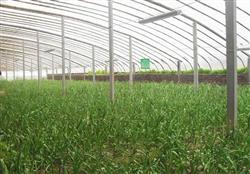
Cultivation Techniques for Intercropping Corn with Cucumber Followed by Garlic
Garlic is an essential seasoning in daily life; it is indispensable for cooking and stir-frying. In recent years, people have discovered many pharmacological effects of garlic, finding that it can prevent and treat a variety of diseases. American scientists have listed garlic as a basic health food. At present, garlic has become a worldwide vegetable, especially in...
条件筛选