How to prevent and control watermelon seedling diseases? A detailed guide to integrated control techniques
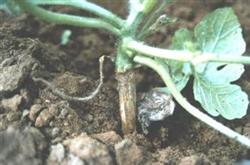
I. Symptoms of the main diseases 1. Damping-off. In the early stage, the root collar of the seedling (the junction of root and stem) develops lesions that look as if scalded by boiling water and become rotten, after which the diseased part turns yellowish-brown, dries out and shrinks; the cotyledons have not yet wilted, but the seedling topples over. Damping-off mostly occurs from the emergence of the cotyledons to the stage when 2 true leaves have flattened out. The disease spreads very quickly; a few days after the appearance of the first diseased plants, seedlings topple over in patches. Under conditions of high temperature and high humidity, the diseased parts of the seedlings and the ground nearby,
I. Symptoms of the main diseases
1. Damping-off. In the early stage, the root collar of the seedling (the junction of root and stem) develops lesions that look as if scalded by boiling water and become rotten, after which the diseased part turns yellowish-brown, dries out and shrinks; the cotyledons have not yet wilted, but the seedling topples over. Damping-off mostly occurs from the emergence of the cotyledons to the stage when 2 true leaves have flattened out. The disease spreads very quickly; a few days after the appearance of the first diseased plants, seedlings topple over in patches. Under conditions of high temperature and high humidity, the diseased parts of the seedlings and the ground nearby,
2. Rhizoctonia rot. Both cotyledon seedlings that have just emerged and larger seedlings can be affected, with larger seedlings having a higher incidence. The stem base of affected seedlings develops oval dark-brown lesions. In the early stage of the disease, diseased seedlings wilt during the day and recover at night. When the lesions extend all the way around the stem, the stem base dries out and constricts, and the plant dies, but the seedling does not topple over. The diseased part often bears a light-brown, spiderweb-like mold, but it is not obvious, and there is no obvious white flocculent material on the diseased part, which distinguishes it from damping-off.
3. Rusty root disease. Rusty root disease is also called "root rot". It is a physiological disease. After the seedlings emerge, new roots are not produced for a long time, the outer skin of the young roots turns rusty brown and gradually rots, causing the aboveground part to wilt; the seedlings are easily pulled up.
II. Conditions for disease occurrence
The damping-off pathogen is strongly saprophytic and can survive in the soil for a long time. The Rhizoctonia rot pathogen generally can survive in the soil for 2-3 years. The damping-off pathogen overwinters in the soil, and the Rhizoctonia rot pathogen overwinters in the soil or in diseased plant residues, directly infecting seedlings in the second year. The pathogens spread through rain, running water, farm tools and contaminated fertilizer. Prolonged rainy weather, poor light inside the seedbed, excessive stuffiness and humidity, and relatively low bed temperature all easily induce damping-off. Rhizoctonia rot occurs more often when the seedbed humidity is relatively high, the temperature is relatively high, and the seedlings grow leggy. Rusty root disease is mainly caused by low seedbed temperature; if the seedbed temperature remains below the critical temperature for seedling growth (10°C) for a long time, rusty root disease is very likely to occur.
III. Control methods
For the control of watermelon seedling diseases, integrated control measures should be adopted, mainly strengthening cultivation management during the seedling stage, with chemical control as a supplement.
1. Selection of seedbed site. The seedbed should be built in a place with high, dry terrain, sheltered from the wind and facing the sun, with good drainage and fertile, loose soil. New soil should be used for the bed soil, and the fertilizer used to prepare the nutrient soil must be fully fermented and decomposed.
2. Bed soil treatment. 50% carbendazim can be used at 8-10 grams per square meter. First mix the chemical thoroughly with an appropriate amount of fine soil. Take 1/3 of the medicated soil and spread it on the bed surface as a base layer. After sowing, use the remaining 2/3 of the medicated soil as cover soil. Alternatively, the medicated soil can be evenly applied into the plow layer while preparing the land, leaving part of the medicated soil to cover the seeds. When treating bed soil with medicated soil, sufficient soil moisture should be maintained to prevent pest damage.
3. Strengthen seedbed management. Keep the seedbed warm at night to prevent cold wind and low temperatures from attacking it, and avoid freezing injury to the seedlings. During the day, ventilation should be strengthened to reduce the temperature and humidity of the seedbed, so that the seedlings grow vigorously and their disease resistance is improved. Water management during the seedling stage should be determined according to seedbed moisture and weather; each watering should not be too heavy, to prevent excessive humidity in the bed. After each watering, it is best to scatter a layer of dry fine soil or dry plant ash to reduce seedbed humidity and preserve soil moisture.
4. Chemical control. Once diseased seedlings are found in the seedbed, remove them promptly and immediately spray chemicals to prevent spread. The chemicals that can be used are: ① 400-fold copper-ammonium mixture (made with 2 parts copper sulfate and 11 parts ammonium bicarbonate, thoroughly mixed and sealed for 24 hours; when using, dissolve 1 part of the chemical in 400 parts water) for foliar spraying, once every 7-8 days, for 2-3 consecutive sprays, with good results. ② 75% chlorothalonil wettable powder at 1000-fold solution, or 70% dexon at 500-fold solution, or 20% Shibaoling suspension at 3000-fold solution, sprayed on the foliage or applied to the roots, also has good control effects.