Detailed Explanation of Key Techniques for Watermelon Vine Pressing and Pruning
Vine pressing and pruning are major technical steps in watermelon cultivation management. Through vine pressing and pruning, land and light energy can be used effectively, and the growth and distribution of watermelon stems and vines can be regulated and suppressed, thereby improving watermelon quality and yield. 1. Vine pressing Before vine pressing, first lay the seedlings down and mound soil around the root zone. When the seedlings have 5-6 true leaves and are about to begin vining...
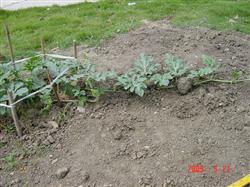
Vine pressing and pruning are major technical steps in watermelon cultivation management. Through vine pressing and pruning, land and light energy can be used effectively, and the growth and distribution of watermelon stems and vines can be regulated and suppressed, thereby improving watermelon quality and yield.
1. Vine pressing Before vine pressing, first lay the seedlings down and mound soil around the root zone. When the seedlings have 5-6 true leaves and before they begin to vine, dig a small pit 12 cm deep at the root zone on one side in the direction the vines are to run, so that the vines fall in that direction. When the vines have grown to about 30 cm, build a large bowl-shaped mound of soil at the root zone and pat it gently firm, forcing the vines to creep forward. The direction is easiest for the vines to follow when they run with the wind. Vine pressing should begin when the vines are 30 cm long, and thereafter be done once every 30-40 cm of growth, until after the fruit has expanded, the vines and leaves have covered the ground, and there is no longer any threat of wind damage, at which point vine pressing is stopped. However, new shoots that climb over the stems and vines of other plants should be pressed down in a timely manner beneath the leaves of nearby other plants. Generally, vine pressing needs to be done 5-6 times during the growing period.
2. Pruning For small-seeded mid-season and early-maturing varieties, two-vine pruning is suitable. In addition to keeping the main vine, select and keep one strong secondary vine at the 5th-7th node of the main vine. The two vines should run in the same direction and be arranged evenly. While pruning, all tendril vines on the main vine and secondary vines should be removed early. Each time vine pressing is done, all small branch vines at every leaf axil on the section of stem and vine from the pressed point to the root must be removed down to the base. If the branch vines are not thoroughly removed section by section, before long branch vines will inevitably sprout again, overpower the main vine, make it hard to distinguish main from secondary, and weave together into a dense canopy, affecting fruit set. Only when, in the late fruit-setting stage, nutrition is mostly concentrated on fruit growth and stem and vine growth has become noticeably weaker, may branch removal be stopped. A total of 5-6 rounds of branch removal are done over the whole growing period. If single-vine pruning is used, the plant spacing can be reduced to 45 cm. Single-vine pruning has no reserve vine and no reserve fruit, leaving no room for adjustment, and is not as good as two-vine pruning. While vine pressing, weed control and pest killing should also be combined. After the fruit has fully expanded, if the vines are still growing too vigorously, pinching the growing tips can be done. Otherwise, pinching is not necessary. Under normal conditions, after the fruit expansion stage, stem and vine growth slows and weakens noticeably, and new shoots no longer continue to grow.
Because watermelon stems and vines are relatively fragile in growth, when pressing vines and pruning in the melon field, great care should be taken, moving lightly, not damaging stems and leaves, and not stepping on the soil surface where roots are concentrated.