Detailed Explanation of Key Techniques for High-Yield Cultivation of New Grape Varieties
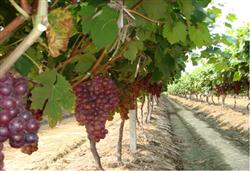
1. Main Characteristics and Traits. First, large clusters and large berries. Takatsuma grape belongs to the large-cluster, large-berry type, with large and compact clusters of conical shape, averaging 600 g per cluster; the berries are large and plump, averaging 17 g per berry, and can reach more than 20 g after flower and fruit thinning, far larger than Red Globe and Black Globe, and comparable to the Ping-Pong grape Fujiminori. Second, good quality...
1. Main Characteristics and Traits
First, large clusters and large berries. Takatsuma grape belongs to the large-cluster, large-berry type, with large and compact clusters of conical shape, averaging 600 g per cluster; the berries are large and plump, averaging 17 g per berry, and can reach more than 20 g after flower and fruit thinning, far larger than Red Globe and Black Globe, and comparable to the Ping-Pong grape Fujiminori. Second, good quality. When fully ripe, the fruit is black, with high sweetness and a soluble solids content of 19%-21%, possessing a rich strawberry flavor and a faint rose aroma; its flavor and storage and transport tolerance both surpass those of Fujiminori. Third, good yield potential. It bears fruit early, has strong fertility, and a high fruit-setting rate, with yield reaching 2000 kg per mu in the second year (1 mu = 667 sq m, the same below). Fourth, strong disease resistance. The number of pesticide sprays can be reduced by half compared with Red Globe and Black Globe; if managed and controlled in the same way as Kyoho, Fujiminori, and Red Fuji, no diseases or insect pests will occur. In addition, Takatsuma's new shoots are thick and upright while its secondary shoots are weak, making summer management simple and labor-saving; both medium and short cane pruning can achieve high yields, making it an ideal replacement variety for the hot, rainy regions of the south.
2. High-Quality, High-Yield Cultivation Techniques
(1) Seedling planting. In hot, rainy regions, arid mountainous areas with little rain, as well as waterlogged, saline-alkali, and continuous-grape-cropping plots, grafted seedlings using special rootstocks such as s04 and Huajia No. 8 should be selected for orchard establishment, to enhance stress resistance and achieve the goals of high and stable yield, high quality and efficiency, and long-lasting vigor. Experiments show that Huajia No. 8 grafted with Takatsuma exhibits vigorous growth and a large amount of secondary shoot growth; the tree framework can be formed in one year, with per-plant yield reaching 7.5 kg in the second year and a maximum per-plant yield of 15 kg, an increase of 1.5 kg over the Kyoho average of 6 kg per plant. The row spacing is 2.5 m x 1-1.3 m, with 200-260 plants per mu, planted in a north-south direction using a double-cross "v" trellis. Spring planting is preferable, and planting can be done from February when temperatures rise until half a month before bud break of locally fruiting grapes. When planting, dig shallow holes and plant shallowly, spreading the root system in all directions, so that the root crown of cutting seedlings is exposed above the bed surface and that of grafted seedlings is exposed 5-10 cm; after gently firming the soil, water with dilute manure water.
(2) Fertilizer and water management. This variety has strong fertilizer tolerance and requires heavy fertilizer and water; especially after entering the high-yield period, heavy fertilizer and water are the most fundamental conditions for high yield and quality. Generally, base fertilizer per mu should be no less than 3000 kg of farmyard manure, 300 kg of cake fertilizer or 1000 kg of dried chicken manure, and 50 kg of high-efficiency potassium sulfate compound fertilizer; for topdressing, apply 30 kg of urea per mu after fruit set, and apply 50 kg of potassium sulfate compound fertilizer and 15 kg of potassium sulfate fertilizer in the late fruit enlargement stage; spray Lufenwei No. 3 or No. 4 once each on the leaves before and after flowering, and spray monopotassium phosphate twice from the fruit enlargement stage to the coloring stage, which can effectively enhance fruit sweetness. In normal years, one thorough watering is needed before bud break to promote fast and uniform sprouting. If 1-1.5 kg of Huifengman liquid fertilizer per mu is applied with water, it has a noticeable effect on loosening the soil and strengthening the tree and improving fruit quality. Before flowering, water lightly once to promote flowering and pollination and reduce seedless fruit. During the flowering period, heavy irrigation is strictly prohibited; after fruit set, water moderately once every 7-10 days to keep the soil moist and promote rapid fruit enlargement. Avoid watering during the coloring and ripening stage; in case of heavy rain, drain accumulated water promptly to speed up coloring and increase sugar content.
(3) Yield control. This variety has many double inflorescences, large inflorescences, and a high fruit-setting rate, and is very prone to delayed ripening and reduced quality due to heavy load. Therefore, when cultivated with own-rooted seedlings and Kyoho rootstock grafted seedlings, the yield per mu must be controlled at about 1500 kg; when cultivated with special rootstock grafted seedlings such as s04 and Huajia No. 8, it can be controlled within 2000 kg per mu. The spacing of fruiting new shoots on the trellis surface should be about 20 cm. If Sichuan Lanyue brand swelling agent is used to treat the clusters, in order to prevent the berries from becoming too solid and crowded later, cluster control, yield control, and fruit thinning techniques must be adopted, achieving one cluster per cane and 3000-3500 clusters per mu, keeping cluster weight at 500-700 g. After fruit set, thin the fruit carefully, removing small berries, seedless berries, malformed berries, and overly dense berries. Lower new shoots and thin, weak new shoots must absolutely not be allowed to bear fruit; they should be cultivated as vegetative canes and renewal canes, and overly dense branches should be removed. From 3-5 days before flowering, pinch the tips above the inflorescence after leaving 5 leaves, and at the same time remove the secondary cluster and 2-3 branches from overly large inflorescences, and pinch off about 1/5 of the cluster tip. Except for the terminal secondary shoot, all other secondary shoots should be removed. Strictly control secondary shoot growth so that the cluster-to-leaf ratio reaches about 1:15, which helps concentrate nutrients for fruit supply. After fruit harvest, allow the upper secondary shoots to extend appropriately to strengthen the tree vigor and lay a foundation for high yield the following year.
(4) Protected cultivation. Because spring in the south has abundant rain and high humidity, making diseases and insect pests difficult to control, rain-shelter cultivation or greenhouse forcing cultivation should be advocated for growing Takatsuma in the south. Experiments show that forcing cultivation can bring Takatsuma fresh fruit to market 15-18 days earlier, raise the selling price by 1-2 yuan per kg, and increase output value by 1500-2000 yuan per mu. The key technical points of rain-shelter and forcing cultivation are: 1) Cover and remove film at the appropriate time. For rain-shelter cultivation, if black pox disease can be reliably controlled in the early stage, the appropriate time to cover film is before flowering; if not, film should be covered earlier at bud break. For forcing cultivation, film can be covered in early February, the surrounding film removed in May, the top film slightly opened for connected greenhouses, and the top film removed after the grapes mature and are picked. 2) Regulate temperature and humidity. From after film covering to early March is the bud break stage, mainly focusing on increasing temperature and preserving moisture; on clear, hot days at noon when the temperature inside the greenhouse reaches above 30°C, open the greenhouse appropriately for ventilation and cooling; when applying bud-promoting fertilizer, combine it with furrow irrigation or sprinkling the bed surface to keep the bed soil moist and maintain high humidity in the greenhouse; from after bud break to flowering and fruit set, regulate according to the principle that the maximum temperature in the greenhouse does not exceed 30°C, lay black and silver-gray dual-color reflective film on the bed surface, and mainly keep the bed soil moist. 3) Promote early bud sprouting. From 20-30 days before bud break, apply 15% concentration calcium cyanamide (i.e. diluted 5-7 times with water) or 1%-2% concentration cyanamide solution (i.e. diluted 30 times with water) to the winter buds, which can increase the bud break rate and promote uniform sprouting. However, do not apply to the top 1-2 winter buds of the fruiting mother cane, and do not apply to the winter buds of old canes or newly planted grape seedlings. To apply to winter buds, use a small brush or writing brush, stirring the liquid while applying, and apply the black sediment together onto the winter buds of fruiting canes; prepare the solution and apply it on the same day.
(5) Fruit bagging. This variety has the outstanding advantage of coloring easily even under insufficient light, so it is especially suitable for bagged cultivation. Bagging not only improves the appearance quality of the clusters but also increases berry weight. After ripening, there is no need to remove the bags, which can avoid damage from birds, bees, rodents, and other pests, and selling the pollution-free fruit in bags will be more attractive. For paper bag selection, grape-specific colored wax paper bags produced by research institutions and regular manufacturers are preferable, as they do not tear under wind and rain, but larger sizes should be chosen to prevent the clusters from later expanding and bursting the bags. The bagging time is when the berries are the size of small peanut kernels, immediately after spraying or dipping with Dacheng or thiophanate-methyl pesticide once. When the fruit begins to color, remove old leaves around the clusters that have lost their function, allowing sunlight to shine directly on the fruit bags and speed up coloring.
(6) Disease and pest control. The main diseases include black pox, gray mold, white rot, anthracnose, and downy mildew; insect pests include clearwing moths, longhorn beetles, scarab beetles, and aphids. Disease and pest control adopts the policy of "prevention first, integrated control," based on agricultural control, with killing pathogens as the key point, and adopts integrated control measures combining careful winter orchard cleaning, eradication of pathogens at the bud swell stage, timely bagging after fruit set, and targeted spraying during the growing period. Pesticides such as Dacheng, Kebo, DuPont Fuxing, Sumilex, metalaxyl, Shibaike, thiophanate, fipronil, fenvalerate, and pirimicarb are selected as pollution-free pesticides, and they should be used alternately and mixed reasonably.