Detailed Explanation of Key Points for Winter Pruning Techniques of Trellis Grapes
Trellis grapes mostly adopt the "dragon bone" pruning method, which can maintain good ventilation and light penetration, strengthen apical dominance, make the tree body robust, and achieve the goal of high quality and stable yield. 1. Retention and pruning of main vines: A single-slope small trellis is more suitable, with the trellis surface inclined toward the south. Munage grapes grow relatively vigorously; according to their characteristics regarding high temperature and sunlight...
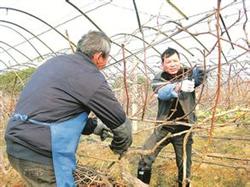
Trellis grapes mostly adopt the "dragon bone" pruning method, which can maintain good ventilation and light penetration, strengthen apical dominance, make the tree body robust, and achieve the goal of high quality and stable yield.
1. Retention and pruning of main vines
A single-slope small trellis is more suitable, with the trellis surface inclined toward the south. Munage grapes grow relatively vigorously; according to their characteristics regarding high temperature and sunlight, the inclination angle is 25-40 degrees, the front trellis height is about 1.2 m, the rear trellis height is about 2 m, the row spacing is about 6 m, the plant spacing is 1.5-2 m, and the trellis width is 4-5 m. Each plant retains 3-4 main vines, and 50-70 plants are used per 667 sq m. The grapes receive sunlight at a good angle and have a relatively large area, which is conducive to photosynthesis and ventilation, and also facilitates mechanized operations such as weeding, fertilizing, and loosening soil within the trellis, so that the main vines are evenly distributed on the trellis surface.
2. Pruning and retention of fruiting mother branches
The pruning and retention of fruiting mother branches directly affects the quality and yield of grapes. If too many are retained, the plant load is heavy, branches and leaves are densely crowded, light and ventilation are poor, berries are small, and quality is poor; if too few are retained, yield is affected. The number of retained plants is determined according to the variety's characteristics and growth vigor. Generally, on the first wire of the main vine, a fruiting branch group is retained about every 25 cm, and 1-2 fruiting mother branches are retained in each group. During winter pruning, the height of the main vine is strictly controlled below the first wire, and thin, weak, and diseased branches, including crossing branches, are cut off, while the front and rear of the main vine should be kept balanced so as to form the largest fruiting area.
3. Pruning and retention length of fruiting mother branches
The pruning of fruiting mother branches is divided into long and short canes. Short-cane pruning retains 2-4 nodes, medium-cane pruning retains about 6 nodes, and long-cane pruning retains about 10 nodes. The retained length is determined according to variety characteristics, branch thickness and maturity, training form, fertilizer and water conditions, and management level. Generally, nodes 4-7 have a relatively high fruiting rate, while later nodes have a poorer fruiting rate, so a pruning method mainly using medium and long canes can be adopted.
All branches sprouting on the main vine below the grape trellis are cut off completely to facilitate ventilation within the trellis. Grapes set on the main vine below the trellis surface, due to direct sunlight exposure, have dark and dull berry color, appear rusty, have thick and unattractive skins, high tannin content, and an astringent taste, affecting the overall quality of the grapes.
4. Outward movement of fruiting positions
Reserve branches and fruiting mother branches form fixed branch groups. For the phenomenon of bare main vines, a robust shoot can be selected in advance from root sprouts as a reserve vine for heading back, and according to the thickness of the branch, 4-8 nodes can be retained for heading back.
In the following year, after the long fruiting mother branch completes its fruiting task, it can be thinned out, while 2-3 new shoots issued from the reserve branch, with the lower-position new shoots still pruned as medium and long canes, are retained as fruiting mother branches. The lower-position new shoots are still retained as 2-3 reserve branches and pruned for retention. In the 3rd year, pruning is carried out in this way, thereby fixing the branch grade and moving the fruiting position outward.