-
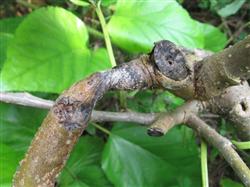
How to prevent and control mulberry shoot-blight disease? Simply remove the mulberry flowers and fruits
Mulberry shoot-blight disease, also known as branch-blight disease or white mulberry fruit disease. Shoot-blight is a mulberry disease that has become widespread in recent years. It is caused by the pathogen Sclerotinia minor, which infects new shoots through the fruit stalk, causing the base of the new shoot to rot and break off. Its characteristic is that mulberry trees bearing female flowers, or both male and female flowers on the same tree, are prone to this disease, with a shoot-blight rate of...
-
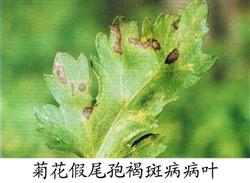
How to control Cercospora leaf spot on chrysanthemums
1. Disease symptoms The spots occur on both sides of the leaves, are nearly circular, with indistinct edges at first, later sometimes forming a thin dark brown ring, and often develop along the leaf margins. On the upper leaf surface the spots are light yellow at first, later brown to dark brown; on the underside they are grayish brown. 2. Disease characteristics The disease is caused by a fungus, the pathogen...
-
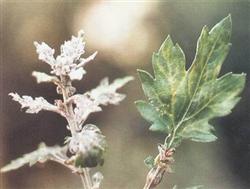
Detailed Explanation of the Occurrence Patterns and Control Methods of Chrysanthemum Powdery Mildew
Chrysanthemum powdery mildew is one of the common diseases in flowers, and it is distributed in both southern and northern China. Chrysanthemum powdery mildew causes poor plant growth, leaf death, and even failure to bloom, seriously affecting greening and beautification results and flower production; it also harms cineraria, pot marigold, coneflower, African daisy, cosmos, aster, dahlia...
-
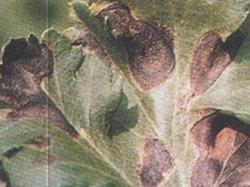
What pesticides are commonly used for controlling pests and diseases in chrysanthemums?
I. Main symptoms: They occur on the leaves, mostly on the lower leaves. The lesions begin as chlorotic yellow spots; after expanding, the lesions become round to irregular in shape, with dark brown edges and grayish-brown centers; in the later stage the lesions dry up and black granular bodies appear. II. Cause of the disease: It is a fungal disease. The pathogen survives in the soil...
-
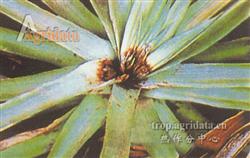
What are the control methods for pineapple seedling heart rot?
How do you control pineapple seedling heart rot? Please give guidance. Pineapple seedling heart rot causes the heart of the seedling to rot and the plant to die. It is mainly caused by heat build-up from piling or by waterlogging. Control methods: avoid piling seedlings for too long, especially during long-distance transport, where piling should be minimized as much as possible to prevent heat, high humidity and poor ventilation from causing heat damage to the seedlings....
-
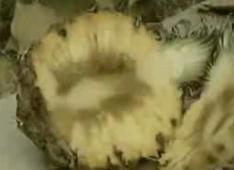
Symptoms and Control Methods of Pineapple Black Heart Disease
What is pineapple black heart disease? How to control it? Please advise. Pineapple black heart disease is one of the major diseases of pineapple, mainly affecting the fruit. In mild cases it affects fruit quality; in severe cases it causes the fruit to lose its commercial value. Symptoms: This disease mainly affects ripe fruit. There are two types of symptoms: one is that the fruitlets are affected and turn brown or form...
-
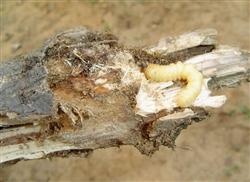
How to control longhorn beetle pests on honey pomelo trees?
What should be done when honey pomelo trees are attacked by longhorn beetles? Please explain the methods. To control longhorn beetles on honey pomelo trees, you can refer to the following methods: 1. Raise chickens in the honey pomelo orchard: this not only helps control longhorn beetle damage, but also preys on other pests, increases income, raises soil organic matter content, promotes fruit growth, and improves fruit quality. 2. Fuse...
-
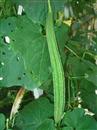
Common pests and diseases in loofah cultivation and their control methods
What pests and diseases need to be controlled when growing loofah? Please provide guidance. When growing loofah, the following pests and diseases need to be controlled: The main insect pest of loofah is: the yellow squash beetle. When insects that look like fireflies appear in a loofah field, these are symptoms of damage by the yellow squash beetle. Adult yellow squash beetles bite and feed on plant leaves, stems, flowers and fruits, breaking off the tender stems of seedlings, with leaf damage being the main type; in severe cases they can cause the death of the entire plant. The larvae cause damage to the roots in the soil; after the 3rd instar they bore and feed between the phloem and xylem, causing the aboveground parts to wilt and die. The yellow squash beetle likes warmth and moisture, is most active at noon, and the adults have a wide feeding range, damaging loofah, bottle gourd, winter melon, zucchini and other gourd vegetables.
-
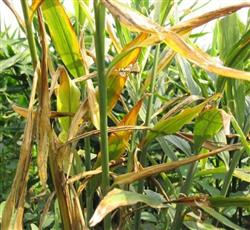
What pests and diseases should ginger be protected from? Detailed explanation of control key points
What pests and diseases should ginger be protected from? Please help introduce the following pests and diseases that need to be controlled during ginger cultivation: stem diseases (ginger blast, ginger rot, etc.); when diseased plants are found in the field, promptly dig out the diseased plants and the soil around them, carry them out of the field for deep burial, apply 125 grams of bleaching powder in the hole or pour 1% bleaching powder solution, then use...
-
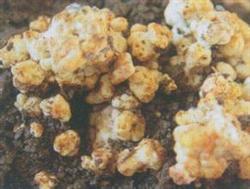
What to Do When Oyster Mushrooms Get Walnut Meat Fungus Disease? Occurrence Patterns and Integrated Control
Recently, many readers have reported that the oyster mushrooms they cultivate have been affected by walnut meat fungus (Diehliomyces microsporus). We are therefore reposting an article titled "Occurrence Patterns and Control Techniques of Walnut Meat Fungus in Oyster Mushrooms" published by Yang Yongheng, An Xiurong and others of the Tai'an City Institute of Agricultural Sciences, Shandong, for growers' reference: In recent years, Tai'an City and its surrounding...
条件筛选