What to Do When Oyster Mushrooms Get Walnut Meat Fungus Disease? Occurrence Patterns and Integrated Control
Recently, many readers have reported that the oyster mushrooms they cultivate have been affected by walnut meat fungus (Diehliomyces microsporus). We are therefore reposting an article titled "Occurrence Patterns and Control Techniques of Walnut Meat Fungus in Oyster Mushrooms" published by Yang Yongheng, An Xiurong and others of the Tai'an City Institute of Agricultural Sciences, Shandong, for growers' reference: In recent years, Tai'an City and its surrounding...
Recently, many readers have reported that the oyster mushrooms they cultivate have been affected by walnut meat fungus (Diehliomyces microsporus). We are therefore reposting an article titled "Occurrence Patterns and Control Techniques of Walnut Meat Fungus in Oyster Mushrooms" published by Yang Yongheng, An Xiurong and others of the Tai'an City Institute of Agricultural Sciences, Shandong, for growers' reference:
In recent years, in some oyster mushroom growing sheds in Tai'an City and surrounding areas, walnut meat fungus infestation has occurred to varying degrees, causing reduced yields and, in severe cases, total crop loss. After several years of investigation and control trials, its occurrence patterns and control techniques are described below.
1 Pathogen
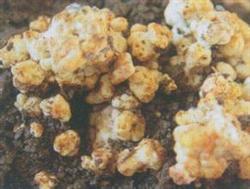
Walnut meat fungus, also known as Diehliomyces microsporus, belongs to the subdivision Ascomycotina, family Gymnoascaceae. The hyphae are white, thick and sturdy, septate, and branched. Conidia are formed in chains or singly. The ascocarp is composed of a loose, interwoven mass of hyphae, initially cream-colored and becoming reddish-brown when mature; it is irregular in shape, with a reticulated wrinkled surface resembling a walnut kernel, and its diameter can reach 1-3 cm, growing in clusters. The asci are irregularly arranged, short and broad, each containing 8 ascospores. The ascospores are colorless and nearly spherical.
2 Infection Symptoms
Because the hyphae of walnut meat fungus are white, thick and sturdy, they cannot be distinguished from oyster mushroom hyphae in the early stage of infection. If walnut meat fungus is already present in the substrate when the oyster mushroom is spawning or during the spawn-running period, although the bag has been fully covered with white hyphae, fruiting is very difficult; when the bag is broken open, a pungent bleaching powder smell can be detected, and at suitable temperatures, ascocarps of the walnut meat fungus pathogen appear at both ends of the bag. If walnut meat fungus infects after the bags are removed and cased with soil, the diseased area produces few and small mushrooms, and in severe cases mushroom-free zones appear, with cauliflower-shaped ascocarps of the pathogen forming in the soil layer.
3 Transmission Routes
Walnut meat fungus is a common soil-borne mold. Mushroom farm operations, moving soil, contaminated spawn, contaminated substrate, sewage, and hyphal fragments in the air can all spread this disease.
4 Conditions for Occurrence
The optimum temperature for ascospore germination is 30°C. Maintaining the substrate temperature at around 28°C for a relatively short period, then letting it fall back to a lower temperature, can stimulate the development of this pathogen. Ascospores can be killed by treatment at 60°C for 30 min (minutes), but dry ascospores cannot be eliminated even by treatment at 80°C for 2 h. Under acidic conditions, the substrate and casing soil favor the germination of the pathogen's spores and hyphal growth; high temperature and high humidity in the mushroom house and poor ventilation favor the occurrence of the disease.
5 Control Measures
①. Carry out strict disinfection of the mushroom shed before use. Use 5 g of potassium permanganate and 10 ml of formalin per [unit] for sealed fumigation. After 2 days, open for ventilation and it is ready for use. For old mushroom houses, shovel away the top 3-4 cm of surface soil from the floor, and dig up subsoil from a vegetable plot for backfilling.
②. When preparing the substrate, make the pH value alkaline.
③. Select high-quality spawn, and discard spawn that has hard lumps or a bleaching powder smell.
④. Keep the spawn-running temperature controlled at 10-16°C as much as possible, and keep the temperature inside the substrate below 25°C.
⑤. Use bag cultivation and wall-type fruiting as much as possible, rather than soil-casing fruiting. If soil-casing fruiting is used, mix 10% lime powder into the casing soil; do not water on the day after removing the bags and casing with soil, and after 2-3 days, once the surface hyphae have recovered, water thoroughly once.
⑥. Keep the air in the mushroom shed flowing freely, and avoid high temperature and high humidity, or a short period of high temperature followed by a temperature drop, to inhibit the occurrence of the disease.
⑦. Once cultivation bags are found to be affected, carefully dig out the casing soil and cultivation bags completely, and spray the surrounding area with 50% carbendazim or lime water. The removed pathogen fruiting bodies should be buried far away from the mushroom shed to prevent the spread of pathogen spores.
⑧. Promptly remove waste substrate and leftover mushrooms to keep the mushroom house clean and sanitary.
⑨. Spraying the diseased area with 3,000-5,000 times diluted benomyl solution has a certain control effect.
In addition, here is another article titled "Integrated Control Techniques for Walnut Meat Fungus in Oyster Mushrooms" published by Miao Lijun of the WuJi County Agriculture Bureau, Hebei Province.
In the past two years, a devastating disease has occurred in oyster mushroom production - walnut meat fungus. This disease mostly occurs during the vegetative growth stage of oyster mushrooms. In the early stage of the disease, the hyphae are white and very difficult to distinguish from normal hyphae; in the later stage, the ascocarps are walnut-shaped and distributed on the surface of the substrate. When a spawn bag is infected, a pungent bleaching powder smell is released when it is broken open; once a spawn bag is infected, it is very difficult for it to fruit again, often causing large-scale total crop loss.
The spread of walnut meat fungus is mainly through three routes: contaminated spawn, spore transmission, and soil transmission. Control methods:
1 Select Excellent Spawn
Excellent spawn is the foundation for high and stable yields of oyster mushrooms. In production, one must select high-quality spawn produced by legitimate research institutions and large spawn factories, to avoid contamination caused by contaminated spawn.
2 Strict Disinfection of the Mushroom Shed
After winter production, during the high-temperature period from June to July in summer, the shed can be sealed at high temperature for physical disinfection; continuous sealing for 5-7 d can achieve a very good disinfection effect. For chemical disinfection, sulfur at 12-15 g/sq m can be used for fumigation, or lime water with a pH value of 12-14 can be used for surface disinfection of walls, shed frames, bed surfaces, and plastic film.
3 Use Fermented Substrate Cultivation
First, mix all the required ingredients evenly, adjust the water content appropriately, and adjust the pH value to 12-14. The fermentation pile should be 1.2-1.5 m wide, naturally piled and extended lengthwise. In the middle of the pile, use wooden sticks 4-6 cm in diameter to make 2-4 rows of ventilation holes at intervals of 30-40 cm, and the holes should be driven down to the bottom. After piling the material, the material temperature begins to rise; when the temperature at the center of the pile rises above 60°C, start timing, and after maintaining it for 24 h, begin the first turning of the pile. When turning, swap the inside and outside, and thoroughly break up and loosen the material. Rebuild the pile, and when the temperature at the center of the pile rises above 60°C again and is maintained for 24 h, fermentation is complete. Readjust the water content to 60%-65% and the pH value to 7.5-8.0, and it is ready for bagging.
4 Disinfection of Casing Soil
For casing soil cultivation, the casing soil must be thoroughly disinfected. The casing soil required for oyster mushroom cultivation should be deep sandy loam selected from plots far away from the mushroom shed. Add 1% quicklime powder, spray in 10%-15% formalin solution while stirring, 100 kg of soil requires 1-1.5 kg of the liquid; cover with film and seal for 24 h, and after removing the excess formaldehyde gas, it is ready for use.
If walnut meat fungus is found during the cultivation process, first take the contaminated cultivation bags out of the mushroom shed and bury them deeply or burn them, and the handling must be thorough. Second, thoroughly spray the other spawn bags, the mushroom shed, and the ground once with lime water with a pH value of 12-14. Reduce unnecessary movement of operators and non-production personnel, and control the further spread of the pathogen. If conditions permit, it is best to use a completely isolated method for further treatment.