Detailed Explanation of the Occurrence Patterns and Control Methods of Chrysanthemum Powdery Mildew
Chrysanthemum powdery mildew is one of the common diseases in flowers, and it is distributed in both southern and northern China. Chrysanthemum powdery mildew causes poor plant growth, leaf death, and even failure to bloom, seriously affecting greening and beautification results and flower production; it also harms cineraria, pot marigold, coneflower, African daisy, cosmos, aster, dahlia...
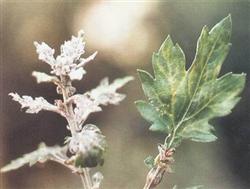
Chrysanthemum powdery mildew is one of the common diseases in flowers, and it is distributed in both southern and northern China. Chrysanthemum powdery mildew causes poor plant growth, leaf death, and even failure to bloom, seriously affecting greening and beautification results and flower production; it also harms cineraria, pot marigold, coneflower, African daisy, cosmos, aster, dahlia, zinnia, rose, Chinese rose, garden balsam, verbena, okra, poinsettia, hollyhock, phlox, begonia, wisteria, and others.
Damage Symptoms In the early stage of infection with chrysanthemum powdery mildew, yellow translucent small white powdery spots appear on the leaves, mostly on the upper surface, mainly damaging the leaves, while petioles and young stems and leaves are more susceptible to infection. When temperature and humidity are suitable, the lesions can rapidly expand and connect into large areas of white powdery patches, or gray powdery mildew layers. In severe cases, the affected leaves fade green and turn yellow; leaves and tender shoots curl, become deformed, age prematurely, and wither; stems bend, new shoots stop growing, flowers are few and small, plants become stunted and sterile or fail to bloom, and death may even occur.
Pathogen and Occurrence Patterns The pathogen causing powdery mildew belongs to the powdery mildew fungi, specifically Oidium chrysanthemi, with the sexual stage being Erysiphe cichoracearum. In southern China under open-field cultivation and in northern China inside greenhouses, it can occur year-round. The pathogen overwinters in diseased plant residues or in the soil. In the following spring, when temperature and humidity are suitable, the ascocarps split open and release ascospores, which spread and disperse via airflow and wind-driven rain, and can cause multiple infections. The disease can occur from May to November, with frequent occurrence from August to October, and infection and disease development are most likely at 20-25 °C. It is most likely to occur under high humidity, weak light, poor ventilation, and a day-night temperature difference above 10 °C. The disease is severe from September to October, mainly due to repeated infections under humid conditions with frequent autumn rain, dew, and fog. It is induced again when air humidity is high, ventilation is poor, and light is insufficient. When watering is excessive, plants are too dense, or drought stress occurs, and cultivation management is poor, causing weak plant growth, the occurrence becomes even more severe.
Control Methods
1. Garden sanitation: In cultivation, pay attention to pruning overly dense and withered yellow plant leaves, pull out diseased plants, sweep up diseased fallen leaves, and burn or deeply bury them in a centralized manner, which can greatly reduce the sources of pathogen transmission.
2. Strengthen production management: Do not plant too densely, control soil moisture, and increase ventilation and light penetration. Avoid excessive application of nitrogen fertilizer; instead, increase phosphorus and potassium fertilizer to enhance the disease resistance of plant leaves. When watering, be careful to keep the leaves dry to prevent water droplets from splashing and spreading the disease during watering, or from high temperature and humidity allowing invasion of the host and causing secondary infection and disease development.
3. Chemical control: For sterilization of potting soil or seedbeds and soil with chemicals, a mixture of 50% thiophanate-methyl and 50% thiram (1:1) at 600-700 times dilution can be sprayed on potting soil or seedbeds and soil to achieve a sterilizing effect. In the early stage of disease, spray 100 times dilution of agricultural antibiotic 120 or antibacterial B0-10 emulsion, or 50% kasugamycin-copper wettable powder or 75% tridemorph emulsion at 1000 times dilution, once every 10 days, for 3 consecutive sprays to control the occurrence and spread of the disease. In particular, using 25% propiconazole emulsifiable concentrate 20 mL added to 100 kg of water for spraying, once every 10-15 days, for 2-3 consecutive sprays, gives relatively good control results. In addition, during the disease period, 70% thiophanate-methyl wettable powder 32-48 g, or 50% thiophanate-methyl wettable powder 45-67.5 g, can be added to 70 kg of water, stirred evenly, and sprayed, once every 7-10 days, for 2-3 consecutive sprays; alternatively, 15% triadimefon emulsion at 1500 times dilution, or 70% thiophanate-methyl wettable powder at 800-1000 times dilution, 50% sulfur-multi suspension at 300 times dilution, or 20% triadimefon emulsifiable concentrate at 2000 times dilution, or 75% chlorothalonil wettable powder at 600 times dilution, or 50% tebuconazole at 1000 times dilution, sprayed once every 7-10 days, for 3-4 consecutive sprays, can achieve good control results.