-
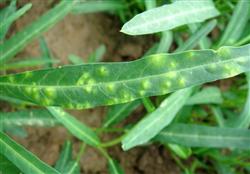
What are the key points for pollution-free control of white rust in water spinach?
Symptoms: The lesions appear on the underside of the leaves. On the upper surface of the leaves, pale yellow to yellow spots first appear, later turning brown. The lesions expand, and on the underside of the leaves white raised blister-like spots form, nearly round or oval to irregular in shape, sometimes merging into larger blisters. In the later stage, the blisters rupture and release white, non-functional sporangia. When the leaves are severely affected, the lesions are dense and the diseased...
-
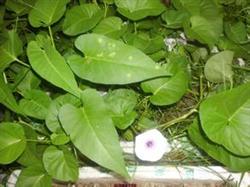
What chemicals are used to control white rust in water spinach?
First, implement a 2- to 3-year crop rotation with other vegetable varieties. Second, before sowing, dress the seeds for sterilization at a ratio of 300 g of 35% metalaxyl per 100 kg of seeds; third, in the early stage of the disease, spray with 50% copper metalaxyl wettable powder at 6000 to 7000 times dilution, or with 72.2% propamocarb aqueous solution at 8000 times dilution, once every 7 to 10 days...
-
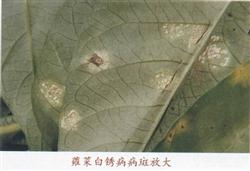
How to prevent and control downy mildew in water spinach? A detailed explanation of practical technical points
1. Practice a 2-to-3-year crop rotation with other vegetable varieties. 2. Before sowing, dress the seed for sterilization at a ratio of 300 g of 35% metalaxyl per 100 kg of seed; 3. In the early stage of the disease, spray with 50% copper metalaxyl wettable powder at 6000 to 7000 times dilution, or with 72.2% Previcur AS at 8000 times dilution, applying once every 7 to 10 days...
-
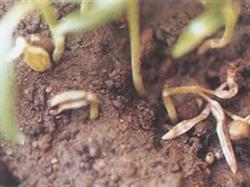
What are the control methods for damping-off in water spinach?
Symptoms After the seeds germinate, infection before emergence mostly causes seed rot; after emergence, infection appears near the soil surface as water-soaked areas that soften and develop basal rot. The diseased part constricts, rapidly spreads around the stem, the seedlings topple, and the whole plant quickly dies, causing patches of dead seedlings. Disease conditions The optimum growth temperature is 15-16°C, and the optimum soil temperature for disease development is...
-
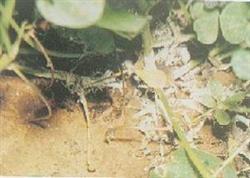
What are the comprehensive control measures for peanut southern blight?
Peanut southern blight is a soil-borne fungal disease that occurs from the pod swelling stage to the maturity stage of peanuts. After the peanut roots, pods and stem bases are infected, they initially show brown soft rot, with white silky mycelium at the root-stem area above ground (hence the name southern blight), along with rapeseed-like sclerotia; the stems and leaves turn yellow and gradually die, and the peanut pods...
-
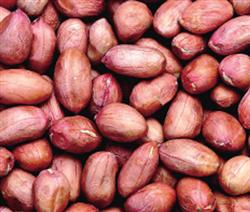
Using chlorpyrifos for peanut seed dressing can effectively control insect pests
Peanut seed dressing without insect damage - chlorpyrifos peanut seed dressing without insect damage is a non-toxic, residue-free biological insecticide that mainly acts on the nervous system of soil-dwelling pests, causing metabolic disorders so they stop feeding and die; it is especially sensitive to larvae. With one seed dressing, it remains active in the soil for more than 130 days and can effectively...
-
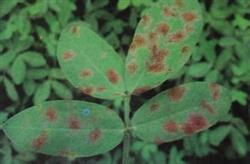
Prevent early defoliation in peanuts and take timely control measures
Peanut net blotch diseased leaves. Early defoliation in the late stage of peanut growth can seriously affect peanut yield. The main causes of early defoliation in the late stage are premature senescence of the plants and damage from leaf spot diseases (net blotch, brown spot, etc.). Peanuts sprayed with paclobutrazol and regulators containing this ingredient shed leaves earlier and more severely. Therefore, preventing early...
-
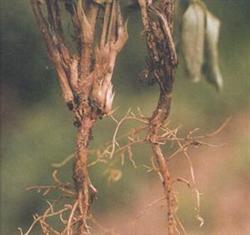
Detailed Explanation of the Occurrence and Control Techniques of Peanut Stem Rot
In recent years, the peanut planting area in our region has increased year by year, and peanut diseases have also risen accordingly, especially peanut stem rot, whose damage has increased relatively rapidly. According to survey statistics, from 2001 to 2003, fields affected by this disease accounted for 89.6%, with mild diseased plant rates of 10-20%, and severe cases reaching over 60%, or even dying in patches with total crop failure....
-
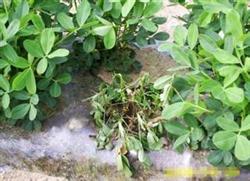
How to prevent and control peanut bacterial wilt? The flowering and pegging stage is key
Peanut bacterial wilt is a devastating disease. Once infected, the whole plant wilts and dies, and it cannot be cured. The flowering and pegging stage of peanuts is the period when bacterial wilt breaks out, and during this time attention should be paid to spraying for control. Specific control method: when peanuts begin to bud, spray the leaves once every 10 to 15 days with a 1500-fold 70% hymexazol water-soluble...
-
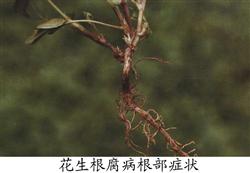
What are the control methods for peanut root rot?
There are broadly two causes of peanut root rot: one is waterlogging, and the other is root rot disease. Control should begin with draining away the standing water and keeping the ditches clear. Before sowing peanuts, treat the seed with a 10% Shileshi seed coating, and after the disease appears, drench the roots with a 1000-fold dilution of Lüheng No. 1 or No. 2; foliar spraying is ineffective. Practise crop rotation: in lightly affected fields, rotate every other year, and in severely affected fields, rotate for 3 to 5 years. Deep ploughing to improve the soil, applying more organic fertiliser, and rational irrigation and drainage will strengthen disease resistance.
条件筛选