Detailed Explanation of the Occurrence and Control Techniques of Peanut Stem Rot
In recent years, the peanut planting area in our region has increased year by year, and peanut diseases have also risen accordingly, especially peanut stem rot, whose damage has increased relatively rapidly. According to survey statistics, from 2001 to 2003, fields affected by this disease accounted for 89.6%, with mild diseased plant rates of 10-20%, and severe cases reaching over 60%, or even dying in patches with total crop failure....
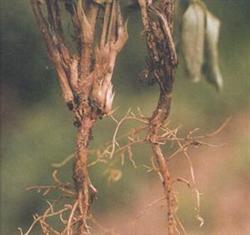
In recent years, the peanut planting area in our region has increased year by year, and peanut diseases have also risen accordingly, especially peanut stem rot, whose damage has increased relatively rapidly. According to survey statistics, from 2001 to 2003, fields affected by this disease accounted for 89.6%, with mild diseased plant rates of 10-20%, and severe cases reaching over 60%, or even dying in patches with total crop failure. Based on experience in recent years, its occurrence, damage and control measures are described as follows:
I. Damage symptoms. The site of attack of stem rot is mainly at the branching point of the first pair of lateral branches or the middle-upper part of the root crown. During the seedling stage, the pathogen first infects the cotyledons, causing the 2 cotyledons to rot and turn dark brown, then infects the stem base near the ground or the underground root crown, producing yellow-brown water-soaked lesions that gradually expand into large black patches and spread around the stem to form a ring-shaped lesion, causing the vascular bundles to rot. In the early stage of infection, the aboveground leaf color becomes lighter, the petioles droop at noon and the compound leaves close, and they can still recover in the morning, but as the disease develops, all petioles collapse and the whole stem wilts. In dry weather, the plant turns yellow-brown and dies, while in rainy weather, the diseased plant rots and turns dark brown. During the seedling stage, diseased plants take about 3-4 days from symptom appearance to death, and in other growth stages, about 10-40 days from symptom appearance to death.
II. Sources of the pathogen. Soil-borne inoculum and moldy seeds are the main sources of stem rot. Normally, seeds that are not moldy have a seed-borne infection rate of about 2%, while moldy pods can have an infection rate of over 37%, and the seed kernels can have an infection rate of over 65%. Soil-manure mixed with diseased plants and the soil in diseased areas are both important sources of infection and spread.
III. Control measures
1. Ensure seed quality and prevent seeds from becoming moldy. Peanuts used for seed should be harvested at the proper time, turned and dried promptly, and stored safely, taking care to prevent mold. Before sowing, sun the seeds and select seeds, removing deteriorated and moldy seeds to ensure seed quality, so as to reduce primary infection by the disease.
2. Reasonable crop rotation. Reasonable crop rotation is a basic measure for disease control. In lightly affected plots, rotation every other year can have a control effect, while in severely affected areas, rotation must be carried out for more than 3 years to significantly reduce the disease. Wheat, corn and sweet potato are good rotation crops.
3. Apply decomposed fertilizer. Any soil-manure and livestock manure mixed with diseased residues must not be applied directly, and must be composted and thoroughly decomposed to minimize the source of inoculum.
4. Chemical control. At present, the most effective method is seed dressing, seed soaking or spraying with carbendazim. For seed dressing, use 25% or 5% carbendazim wettable powder, and dress seeds at 0.5% or 0.3% of the seed weight respectively. First moisten the seeds with clean water, then mix them with the powder so that the powder evenly adheres to the seed surface, and then sow. For seed soaking, use 25% or 50% carbendazim wettable powder, soaking seeds at 1% or 0.5% of the seed weight respectively, using 25-30 kg of water, mix the powder evenly in the water, then add 50 kg of seeds and soak for 24 hours, stirring several times, so that the seeds absorb all the medicated water, and then sow. The effect of spraying is somewhat poorer than that of seed soaking and seed dressing, but it can serve as a remedial measure to prevent disease during the peanut seedling stage. Use 25% or 50% carbendazim wettable powder to prepare 500-fold or 1000-fold solutions respectively, or use 70% thiophanate-methyl 800-fold solution, and spray after the peanut seedlings have all emerged, then spray once more before flowering, which can basically suppress the expansion and spread of the disease.
The above chemicals also have a good control effect on root rot and black mold.