What are the comprehensive control measures for peanut southern blight?
Peanut southern blight is a soil-borne fungal disease that occurs from the pod swelling stage to the maturity stage of peanuts. After the peanut roots, pods and stem bases are infected, they initially show brown soft rot, with white silky mycelium at the root-stem area above ground (hence the name southern blight), along with rapeseed-like sclerotia; the stems and leaves turn yellow and gradually die, and the peanut pods...
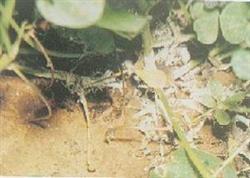
Peanut southern blight is a soil-borne fungal disease that occurs from the pod swelling stage to the maturity stage of peanuts. After the peanut roots, pods and stem bases are infected, they initially show brown soft rot, with white silky mycelium at the root-stem area above ground (hence the name southern blight), along with rapeseed-like sclerotia; the stems and leaves turn yellow and gradually die, and the peanut pods rot. Once the disease breaks out, control results are poor.
The pathogen of peanut southern blight spreads through soil, running water and seeds, and is highly dangerous. Once it invades, the pathogen accumulates year after year, making it very difficult to control and eradicate later. Under suitable conditions, mycelium produced by germinating sclerotia directly invades from the peanut roots or stem base or enters through wounds, multiplies and causes damage, leading to disease and rot of the roots and stems. Mature sclerotia on new diseased plants can also spread through rainwater, irrigation water, insects, farming operations and other factors, continuously causing secondary infections. Throughout the entire peanut growing season, the pathogen can carry out repeated infections many times, and finally the sclerotia formed in the diseased tissue fall into the soil or remain in the diseased plants to overwinter.
Control measures:
1. Clean up the field
After the peanut harvest, promptly remove the diseased residues completely from the field, leaving no stubble, so as to eliminate the overwintering source of inoculum.
2. Reasonable crop rotation
Rotation with gramineous crops for more than 3 years can be carried out to reduce the accumulation of inoculum.
3. Soil disinfection
In combination with spring plowing and deep plowing of the land, use 2 kg per mu of 70% thiophanate-methyl, mix it evenly with fine soil and spread it into the soil to eliminate remaining pathogens.
4. Strengthen field management
Use nitrogen, phosphorus and potassium fertilizers scientifically and reasonably, and apply more organic fertilizer, zinc fertilizer, calcium fertilizer and boron fertilizer. After peanuts emerge, check the seedlings and replant missing ones in time to ensure a full stand with moderate density; during the mid-growth period, weed to prevent the field from becoming overgrown, so as to facilitate ventilation and light penetration, enhance the disease resistance of the plants, and control the occurrence of southern blight.
5. During the peanut growing season, promptly pull out diseased plants and burn the diseased residues, so as to reduce the accumulation and spread of the pathogen and control the speed and extent of the epidemic.
6. Chemical control
You can use 50% iprodione or 50% procymidone 1000-fold solution, 40% dimethachlon 600-fold solution, 50% carbendazim 800-fold solution, or tebuconazole, difenoconazole and other appropriate agents, applied alternately by spraying 2 to 3 times, once every 7 to 15 days, and be careful to spray evenly and drench thoroughly. You can also drench the roots with 70% thiophanate-methyl 800-fold solution at the peanut pod-setting stage, and the control effect is very obvious.