What are the control methods for damping-off in water spinach?
Symptoms After the seeds germinate, infection before emergence mostly causes seed rot; after emergence, infection appears near the soil surface as water-soaked areas that soften and develop basal rot. The diseased part constricts, rapidly spreads around the stem, the seedlings topple, and the whole plant quickly dies, causing patches of dead seedlings. Disease conditions The optimum growth temperature is 15-16°C, and the optimum soil temperature for disease development is...
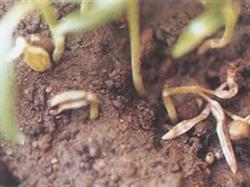
Symptoms After the seeds germinate, infection before emergence mostly causes seed rot; after emergence, infection near the soil surface appears as water-soaked areas, softens, develops basal rot, the diseased part constricts, rapidly spreads around the stem, the seedlings topple, and the whole plant quickly dies, causing patches of dead seedlings.
Disease conditions The optimum growth temperature is 15-16°C, and the optimum soil temperature for disease development is 10°C. It is inhibited when the temperature is above 30°C. Low temperatures are unfavorable for host growth, but the pathogen can still remain active. In particular, low temperature and high humidity during the seedling-raising period favor disease development. When the nutrients in the cotyledons of the seedlings are basically used up and before the new roots are well established, it is the susceptible stage. At this time, true leaves have not yet emerged, carbohydrates cannot increase rapidly, and disease resistance is weak. If there are continuous cloudy and rainy or snowy days or a cold wave, the soil temperature is low, photosynthesis is weak, seedling respiration increases, consumption grows, the young stem cells elongate, and the cell walls become thinner, giving the pathogen an opportunity to invade. Therefore, this disease mainly occurs before the seedlings grow 1-2 leaves.
Control methods Chemical control: At the beginning of the disease, start spraying 40% fosetyl-aluminum wettable powder at 200 times dilution, or 70% ethylicin-mancozeb wettable powder at 500 times dilution, 58% metalaxyl-mancozeb wettable powder at 500 times dilution, 64% oxadixyl-mancozeb wettable powder at 500 times dilution, 18% metalaxyl-amine-mancozeb wettable powder at 600 times dilution, 69% dimethomorph-mancozeb wettable powder at 1000 times dilution, 72.2% propamocarb aqueous solution at 800 times dilution, once every about 10 days, for 2-3 consecutive treatments, and make sure to spray evenly and thoroughly. Agricultural control: (1) Choose disease-resistant varieties. (2) Promote the application of compost fermented with effective microorganisms and fully decomposed organic fertilizer. (3) Practice crop rotation with true seedlings; in low-lying wet land, use ridge cultivation or high beds with deep furrows, plant at a reasonable density, prevent excessive surface humidity, and drain promptly after rain.