-
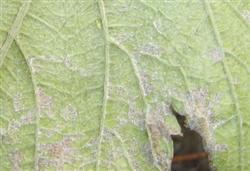
Control Methods and Technical Key Points for Grape Downy Mildew
Control methods: 1. Remove fallen leaves and diseased branches, bury them deep or burn them. 2. Timely pinch off growing tips, prune, drain and weed, and apply more phosphorus and potassium fertilizer. 3. At the early stage of the disease, that is, after July, apply chemicals as soon as slight lesions are seen on the underside of leaves. The chemicals include: Pubo, Ridomil, Sandofan, metalaxyl, Shuangmeiyitejing, etc., used alternately, spraying 4 to 5 times in a row...
-
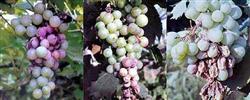
How to treat grape water rot? Detailed control methods
Based on your description, it is likely grape white rot, one of the most important grape diseases, especially in rainy years when it often occurs together with anthracnose, causing great damage. Grape white rot can harm clusters, canes and leaves. After the cluster and rachis are infected, they become light brown and water-soaked rot, and the whole cluster or part of the small clusters...
-
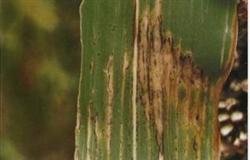
Symptom Identification and Control Methods of Sorghum Black Bundle Disease
Symptoms Sorghum black bundle disease is a vascular bundle disease, also known as tracheomycotic blackening disease. When symptoms appear on leaves, brown streaks form on the leaf veins, mostly presenting as large necrotic spots along one or both sides of the main vein, causing the leaves and leaf sheaths to turn purple or brown; in severe cases the leaves dry up, the stalks become slightly thicker, and branching occurs on the upper part of diseased plants. Cross-sectioning the diseased stalk...
-
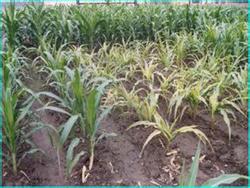
Symptom Identification and Control Methods for Sorghum Downy Mildew
Sorghum seedling blight - Symptoms: The disease can occur when sorghum grows to 4-5 leaves. It starts from the lower leaves and then spreads upward. Infected leaves develop purplish-red streaks that gradually merge, causing the leaves to gradually die from the tip, and the seeds turn very brown. Sorghum seedling blight - Pathogen: Known as Fusarium moniliforme, a fungus belonging to the subphylum Deuteromycotina. On PDA medium...
-
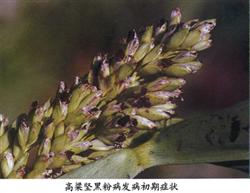
Symptom Identification and Control Methods for Sorghum Head Smut
Symptoms The diseased plants are shorter than healthy plants. In the early stage of the disease, the ear sheath of the diseased ear is very tight, the lower part is swollen, and the flag leaf is upright; when peeled open, a white rod-shaped structure can be seen inside, namely the smut gall. The smut gall inside the sheath is initially small and finger-shaped, gradually grows larger, and later the middle part swells into a cylindrical shape and becomes relatively hard. During the development of the smut gall, the internal tissue changes from white to black, then...
-
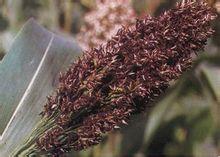
Occurrence Patterns and Control Methods of Sorghum Head Smut
As the sorghum planting area continues to expand and the planting years lengthen, the damage caused by sorghum head smut is becoming increasingly serious, directly affecting the development of sorghum production. I. Degree of damage: In the early 1990s, sorghum head smut occurred only sporadically in a few local areas of the county. By 2000, the affected area in individual townships was about 43 hectares, with a diseased plant rate of 15%, while other planting areas had only mild occurrence. According to a 2004 survey, the affected area in the county was 800 hectares, accounting for 34% of the total sorghum sown area, with an average diseased plant rate of 20.5% in affected fields; in 2005, the affected area in the county was 1333 hectares, accounting for 67% of the total sorghum sown area, with an average diseased plant rate of 31.2% in affected fields. In the sorghum planting area of the Second Brigade of Biesituobie Township, the diseased plant rate reached 70.5%, with a severity of 70%.
-
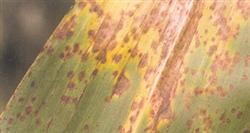
Symptoms and Control Methods of Sorghum Anthracnose
Symptoms This disease is an important disease of sorghum and occurs in all sorghum-producing areas. It can infect plants from the seedling stage to the mature plant stage. Infection at the seedling stage damages the leaves, causing leaf blight and resulting in dead sorghum seedlings. Leaf lesions are spindle-shaped, reddish-brown in the center with purplish-red margins, and dense small black dots appear on the lesions, which are the pathogen's acervuli. Anthracnose...
-
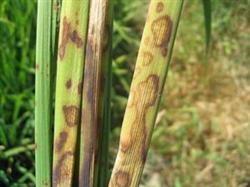
Symptoms and Control Methods of Sorghum Banded Leaf and Sheath Blight
Symptoms: This disease occurs commonly in northern China and Taiwan, China, and is more severe in hybrid sorghum; it also occurs in central and southwestern China. It mainly affects the leaf sheath, but can also affect the leaves. After infection, water-soaked lesions first appear on the stem near the ground, followed by lesions on the leaf sheath with alternating purplish-red and grayish-white bands. In the late growth stage or under rainy and humid weather...
-
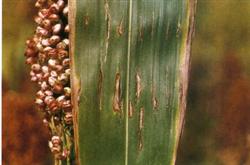
Symptoms and Control Methods of Bacterial Red Stripe Disease in Sorghum
Symptoms mainly affect leaves. Leaf spots initially appear as water-soaked, narrow, fine small stripes, which after expansion turn light reddish-brown. Some lesions have brown centers with red edges, and broad long-ovate lesions appear intermittently on the stripes. Sometimes the lesions can cover most of the leaf area. When humidity is high, small granular bacterial ooze can be seen overflowing, and after drying...
-
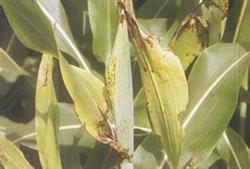
Symptom Identification and Control Methods of Sorghum Leaf Spot
Symptoms Also called spot disease. All parts of the whole plant can be affected, mainly damaging the leaves. The lesions are irregular in shape, long to spindle-shaped or semicircular, varying in size, can reach about 1cm or more, yellow-brown to gray-brown, with red-purple edges. The lesions often start from the leaf margin or leaf tip, and some also occur on the leaf surface or the upper part of the panicle...
条件筛选