Symptoms and Control Methods of Sorghum Banded Leaf and Sheath Blight
Symptoms: This disease occurs commonly in northern China and Taiwan, China, and is more severe in hybrid sorghum; it also occurs in central and southwestern China. It mainly affects the leaf sheath, but can also affect the leaves. After infection, water-soaked lesions first appear on the stem near the ground, followed by lesions on the leaf sheath with alternating purplish-red and grayish-white bands. In the late growth stage or under rainy and humid weather...
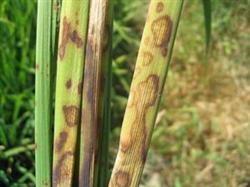
Symptoms: This disease occurs commonly in northern China and Taiwan, China, and is more severe in hybrid sorghum; it also occurs in central and southwestern China. It mainly affects the leaf sheath, but can also affect the leaves. After infection, water-soaked lesions first appear on the stem near the ground, followed by lesions on the leaf sheath with alternating purplish-red and grayish-white bands. In the late growth stage or under rainy and humid weather conditions, brown sclerotia form on the diseased tissue. The disease can also spread to the top of the plant, causing damage to the leaves. Severely affected plants die prematurely. When the leaf sheath at the stem base is infected, small white-green water-soaked lesions first appear, then expand into elliptical lesions with brown edges and lighter centers. Infected leaves show grayish-green to grayish-white cloud-like spots, and most lesions merge into a tiger-stripe pattern, causing the entire leaf to die. When humidity is high, white mycelium grows on the inner and outer surfaces of the leaf sheath, and some produce small dark brown sclerotia.
Pathogen: Rhizoctonia solani Kuhn anastomosis groups AG-1-IA and AG-5. According to isolations in northern China, the AG-1-IA anastomosis group accounted for 77%, the AG-5 anastomosis group accounted for 19.2%, and AG-4 accounted for 3.8%. The sexual state is Thanatephorus cucumeris (Frank) Donk, known as the cucumber death fungus, a fungus in the Basidiomycotina. The temperature range for mycelial growth is 7-40°C, with an optimum of 26-32°C. Sclerotia can germinate and produce mycelium after 10-12 days at 26-32°C and relative humidity above 95%. The suitable pH for mycelial growth is 5.4-7.3. Mycelium can only invade the host when relative humidity is above 85%.
Transmission routes, disease conditions, and control methods: see Corn Banded Leaf and Sheath Blight.