Symptom Identification and Control Methods for Sorghum Downy Mildew
Sorghum seedling blight - Symptoms: The disease can occur when sorghum grows to 4-5 leaves. It starts from the lower leaves and then spreads upward. Infected leaves develop purplish-red streaks that gradually merge, causing the leaves to gradually die from the tip, and the seeds turn very brown. Sorghum seedling blight - Pathogen: Known as Fusarium moniliforme, a fungus belonging to the subphylum Deuteromycotina. On PDA medium...
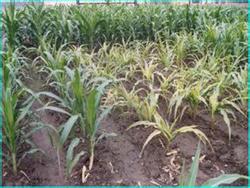 Symptoms: This disease invades sorghum in either systemic or localized form. It mostly affects the leaves. When seedlings are infected, chlorotic or pale yellowish-white areas appear on the leaves; under high humidity, white mold-like growth appears on the leaf underside; later, green and white parallel stripe tissues appear on the leaves; finally, light reddish-brown stripes appear, and the chlorotic interveinal tissues become necrotic lesions causing the leaves to split. This is the typical symptom of the disease. Plants infected at the seedling stage are stunted, mostly dying before flowering and seed set; those that survive cannot flower, and although they may flower later, yields drop sharply. Some diseased plants show clustered symptoms, very similar to crazy top. After sorghum is affected by downy mildew, it is prone to inducing purple leaf spot disease. The diseased tissues of this disease are not distorted or malformed, which distinguishes it from crazy top disease. In recent years, the damage from this disease has shown an upward trend.
Pathogen: Peronosclerospora sorghi, a fungus belonging to the subphylum Mastigomycotina. Besides infecting sorghum, this fungus can also infect corn. For the morphological characteristics of the pathogen, see corn downy mildew. In addition, it has been reported that Sclerospora sorghi (kulk.) Westen et Uppal, known as sorghum downy mildew fungus, belonging to the subphylum Mastigomycotina, is also a pathogen of this disease. The sporangiophores of Sclerospora sorghi are erect, slightly swollen at the base, 100-150 um long, with dichotomous branching at the apex, pointed terminal sterigmata, and one terminal sporangium, emerging from the stomata of the lower leaf epidermis. Sporangia are nearly round, without papillae, colorless, measuring 15-29 x 15-26.9 (um), borne on elongated and tapering sterigmata; under high humidity, sporangia germinate to form germ tubes. Oogonia are spherical, measuring 40-50 um, embedded in the mesophyll tissue between vascular bundles. Oospores are spherical, colorless, with a pale yellow wall,
measuring 25-42.9 um. Recently it has been reported that a new variety of Sclerophthora macrospora is also a pathogen of this disease. The mycelium is colorless, multinucleate, and non-septate. Oogonia are nearly spherical, brown, measuring 27.5-72.5 x 20-63.8 (um). There are 1-4 antheridia, lateral, light yellowish-brown, measuring 13.18-40.3 x 6.3-21.3 (um). Oospores are spherical, yellowish-brown, measuring 23.8-57.5 x 21.3-53.8 (um).
Transmission routes and disease conditions: The pathogen overwinters in the soil as oospores and can survive for several seasons, becoming the primary infection source of the disease the following year. Oospores germinate to produce germ tubes that infect the leaves of seedlings; after seedlings become diseased, sporangia are produced in the diseased areas and spread by wind and rain, causing secondary infection. Germination of the sporangia of this fungus requires high humidity and temperatures below 20 degrees C; under dry field conditions, the spores lose viability after 3-4 hours.
Control methods: (1) Select disease-resistant varieties. (2) Promptly remove diseased residues after harvest. (3) Pull out diseased plants whenever found in the field and burn them in a centralized manner. (4) In areas with severe incidence, implement large-scale crop rotation. (5) Strengthen field management, drain promptly after rain, and prevent moisture retention. (6) When necessary, spray 72% Keshuangqing or 72% Kelu wettable powder at 700 times dilution, or 69% Anke Mancozeb wettable powder at 1000 times dilution, or 64% Shadufan wettable powder at 500 times dilution.