Symptom Identification and Control Methods for Sorghum Head Smut
Symptoms The diseased plants are shorter than healthy plants. In the early stage of the disease, the ear sheath of the diseased ear is very tight, the lower part is swollen, and the flag leaf is upright; when peeled open, a white rod-shaped structure can be seen inside, namely the smut gall. The smut gall inside the sheath is initially small and finger-shaped, gradually grows larger, and later the middle part swells into a cylindrical shape and becomes relatively hard. During the development of the smut gall, the internal tissue changes from white to black, then...
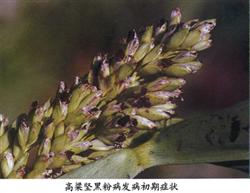
Symptoms The diseased plants are shorter than healthy plants. In the early stage of the disease, the ear sheath of the diseased ear is very tight, the lower part is swollen, and the flag leaf is upright; when peeled open, a white rod-shaped structure can be seen inside, namely the smut gall. The smut gall inside the sheath is initially small and finger-shaped, gradually grows larger, and later the middle part swells into a cylindrical shape and becomes relatively hard. During the development of the smut gall, the internal tissue changes from white to black, then splits open; the smut gall extends outward from inside the sheath, and the white membrane covering its surface also ruptures, exposing black filamentous structures and black powder, namely the remaining vascular bundle tissue of the inflorescence and the teliospores of the pathogen. Leaf infection forms reddish-purple striped spots on the leaves, which after expansion become long fusiform streaks; later the middle of the streaks ruptures, and black spore piles form on the lesions, with a small amount of spores. This disease occurs commonly and severely in Liaoning, Jilin, and Shanxi.
Pathogen Sphacelotheca reiliana (Ktllln.) Clint. Synonym Sorosporium reilianum (Ktlhn.) Mc.Alp., called sorghum head smut fungus, a fungus of the Basidiomycotina. Teliospores are spherical to oval, dark brown, with small spines on the wall surface, measuring 10-15 x 9-13 (um). In the early stage, teliospores often gather in groups of more than 30, later forming spherical to irregular spore balls, measuring 50-70 um, but compact, and dispersing after maturity. The spore pile is initially covered by a thin membrane composed of hyphae, which later ruptures and releases the teliospores. Teliospores require physiological after-ripening before germination; treatment at 32-35 degrees C under moist conditions for 30 days significantly increases the germination rate. The pathogen can grow on artificial culture media.
Transmission routes and disease conditions This disease is mainly spread by seed-borne inoculum. The pathogen scattered in the soil can survive for 1 year, and teliospores buried deep in the soil can survive for 3 years. Teliospores scattered in soil or manure are the main source of infection. After teliospores germinate,
they invade sorghum young buds with binucleate hyphae. From seed germination until the bud is 1.5 cm long is the most suitable infection period. The invading hyphae first remain in the tissue below the growing cone, enter the interior after 40 days, and enter the differentiated flower buds after 60 days. This disease is a systemic infection disease of seedlings. The pathogen has two host-specialized forms: sorghum and corn. The sorghum-specialized form mainly infects sorghum; although it can infect corn, the incidence rate is not high. The corn-specialized form only infects corn and cannot infect sorghum. Three physiological races have been found in China. Soil temperature and water content are closely related to disease occurrence. When soil temperature is 28 degrees C and soil water content is 15%, the incidence rate is high. During spring sowing, if the soil temperature is relatively low or the soil covering is too thick, seedlings emerge slowly and are prone to the disease. Continuous cropping fields have severe disease occurrence.
Control methods (1) Select disease-resistant varieties Currently, those resistant to head smut in production
The hybrids include: Heiza 34, Heiza 46, Qiza No. 1, Jinza No. 5, Xinza No. 5, Xinza No. 7, Jiza No. 1, Liaozai No. 4, Liaosiza No. 2, etc. Resistant parents include Heilong 14A, 7152A, Jinong 105A, etc. (2) Large-scale crop rotation Carry out rotation with other crops for more than 3 years, which can effectively control the occurrence of this disease and is an economical and effective agricultural control measure. (3) Deep plowing in autumn for sterilization This can reduce the source of inoculum and reduce disease occurrence the following year. (4) Seed treatment 1. Hot water seed soaking. Soak seeds in warm water at 45-55 degrees C for 5 minutes, then keep them covered; sow immediately after the seeds germinate, which can both protect seedlings and reduce the incidence rate. 2. Chemical seed dressing. Use 2 g of 25% triadimefon wettable powder to dress 1 kg of sorghum seed, with excellent control effect. It is also possible to use 50% carboxin powder 358 to dress 5 kg of seed, then sow after dressing. (5) Sow at the proper time, and it is not suitable to sow too early. Improve sowing quality so that seedlings emerge as soon as possible and reduce the chance of pathogen infection from young buds. (6) Remove diseased ears, which should be done before the gray gall appears and before it ruptures, and bury them deeply or burn them in a centralized manner.