Symptom Identification and Control Methods of Sorghum Leaf Spot
Symptoms Also called spot disease. All parts of the whole plant can be affected, mainly damaging the leaves. The lesions are irregular in shape, long to spindle-shaped or semicircular, varying in size, can reach about 1cm or more, yellow-brown to gray-brown, with red-purple edges. The lesions often start from the leaf margin or leaf tip, and some also occur on the leaf surface or the upper part of the panicle...
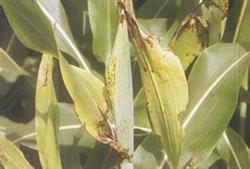
Symptoms Also called spot disease. All parts of the whole plant can be affected, mainly damaging the leaves. The lesions are irregular in shape, long to spindle-shaped or semicircular, varying in size, can reach about 1cm or more, yellow-brown to gray-brown, with red-purple edges. The lesions often start from the leaf margin or leaf tip, and some also occur on the leaf surface or the upper part of the panicle, causing the flag leaf to break over. When the lesions expand, they often merge into larger patches, and later on the dried leaf spots, scattered or aligned small black dots can be seen, which are the pathogen's pycnidia. Seeds and glumes affected by the disease produce similar symptoms. It occurs in Beijing, Shanxi, Inner Mongolia, Northeast China and Southwest China. The damage is becoming increasingly serious.
Pathogen Phyllosticta sorghina Sacc., called sorghum leaf spot fungus, belonging to the Deuteromycotina fungi. The pycnidia are black, subspherical, scattered on the leaf surface, protruding from the epidermis, measuring 64-194um. The conidia are oval, single-celled, colorless, measuring 3.5-6 x 2.0-3.0 (um). Besides infecting sorghum, it can also infect broomcorn millet, foxtail millet, barnyard grass, sugarcane, Sudan grass, etc. Transmission routes and disease conditions The pathogen overwinters on diseased residues as pycnidia. The following year in Beijing, Jilin and other places, the disease begins in June, and symptoms become obvious or epidemic in July-August. According to observations, fields sown early have more severe disease than fields sown late. There are differences in disease resistance among varieties; in the same field, Kang 7 and Shenza 5 were more severely affected, while Kang 4 showed no disease. In 1994, in Miyun and Yanqing of Beijing, the hybrid sorghum Kang 7 and Shenza 5 were planted and had poor resistance to this disease, and coupled with the special climate that year, in June
there was drought with no rain, after July rainfall increased, with rainfall of 575mm, reaching 268mm in August, more than in previous years, and sunshine decreased significantly, the air humidity in July-August was 78.7%-79%, and the temperature was 0.5-2.5°C higher than usual. Such humid and stuffy weather caused the epidemic of leaf spot. In recent years, the damage of this disease has shown an upward trend, with severe cases resulting in total crop failure or no harvest.
Control methods (1) Adapt to local conditions and select disease-resistant varieties suitable for local cultivation. When introducing new varieties, pay attention to combining agronomic traits with disease resistance, and screen out new varieties with good quality, high yield and disease resistance suitable for the local area. (2) Sow at the appropriate time, not too early. (3) In areas with severe disease, spray 36% thiophanate-methyl suspension concentrate at 600 times dilution or 50% benomyl wettable powder at 1500 times dilution, 80% Pencozeb wettable powder at 600 times dilution, 80% Daconil M-45 wettable powder at 600 times dilution, 30% Luyedan wettable powder at 500-800 times dilution at the early stage of disease onset.