-
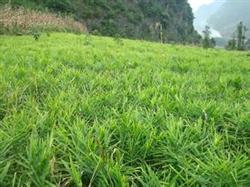
Intercropping and Relay Cropping Technique for Lettuce, Ginger, Watermelon and Bok Choy
1. Topdressing: generally 2 to 3 times. The first is in early to mid-June, applying 1000 kg of barnyard manure plus 15 kg of urea per mu between the rows, covered with a thin layer of soil. The second is in early to mid-July after the mother ginger is dug, applying 150 kg of decomposed rapeseed cake or 30 kg of compound fertilizer per mu; the third is in early September after the frame is removed, applying another dose of human excrement and urine to prevent nutrient deficiency...
-
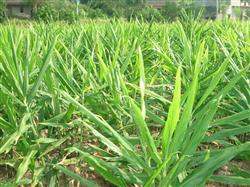
Key Techniques for High-Yield Cultivation of Ginger Intercropped with Watermelon
When planting ginger, apply heavy base fertilizer and increase phosphorus and potassium fertilizer; avoid applying too much nitrogen fertilizer. Apply sufficient base fertilizer, mainly organic fertilizer, with a combination of slow-release and quick-release chemical fertilizers. Base fertilizer generally accounts for 40% of the total fertilizer application. Before sowing, apply 15 kg of imported compound fertilizer plus 50 kg of calcium magnesium phosphate fertilizer per mu as deep-layer base fertilizer. After sowing, use high-quality farmyard manure...
-
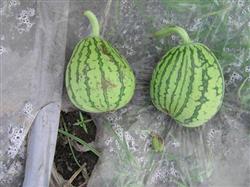
Why is it hard for watermelons to set fruit, and why are there so many deformed fruits?
During the production process, watermelons are often affected by unfavorable factors, which can lead to difficulty in setting fruit and a large number of deformed fruits, reducing yield and marketability and directly affecting growers' income. The reasons for difficulty in setting fruit and a large number of deformed fruits in watermelons are as follows: abnormal weather conditions. During the flowering and fruit-setting period of watermelons, high temperatures, ...
-
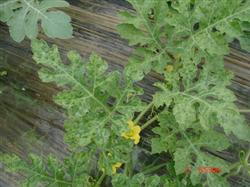
Be Alert to the Harm of a New Watermelon Virus, Growers Should Pay Attention to Early Prevention and Control
A quarantine viral disease, Cucumber green mottle mosaic virus, has been detected. Taking precautions is warranted, but pulling up plants and replanting without any reason is unnecessary. Here, we introduce this newly emerging viral disease. Cucumber green mottle mosaic virus has a relatively narrow host range, occurring mainly on cucurbits...
-
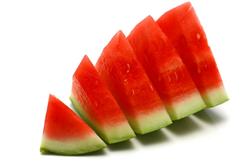
Key Cultivation and Control Techniques for Major Watermelon Pests and Diseases
Yu Yongjun, a villager from Group 3 of Yuwanggang Village, Qifang Town, Zaoyang City, Hubei Province, once hailed as the "Watermelon King," has through years of practice worked out a good method for making watermelons sweeter, now offered to fellow growers for reference. 1. About 1 week after fruit set, dig a hole 10 cm from the main root, apply 50 g of cake fertilizer per plant, cover with soil and water. This method can make...
-
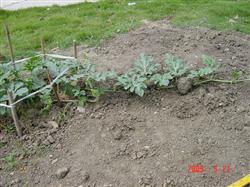
Detailed Explanation of Key Techniques for Watermelon Vine Pressing and Pruning
Vine pressing and pruning are major technical steps in watermelon cultivation management. Through vine pressing and pruning, land and light energy can be used effectively, and the growth and distribution of watermelon stems and vines can be regulated and suppressed, thereby improving watermelon quality and yield. 1. Vine pressing Before vine pressing, first lay the seedlings down and mound soil around the root zone. When the seedlings have 5-6 true leaves and are about to begin vining...
-

Key technical points for hand pollination of watermelon
(1) Flower-to-flower pollination method: Gently lift the female flower's stalk so that the stigma is exposed, then select a male flower that opened the same day, pick it together with its stalk, turn the petals outward to expose the stamens, and gently smear the pollen onto the stigma of the female flower at the fruit-setting node, so that the pollen is evenly scattered on the stigma. Generally, 1 male flower can pollinate 2...
-
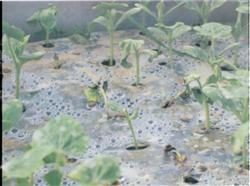
What are the key points for managing watermelon seedlings?
What issues should be noted in watermelon seedling management? (1) Temperature management: In temperature management, two tendencies should be avoided. One is not daring to remove the film for ventilation, fearing the seedlings will freeze, which results in high temperature and high humidity in the seedbed and causes the seedlings to grow leggy; the other is too much ventilation, which makes the temperature inside the bed too low, causing slow seedling growth...
-
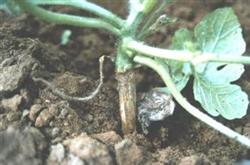
How to prevent and control watermelon seedling diseases? A detailed guide to integrated control techniques
I. Symptoms of the main diseases 1. Damping-off. In the early stage, the root collar of the seedling (the junction of root and stem) develops lesions that look as if scalded by boiling water and become rotten, after which the diseased part turns yellowish-brown, dries out and shrinks; the cotyledons have not yet wilted, but the seedling topples over. Damping-off mostly occurs from the emergence of the cotyledons to the stage when 2 true leaves have flattened out. The disease spreads very quickly; a few days after the appearance of the first diseased plants, seedlings topple over in patches. Under conditions of high temperature and high humidity, the diseased parts of the seedlings and the ground nearby,
-
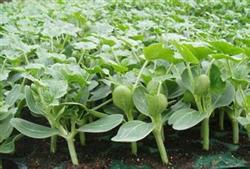
Four key steps to master for raising watermelon seedlings in a heated hotbed
Raising watermelon seedlings in a heated hotbed has the characteristics of fast warming, even temperature, low cost and simple operation. It can cultivate robust watermelon seedlings in January and February when the air temperature is very low, and its seedling-raising effect is similar to that of an electric heating hotbed. 1. Build the seedbed. First dig a bed pool 4.5 m long from east to west, 1.6 m wide from north to south and 0.2 m deep...
条件筛选