-
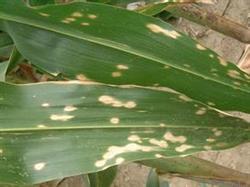
How to prevent and control corn gray leaf spot? A full analysis of the technical key points
Corn gray leaf spot can occur throughout the entire growth period, but the disease is most severe at the tasseling and grain-filling stages. In the early stage of the disease, water-soaked light brown spots appear. These streaks extend parallel to the leaf veins, are often rectangular, and are more obvious when held up to the light. The center of the lesion is gray, and the edge has a brown line. The lesion size is 2-4 x 10-24 (mm), and...
-
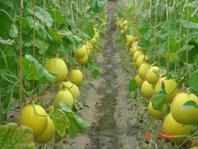
Key Technical Points for High-Yield and High-Efficiency Cultivation of Thin-Skinned Melons in Cold Greenhouses
Thin-skinned melons have traditionally been cultivated by letting the vines trail on the ground, with the vines growing in a tangled and crisscrossing manner that is very difficult to manage, and the yield is also low. When thin-skinned melons are cultivated in cold greenhouses, using the trellising method just like growing cucumbers in large greenhouses, higher yields and economic benefits have been achieved, with an average of 667 sq m producing over 5,000 kg of melons, and a net benefit of...
-
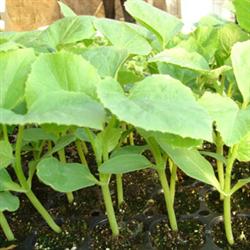
Open-field sowing methods and technical key points for melons
Open-field melon sowing method: open-field melons are grown using plastic film mulching with a water-and-dry bed system. Generally, the water bed is 0.5 m wide, the dry bed is 1.5-1.8 m, and the furrow is 20 cm deep. A north-south orientation of the beds is best. Before forming the ridges, open a small furrow (8-10 cm) with a small plow on both sides of the dry bed at 30 cm from the ridge edge line and apply organic fertilizer. The ridge height is 20 cm, the top opening of the water furrow is about 50 cm wide, and the depth is...
-
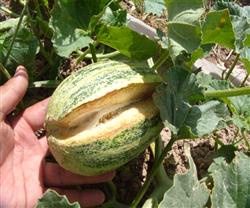
Detailed Explanation of the Key Technical Points for the "Three-Avoidance" Cultivation of Melons
Scientific fertilization. According to the fertilizer and water requirements during the melon's growth period, supply fertilizer and water in a balanced manner; do not irrigate or fertilize blindly. When fertilizing, not only should sufficient base fertilizer be applied to meet the needs of the melon's early growth, but also timely topdressing should be carried out in the later stage of melon growth to meet the fertilizer requirements of the melon's later growth. Reasonable irrigation...
-
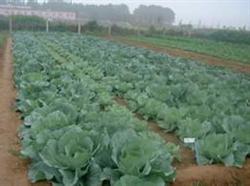
How to grow strong seedlings of spring cabbage? Detailed explanation of technical management measures
Currently it is the seedling-raising period for spring cabbage, and the following technical key points should be grasped in production. Select good varieties: choose selected 8398, Chungang No. 2, Chungang No. 3 and other varieties with strong cold resistance, disease resistance and strong winter hardiness. Prepare the seedbed: choose a field with fertile soil that has not grown cruciferous vegetables in the previous year as the seedbed, ...
-
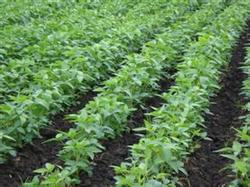
Soybean Disease Control Measures and Technical Key Points
Soybean Sclerotinia Stem Rot Soybean sclerotinia stem rot mainly infects the stems, and symptoms usually begin to appear in late July. In the early stage of infection, brown lesions appear on the stems, after which white cottony mycelium and white granules develop on the lesions, later turning into black granules (sclerotia). When the diseased plant stem is cut lengthwise, black cylindrical sclerotia resembling mouse droppings can be seen. After the diseased plant dies...
-
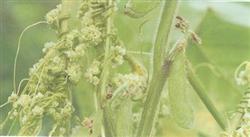
Dodder Control Methods and Technical Key Points in Soybean
Dodder, also called yellow silk vine or tangling silk vine, is a malignant weed. It harms many crops and can cause total crop failure in soybean, and it occurs commonly in all regions. (1) Morphology: The stem of soybean dodder is yellow, orange-yellow or yellow-green, smooth and hairless, thread-like, and coils leftward around the host stem. The leaves are reduced to membranous scales. The flowers...
-
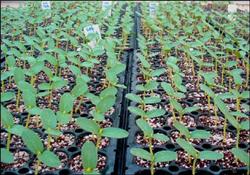
Detailed Explanation of Key Technical Points for Raising Muskmelon Seedlings in Early Spring
To prepare the nutrient soil, use fertile soil that has never been planted with melons or vegetables and fully fermented and decomposed chicken manure or human waste, sift and mix them thoroughly at a ratio of 7:3. For each cubic meter of nutrient soil, add 2.5 kg of superphosphate, 0.5 kg of potassium sulfate, and 15-20 g of 95% hymexazol. To build an electric heating hotbed, 24-26 sq m of seedbed is needed per mu of field. The seedbed is wide 1...
-
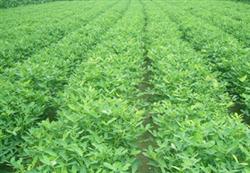
Key Technical Points and Fertilization Methods for Topdressing Summer Peanuts
Fertilization should follow the "two topdressings, one spray, four supplements" approach. Specifically: the two topdressings are, first, early topdressing before the peanut plants form a full cluster, with 10 kg urea, 15 kg diammonium phosphate and 10 kg potassium chloride; the second topdressing is at the early stage of young pod swelling, generally 10 kg urea per mu. The one spray is in the late growth stage, per mu...
-
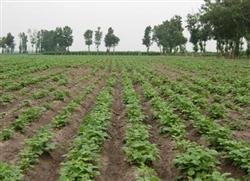
Methods and key technical points for applying sufficient basal fertilizer to mung beans
Although mung bean rhizobia have nitrogen-fixing ability, applying additional farmyard manure and phosphorus and potassium fertilizers has a clear yield-increasing effect. Before sowing, apply 2500 kg of farmyard manure, 20 kg of phosphate fertilizer and 1 kg of biological potassium fertilizer per mu as basal fertilizer. For fields where there is not enough time to apply basal fertilizer, during the early growth stage, that is, the branching and early flowering stage, apply 7.5 kg of ternary compound fertilizer per mu as topdressing...
条件筛选