Detailed Explanation of Key Technical Points for Raising Muskmelon Seedlings in Early Spring
To prepare the nutrient soil, use fertile soil that has never been planted with melons or vegetables and fully fermented and decomposed chicken manure or human waste, sift and mix them thoroughly at a ratio of 7:3. For each cubic meter of nutrient soil, add 2.5 kg of superphosphate, 0.5 kg of potassium sulfate, and 15-20 g of 95% hymexazol. To build an electric heating hotbed, 24-26 sq m of seedbed is needed per mu of field. The seedbed is wide 1...
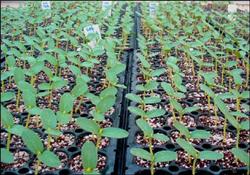
Preparing the nutrient soil: use fertile soil that has never been planted with melons or vegetables and fully fermented and decomposed chicken manure or human waste, sift and mix them thoroughly at a ratio of 7:3. For each cubic meter of nutrient soil, add 2.5 kg of superphosphate, 0.5 kg of potassium sulfate, and 15-20 g of 95% hymexazol.
Building the electric heating hotbed: 24-26 sq m of seedbed is needed per mu of field. The seedbed is 1-1.2 m wide, 10-12 m long, and 12 cm high. First lay a layer of plastic film on the bed bottom, evenly scatter dry wheat husks or sawdust 3 cm thick on the film, then lay another layer of plastic film on top of the wheat husks, spread clean coarse sand or gravel 2 cm thick on the film as an irrigation water layer, cover with nutrient soil 10 cm thick, then irrigate. After the water seeps through, cut blocks 10 cm square and lay the electric heating wire. Along the side rows of the seedbed, lay one line every 10 cm in width; in the central part, lay one line every 20-30 cm in width. After straightening, press them into the slits between the cut blocks of the seedbed, at a depth flush with the bed surface, or 0.1-0.3 cm below the bed surface. Connect the electric heating wire externally to a temperature controller and power supply. Build a small arched shed over the seedbed, and cover it with straw mats and film at night for insulation. Laying the electric heating wire on the bed surface can directly heat the soil around the seeds. Because plastic film and dry wheat husks are laid under the nutrient soil, heat is prevented from transferring downward, saving electricity. After power is turned on, the soil temperature is high, the seeds germinate quickly, emerge early, have well-developed root systems, and the seedlings are short and sturdy.
Seed disinfection and germination acceleration before sowing: the seeds to be sown should have impurities and inferior ones removed, and be sun-dried for 1-2 days. After sun-drying, soak the seeds for 30 minutes with "Tianda 2116" (200-fold solution, special type for soaking and mixing seeds) mixed with 95% hymexazol (3000-fold solution), then soak them for 30 minutes in warm water at 55°C, and finally continue soaking them for 4-5 hours in clean water at 30°C. Remove and drain, place them in a constant-temperature chamber at 25-30°C to accelerate germination. After 24 hours, place them again in a freezing box and freeze at -2-0°C for 4-6 hours, then put them into well water to warm back up for 20 minutes, drain the water and continue to accelerate germination. After 12 hours, freeze them once more. When most seeds have sprouted white, they can be sown. Use warm water to infiltrate and irrigate the seedbed until the soil surface changes color. Place 1 seed flat in the exact center of each nutrient soil block, with the radicle facing downward or to the side. After sowing, cover with soil 1.5-2 cm.
Seedbed management: after sowing, turn on the electricity for heating, and cover the outside with straw mats plus plastic film for insulation, keeping the temperature at about 25°C to facilitate early emergence. After the seedlings emerge, cut off the power; as long as the bed temperature is not lower than 15°C, generally do not turn the power on again. During the day, remove the straw mats and withdraw the small arched shed film to let the melon seedlings receive more sunlight; at night, cover with double-layer anti-drip film and straw mats for insulation. Control the bed temperature at 25-32°C during the day and 18-20°C at night, with the minimum not lower than 15°C. When the seedlings have more than 2 true leaves, the anti-drip film can be removed at night and only straw mats kept, maintaining the temperature at 15-18°C and increasing the temperature difference, which helps differentiate female flowers. For seedlings cultivated with double-vine or multi-vine pruning, pinch off the growing tip at the 4-5 leaf stage, and they can be transplanted with side vines. For melon seedlings with single-vine pruning, transplant at the 3-leaf 1-heart stage. To cultivate strong seedlings, during the seedling-raising period the opaque covers should be removed as early as possible and put on as late as possible, to extend the light exposure time. At the 2-leaf stage of the seedlings, spray 1-2 times with "Tianda 2116" (1000-fold solution, special type for strong seedlings) mixed with 95% hymexazol (3000-fold solution), to prevent and control seedling-stage diseases and promote strong seedlings. If planting in continuous cropping, to prevent soil-borne diseases such as Fusarium wilt, use black-seed pumpkin as rootstock and cultivate grafted seedlings.