How to grow strong seedlings of spring cabbage? Detailed explanation of technical management measures
Currently it is the seedling-raising period for spring cabbage, and the following technical key points should be grasped in production. Select good varieties: choose selected 8398, Chungang No. 2, Chungang No. 3 and other varieties with strong cold resistance, disease resistance and strong winter hardiness. Prepare the seedbed: choose a field with fertile soil that has not grown cruciferous vegetables in the previous year as the seedbed, ...
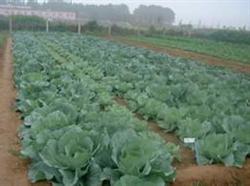 The sowing and seedling-raising period of spring cabbage is in the cold winter season. To avoid freezing damage and ensure safe production, in recent years we have adopted improved small cold frames to cultivate high-quality strong seedlings and achieved successful experience. The improved new-style small cold frame has the characteristics of fast heating and good heat preservation. Compared with the previous simple seedbed, it has higher light transmittance and stronger light, and can increase the seedbed temperature by 3-5°C. Farmers call it a "small greenhouse". The supporting techniques are introduced as follows:
I. Selection of bed site
For the improved small cold frame, the bed site should be selected in a field that is sheltered from wind and faces the sun, has convenient irrigation, fertile soil, and whose previous crop was not a cruciferous crop.
II. Facility materials
25-30 small bamboo poles 2 m long, or 12-14 bamboo poles 3 m long. 6-7 kg of 10# iron wire and 3-4 kg of 12# iron wire. 8-10 wooden stakes 50-60 cm long with a transverse diameter of 6-8 cm, and 3-5 wooden poles 2 m long with a transverse diameter of 6-8 cm. 50-75 kg of corn or sorghum straw, and 0.5-1 kg of binding wire or binding rope.
III. Construction of the cold frame
1. Basic structure: an improved small cold frame is composed of three parts: the frame, the covering material, and an additional windbreak wall. The frame includes the wall frame, tension wires, arch rods and wooden stakes. The covering material is greenhouse film. The windbreak wall, also called a wind screen, is usually made by tying corn or sorghum straw and is set outside the north wall of the cold frame to block and slow the invasion of cold wind from the north.
2. Specifications: the small cold frame faces south with its back to the north. The north wall is 75-90 cm high, the south wall is 15-20 cm high, and the east and west gable walls gradually increase in height from south to north. The size of the cold frame varies with the transplanting area. For every 1 mu of field to be transplanted, a seedbed area of 12-15 sq m is needed. Usually, building one small cold frame 8-10 m long from east to west and 2.5-3 m wide from north to south can cultivate high-quality strong seedlings for 2 mu of field. The windbreak wall is about 12 m long from east to west and 2 m high.
3. Construction: mainly building earthen walls. After the bed site is marked out, dig soil around the outside of the bed to build the walls, tramping it firmly while building, so that the north wall is 60-70 cm higher than the south wall, and the east and west gable walls form a single slope that is high in the north and low in the south. After the wall frame is built, cut it into a relatively smooth wall surface, with a wall thickness of about 35 cm. Then level the ground. Finally, make the windbreak wall. The method is to first draw a line 1 m behind the north wall, with its length exceeding the north wall by 2 m, then dig 3-5 pits at equal distances on this line, plant 2 m long wooden poles, tie 2-3 runs of iron wire on the poles, and tie crop straw to the iron wire to form the windbreak wall.
4. Fertilizing and making beds: apply 500-700 kg of manure soil with high organic matter content, 10-15 kg of special fertilizer for vegetables, or 1 kg of urea, 10 kg of superphosphate, and 5 kg of potassium sulfate into the bed. After fertilizing, rake the ground level so that soil and fertilizer are mixed evenly, then make the beds. For convenience of management, generally 2 small beds can be made inside the cold frame.
5. Select good varieties: for spring cabbage cultivation, in order to bring it to market earlier and increase benefits, early-maturing or mid-early-maturing varieties should be selected that have strong winter hardiness, tolerance to low temperature and weak light, resistance to premature bolting, good quality and disease resistance. For example: Zhonggan No. 10, No. 11, No. 15 and No. 21, paired with foreign small varieties such as Tieqiu, Zanmei, and Qishi. The seeding rate per mu of field is 50-60 g.
6. Sowing: the suitable sowing period is mid-to-late December. It is appropriate that after sowing there are 10-15 days of emergence and growth before "Minor Cold". Before sowing, first water the seedbed thoroughly, and after the water infiltrates, refill and level the bed surface with nutrient soil, then sow. The sowing rate in the seedbed is 3-4 g per sq m. The sowing rate should be strictly controlled to prevent the seedlings from becoming thin and weak due to excessive density. After sowing, cover with soil to a thickness of 0.5-0.7 cm.
7. Covering: first use 10# iron wire to stretch 3-4 runs of tension wires on the east and west walls at intervals of 0.7-0.8 m, tie both ends to the large ends of the wooden stakes and fasten them to the outside of the gable walls. Then use small bamboo poles to tie 12-14 arch rods on the iron wires at intervals of 0.7-0.8 m. Finally cover with greenhouse film. First dig a trench in front of the south wall to bury and press the front film edge firmly; the side on the north wall is used for ventilation and as an entrance and exit for labor during seedbed management, so the film edge can be laid flat on the wall surface and pressed firmly with bricks; for ventilation, stretch 5-6 runs of film-pressing lines on the film surface to prevent it from being lifted by wind.
8. Seedbed management: do not ventilate from sowing until the first true leaf appears. After the first true leaf appears, begin ventilation, with the vent gradually increasing from small to large for hardening. During this period, keep the seedbed temperature at 15-20°C during the day and 8-10°C at night. After that, depending on seedling condition, choose noon on a sunny day for thinning and weeding. Thinning mainly removes yellow, thin, weak and small seedlings. The new seedling-raising method changes the past one-stage seedling raising without pricking out into two-stage cultivation through pricking out to achieve high-quality strong seedlings. One week before pricking out, prepare the pricking-out bed. Seedbed requirements: fertile, loose, level soil, and conduct one soil treatment to sterilize and kill insects and increase the seedling survival rate. Three days before pricking out, appropriately lower the nighttime temperature of the seedbed, then harden again to enhance adaptability. Prick out at the 3-true-leaf stage of the seedlings. Choose fine weather and use the method of pricking out the larger seedlings. That is, select large seedlings in the seedbed for transplanting, leaving the small seedlings to continue growing. When pulling seedlings, handle them gently, do not damage leaves or roots, and carry as much original soil as possible. Method: first open a furrow and water, then plant the seedlings and cover with soil. The plant and row spacing is 8 cm square. After pricking out, cover with a small arched frame and pay attention to heat preservation and cold protection. Do not ventilate for 3 days; after 3 days, depending on seedling condition, ventilate slightly for hardening. Keep the seedbed temperature at 14-15°C during the day and 7-8°C at night. 10-15 days before transplanting, carry out large ventilation to harden strong seedlings. First enlarge the ventilation to harden the seedlings for adaptability to the field environment for 5-7 days, then remove all covering materials so that the seedlings enter an open-field environment. When the seedling age is 60-70 days and the seedlings meet the appearance standard of "thick and strong stems with 6 leaves, thick leaves with green color, well-developed roots and no pests or diseases", transplant the strong seedlings.