-

Symptom Identification and Control Methods for Impatiens Downy Mildew
[Symptoms] Mainly affects the stem. At first, oily dark green streaky patches appear at the root-stem junction, rapidly expanding into irregular dark brown areas; in severe cases, the entire stem and leaves turn black, the plant quickly collapses, and the root crown becomes sunken, causing the plant to lodge and die. Under saturated humidity persisting for a long time, sparse white mold grows on the diseased areas, which are the pathogen's sporangiophores and sporangia. [Morphological characteristics of the pathogen] It grows rapidly and produces abundant spores on CMA, OMA, and V4A media, while on PDA medium it grows
-
Symptom Identification and Control Methods for Southern Blight in Impatiens
Southern blight in impatiens attacks the roots, stems and fruits of plants, causing damping-off, root rot, basal rot and fruit rot. This disease can also harm plants such as iris, orchids, peonies, peaches and plums. Symptoms: In the early stage of the disease, a brownish-black wet rot appears at the base of infected plants, later followed by white silky mycelium and the formation of sclerotia the size of rapeseeds. In the late stage of the disease, severely infected plants collapse with damping-off. Pathogen: The pathogen is Sclerotium rolfsii Sacc., belonging to the Deuteromycotina
-
Identification and Control of Powdery Mildew and Brown Spot on Impatiens
Powdery mildew symptoms: It mainly damages the leaves, but flowers and stems can also be affected. On impatiens leaves, round white mold spots first appear, generally starting in May; after June, the spots expand or several spots merge into patches, each layer thickening to form a white powdery mold layer. The mold layer can form on both the front and back of the leaves. By early autumn, small yellow round dots form within the white powdery layer, then gradually darken and finally turn dark brown. In severe cases, the leaves wither and fall early. Pathogen and occurrence pattern: The pathogen belongs to the Ascomycotina, and powdery mildew is caused by Sphaerotheca. Asco
-
Identification of Symptoms and Control Methods for Powdery Mildew on Impatiens
Symptoms This disease mainly occurs on the leaves and tender shoots. It generally begins in June, and after July the leaf surface becomes covered with a white powdery layer. Subsequently, small yellow granules form within the white powdery layer, and the color gradually deepens, finally turning dark brown. Transmission route The pathogen overwinters in diseased plant residues and seeds. The following year, when environmental conditions are suitable, the pathogen spreads via wind and rain. August to September is the peak period of the disease. Control methods 1. Do not plant too densely, provide appropriate ventilation, strengthen fertilizer and water management, and enhance the disease resistance of the plants. Remove diseased leaves and diseased plants
-
Symptoms, Identification, and Control Methods of Leek Anthracnose
Anthracnose is an important disease of leek, widely distributed and commonly occurring. It usually occurs very mildly, with no obvious impact on production; only in individual plots or when there is more rain during the growing period does the disease become severe, with 100% of plants infected, and some leaves dying from the disease, significantly affecting yield and quality. [Symptoms] This disease mainly infects leaves and leaf sheaths. Initially, small white spots appear on the surface of leaves or leaf sheaths, which later develop into nearly oval to long spindle-shaped or irregular white necrotic dead spots, with a distinct boundary between diseased and healthy tissue. Finally, black
-
Identification and Control Methods for Common Rhododendron Diseases
The main diseases of rhododendrons include root rot, brown spot, black spot, leaf blight, and iron-deficiency chlorosis. After a rhododendron suffers from root rot, its growth weakens, the leaves wilt and dry up, and water-soaked brown patches appear on the root surface; in severe cases, soft rot develops, and the roots gradually rot and peel, with the xylem turning black. This disease is most likely to occur under conditions of high temperature and high humidity. The control method is to strictly disinfect the potting soil before repotting, and to keep the soil loose and moist with good permeability, avoiding waterlogging. If an affected plant is found, deal with it promptly.
-
Symptom Identification and Control Methods of Ginger Anthracnose
Ginger anthracnose. On infected leaves, nearly circular or irregular water-soaked chlorotic lesions first appear mostly from the leaf tip or leaf margin, later joining together into irregular large patches; in severe cases the leaves may dry up. When humid, small blackish, slightly rough granular dots grow on the lesions, namely the pathogen's acervuli. The disease can also attack stems and leaf tips, forming short stripe-shaped lesions on stems and leaf tips that likewise bear small black dots; in severe cases the leaves may droop but remain green.
-
High-quality hybrid japonica rice Dianza 80 passes variety certification
The new high-quality hybrid japonica rice variety "Dianza 80", bred by the Yunnan Dian-type Hybrid Rice Research Center and the Gejiu City Seed Company, was approved at the fifth meeting of the fifth Yunnan Provincial Crop Variety Certification Committee. "Dianza 80" has a full growth period of 171 days. Plant height 94.5 cm, panicle length 19.6 cm, total grains per panicle 157 grains, filled grains per panicle 115.2 grains, seed setting rate 72%, 1000-grain weight 25 g; leaves erect at seedling stage, tolerant to fertilizer, uniform growth; flag leaf erect, compact plant type, strong till
-
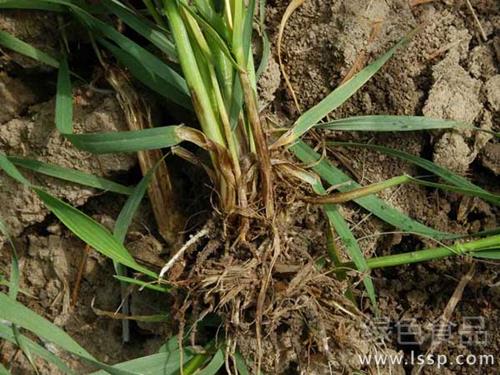
How to prevent and control wheat root rot? Identification of symptoms of root rot, stem blight and yellow leaves, and medication
How to prevent and control wheat root rot when roots rot, stems wither and leaves turn yellow
-
Identification and Control Methods of Cotton Stem Blight
Symptoms The disease occurs more severely in the Northeast cotton region, the Yellow River basin and the Yangtze River basin, and the cotton regions along the rivers and coast. Cotton can be affected throughout the entire growth period, with the seedling stage and bud stage suffering the most severe damage. When cotyledons and true leaves are infected, small round spots initially appear with purplish-red edges and grayish-white centers, after which the lesions expand or merge into irregular-shaped lesions. Some lesions develop concentric rings in the center, scattered with small black granules, which are the pathogen's pycnidia. The diseased parts often break apart and fall off. Under high humidity, water-soaked lesions appear on young tender leaves, then spread rapidly as if scalded by boiling water,
条件筛选