-
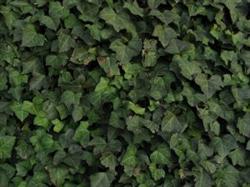
Detailed Explanation of Main Diseases of Kudzu Root and Their Control Methods
The dried root of the leguminous plant wild kudzu (Pueraria lobata (Willd.) Ohwi), also known as sweet kudzu, dried kudzu, and powder kudzu. Nature neutral, taste sweet and pungent. It has effects such as relieving muscles and reducing fever, promoting fluid production and quenching thirst, and promoting eruption of rashes. It mainly treats symptoms such as cold and fever, incomplete rash eruption, gastroenteritis, and high blood pressure. Its flowers are neutral in nature and sweet in taste, and have the effect of sobering up and stopping...
-
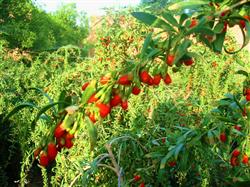
How to Fertilize Goji Berry? Detailed Explanation of Methods and Technical Key Points
When people mention goji berry, they think of the red goji berries, and few know that there is also a leafy vegetable goji whose tender leaves can be eaten. The vegetable goji is a deciduous shrub in the Solanaceae family, with a plant height of 1 m. The branches are slender, long, curved or drooping; young branches are angular, with gray outer bark, hairless, usually bearing short thorns born in the leaf axils. The leaves are alternate...
-
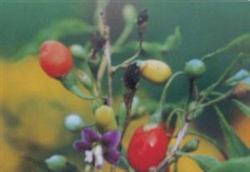
Control Methods and Technical Key Points for Goji Berry Anthracnose
Symptoms Goji berry anthracnose is commonly known as black fruit disease. It mainly damages green fruits, tender branches, leaves, buds, flowers, etc. When green fruits are infected, small black spots or irregular brown patches initially appear on the fruit surface. During continuous rainy weather, the lesions keep expanding, and half or the entire fruit turns black; when dry, the fruit shrivels; when humidity is high, many orange-red gelatinous dots grow on the diseased fruit; tender branches, leaf tips...
-
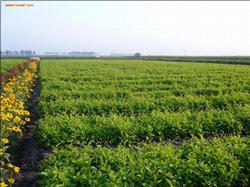
Detailed Explanation of the Techniques and Methods for Establishing Fast-Growing Goji (Wolfberry) Plantations
Goji has strong adaptability and can tolerate cold, drought, and salinity-alkalinity. It can grow in sandy loam, loam, loess, and sandy wasteland saline-alkali soils alike. Goji prefers a cool climate; it loves light and loves fertilizer. II. Propagation Methods. Goji flowers are solitary or several clustered in the leaf axils, with a pink or pale purple-red corolla bearing dark purple vein patterns; the pedicels are slender...
-
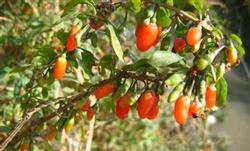
How to prevent and control wolfberry black fruit disease? These methods are very practical
Wolfberry black fruit disease damages the green fruit, flowers and buds of wolfberry, and also damages young shoots and leaves. From the early fruiting stage in early May to the late fruiting stage in mid-October, wolfberry can be infected by this disease. From May to June, when the daily average temperature is above 17°C, the relative humidity is around 60%, and there are 2~3 rainy days per ten-day period, the disease can occur in the field. From July to September, when the daily average temper...
-
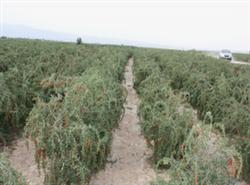
Control Methods and Key Technical Points for Black Fruit Disease of Goji (Lycium barbarum)
Goji root rot is widespread and causes serious damage. Plants killed by the disease account for 3%-5% each year, causing great losses to goji production. According to research by Lu Zhankui and others at the Ningxia Academy of Agriculture and Forestry Sciences, root rot symptoms fall into the following two types: (1) Root decay type. Roots or the root crown show varying degrees of decay and peeling, and the stem...
-
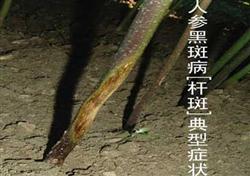
Identification Methods and Control Measures for Ginseng Diseases
Ginseng damping-off disease 1. Symptoms. Caused by infection with Rhizoctonia solani and Fusarium species. It prevents young seedlings from emerging, or after emergence attacks the stem of the seedling at the boundary between dry and moist soil 3-5 cm below the soil surface. The affected part is light yellowish-brown, gradually turning dark yellowish-brown, forming sunken elongated lesions that penetrate deep into the stem and cause rot; after enlargement the diseased...
-
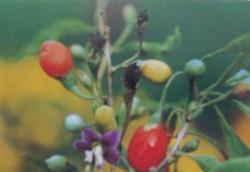
Control Methods and Technical Key Points for Black Fruit Disease of Goji Berry
Black fruit disease is one of the major diseases of goji berry (Lycium barbarum). The pathogen damages the green fruit, flowers and buds of goji berry, and also damages young shoots and leaves. After the green fruit of goji berry is infected, small black spots or black patches or black net-like patterns begin to appear. On cloudy and rainy days, the lesions expand rapidly, turning the fruit black and producing orange-red conidial masses, making it unfit for medicinal use. ...
-
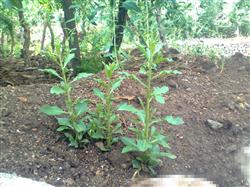
Management Methods and Technical Key Points for Young Goji Berry (Lycium barbarum) Plants
Trunk-establishing pruning: After the planted seedlings sprout, remove the sprouts below 30 cm above the base of the main trunk (the branching zone); above the branching zone, select and retain 3-5 lateral buds or lateral branches growing in different directions with a spacing of 3 cm-5 cm as the scaffold branches forming the small tree crown (the first layer of the tree crown), and at a plant height of 40 cm-50 cm...
-
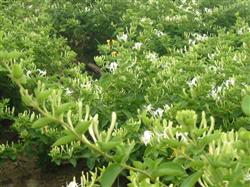
Honeysuckle Propagation Methods and Key Points of High-Yield Cultivation Techniques
Honeysuckle (Lonicera japonica Thunb.), also known as Japanese honeysuckle, Erhua, honeysuckle vine or mandarin duck vine, is a semi-evergreen twining liana of the genus Lonicera in the Caprifoliaceae family. Young branches are densely covered with coarse hairs and glandular hairs; leaves are opposite, ovate or ovate-lanceolate, 3-50n long, entire, with coarse hairs on both surfaces when young. Flowers are borne in pairs in leaf axils, corolla tubular, ...
条件筛选