Honeysuckle Propagation Methods and Key Points of High-Yield Cultivation Techniques
Honeysuckle (Lonicera japonica Thunb.), also known as Japanese honeysuckle, Erhua, honeysuckle vine or mandarin duck vine, is a semi-evergreen twining liana of the genus Lonicera in the Caprifoliaceae family. Young branches are densely covered with coarse hairs and glandular hairs; leaves are opposite, ovate or ovate-lanceolate, 3-50n long, entire, with coarse hairs on both surfaces when young. Flowers are borne in pairs in leaf axils, corolla tubular, ...
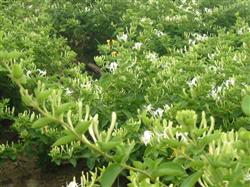
Honeysuckle (Lonicera japonica Thunb.), also known as Japanese honeysuckle, Erhua, honeysuckle vine or mandarin duck vine, is a semi-evergreen twining liana of the genus Lonicera in the Caprifoliaceae family. Young branches are densely covered with coarse hairs and glandular hairs; leaves are opposite, ovate or ovate-lanceolate, 3-50n long, entire, with coarse hairs on both surfaces when young. Flowers are borne in pairs in leaf axils, corolla tubular, bilabiate, white when first opening, later turning golden yellow. Berries are spherical, black when ripe. Flowering period is April-June, fruiting period is October-November. Honeysuckle leaves remain evergreen through winter without withering, hence the name "Rendong" (winter-enduring); in spring and summer it blooms continuously, first white then yellow, with white and yellow intermingled, and it is fragrant, making it a fine ornamental flower and bonsai material. Honeysuckle has strong adaptability and is not demanding about climate or soil; it likes light but also tolerates shade; its roots are deep, and it tolerates waterlogging, drought and cold, and can prevent soil erosion; it has strong sprouting ability; it grows best in moist, fertile, deep loamy soil.
1 Propagation Methods
(1) Seed sowing and seedling raising: When the fruit ripens in October, harvest it, wash off the flesh, air-dry the clean seeds and store them in sand, and sow in April in spring. Before sowing, soak the seeds in 25t warm water for a day and a night, take them out and mix with moist sand, place indoors, stir once a day, and sow when 30-40% of the seeds have germinated, then cover with grass, spray water once a day, and seedlings can emerge in 10d.
(2) Cutting propagation: Honeysuckle can be propagated by cuttings in spring, summer and autumn, but the survival rate in summer is low. Select 1-2 year old strong vigorous branches free of pests and diseases for cuttings, cut into about 20-30cm, remove the lower large leaves, open furrows at a row spacing of 20cm, furrow depth 10-20cm, insert obliquely into the furrow at a plant spacing of 2-3cm, leaving 10-15 cm of the aboveground part, fill with soil, tread flat, water to keep moist, and roots can form in half a month.
(3) Layering propagation: This method can be carried out in spring, summer and autumn. Press the vines into the soil 3-4cm, keep the soil moist, loosen the soil and weed in time, do not damage the new roots, and cut and transplant the following spring after rooting.
2 Cultivation Management
(1) Land preparation and planting: For high-yield cultivation of honeysuckle, choose relatively gentle terrain with deep, fertile, moist sandy loam for planting. Dig holes at a plant-row spacing of 100cm x l50cm, hole diameter 30cm, depth 30cm, and apply 3-5kr of organic fertilizer per hole. Plant 5-6 small seedlings per hole, or use 5-6 cuttings inserted straight in a fan shape. Water after planting and seal the soil.
(2) Field management: After honeysuckle cultivation survives, fertilize in combination with loosening the soil every early spring. The method is to open a shallow trench 30cm around the flower clump, apply fertilizer in a ring into the trench, then cover with soil, and shape the soil around the flower clump into a basin shape to retain fertilizer and water. Large flower clumps over 5 years old can be given 5kg of farmyard manure and 50-100g of chemical fertilizer, and small seedlings should be given less as appropriate. In spring and during the flowering period, pay attention to watering to prevent drought; before freezing, water once with freezing water and earth up to protect against cold. To increase flower yield, prune the tender branches every winter so that
the lower part gradually becomes thick and strong, forming upright growth, so that the growing branches and vines form an umbrella shape, which is conducive to ventilation and light penetration, more flowering, and convenient harvesting.
(3) Pest and disease control: The main disease of honeysuckle is brown spot disease. When it occurs, yellow-brown lesions appear on the leaves, mostly from July to August. For control, spray with 1:1.5:300 Bordeaux mixture or 0.2% solution of 65% zineb, and clear away fallen leaves to reduce the source of disease. The main pests are aphids, inchworms and longhorn beetles. Aphids and inchworms damage leaves and flower buds; for control, spray with 0.125% solution of 90% trichlorfon. But stop applying pesticide 20d before picking flowers. Longhorn beetles mainly damage the xylem, causing stems and leaves to wither and die. The control method is to spray the ground with derris extract or trichlorfon around Qingming Festival when the longhorn beetles emerge from the soil, and in summer and autumn when damage is found, cut off the infested branches and inject pesticide into the insect holes.
3 Harvesting and Processing
For honeysuckle harvesting, it is best to pick the flower buds that are about to bloom. There are two harvesting standards: one is when the upper part of the flower needle swells and turns white while the lower part is green, commonly called "two-white needle"; the other is when it turns completely white, commonly called "large-white needle". "Large-white needle" should be picked in time, otherwise it will open the same day; "two-white needle" can still be picked the next day. Picking too early or too late will affect the quality and yield of the flowers. Harvested flowers should be sun-dried or oven-dried in time, stored temporarily, then re-dried after moisture returns, cleaned of impurities, graded, packaged and stored. The harvesting of leaves and vines can be combined with pruning; in autumn and winter, cut part of the tender branches, dry them in the sun and use them as medicine.