How to Fertilize Goji Berry? Detailed Explanation of Methods and Technical Key Points
When people mention goji berry, they think of the red goji berries, and few know that there is also a leafy vegetable goji whose tender leaves can be eaten. The vegetable goji is a deciduous shrub in the Solanaceae family, with a plant height of 1 m. The branches are slender, long, curved or drooping; young branches are angular, with gray outer bark, hairless, usually bearing short thorns born in the leaf axils. The leaves are alternate...
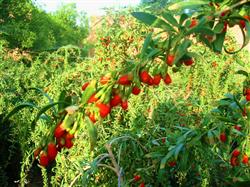 Goji berry has a long annual growth period, from mid-March to early November, going through important phenological processes such as flower bud differentiation, branch and leaf growth, flowering and fruiting, and root growth. Each process consumes large amounts of nutrients, and on top of that, some phenological periods overlap, for example: branch and leaf growth, flower bud differentiation, and flower bud and fruit growth all occur at the same time. Therefore, it requires many nutrients and has a long fertilizer supply period. If nutrient supply is insufficient, the newly sprouted branches will be short and weak, flower bud differentiation will be affected, the number of flowers will be reduced, flower and fruit drop will worsen, and the fruit will be small; it will also affect root growth and the photosynthetic capacity of the leaves. It not only affects the yield of the current year, but also directly affects the nutrient accumulation of the tree and the growth and fruiting of the following year. Fertilization is meant to continuously increase the nutrients in the soil, create good growing environment conditions for goji berry, so that it grows well, has more flowers and fruits, and yields high.
Types and timing of fertilization: In production, fertilizer types are divided into base fertilizer and topdressing. Base fertilizer is mainly farmyard manure, supplemented by chemical fertilizer. Farmyard manure mainly includes sheep manure, cattle and horse stable manure, oil residue (cake meal), and human excrement and urine. Farmyard manure can not only improve the soil and increase fertility, but is also a very good complete fertilizer that can supply the various nutrients needed for goji berry growth.
Base fertilizer is best applied in autumn, and old goji berry production areas all have the habit of applying base fertilizer in October. If there is not enough time to apply base fertilizer in autumn, it should be applied early in the following spring, together with a portion of quick-acting fertilizer, so that the fertilizer effect can take effect as soon as possible.
Topdressing is the application of quick-acting fertilizer during the growth and fruiting period of goji berry to make up for the shortage of base fertilizer. It is mainly quick-acting chemical fertilizer, supplemented by decomposed human excrement and urine. As for chemical fertilizers, nitrogen fertilizers include urea, ammonium sulfate, ammonium nitrate, and ammonium bicarbonate, etc.; phosphate fertilizers include superphosphate, triple superphosphate, etc.; potassium fertilizers include potassium sulfate, potassium chloride, etc. In addition, nitrogen-phosphorus-potassium three-element compound fertilizer, ammonium phosphate, and potassium dihydrogen phosphate two-element compound fertilizer, etc., are all very good fertilizers for goji berry.
Among the different nitrogen-phosphorus-potassium combination fertilizers applied to goji berry trees, the full nitrogen-phosphorus-potassium fertilizer gives the highest yield and the largest fruit, followed by the nitrogen-potassium fertilizer plot. Experiments show that adding potassium fertilizer on the basis of applying nitrogen and phosphorus fertilizer can promote the absorption of soil nutrients by goji berry trees, and adding potassium fertilizer is also beneficial to tree growth and development. Potassium fertilizer experiments also show that from before the goji berry leaves sprout until the end of fruit harvesting, supplementing potassium fertilizer is very necessary.
Goji berry trees require different fertilizers at each growth stage. From sprouting to before flowering, the main need is to satisfy the nitrogen requirement for branch and leaf growth; during the peak periods of flower bud differentiation, branch and leaf growth, and fruit growth and development, it is better to apply nitrogen, phosphorus, and potassium fertilizers in combination.
The timing of topdressing should be determined according to the growth and fruiting conditions of the tree. Late April to early May is the period of new branch and leaf growth and flower bud formation on old eye branches, and the first topdressing is needed, mainly with urea, combined with an appropriate amount of phosphate fertilizer; early June to the end of July is the peak period of the year for massive new branch growth, flower bud formation, and flowering and fruiting, and also the peak period for massive fruit expansion and growth, requiring sufficient nitrogen, phosphorus, and potassium fertilizers. If fertilizer is insufficient, it will affect growth and worsen flower and fruit drop. If in early August the goji berry has much new branch growth and quite a few flower buds, in order to promote autumn fruit growth, another application of nitrogen-phosphorus-potassium fertilizer should be made at this time.
In order to alleviate the contradiction of insufficient tree nutrients, starting from early June, throughout the peak flowering and fruiting period, foliar topdressing should be carried out once every 15-20 days, which has a very good effect on preserving flowers and fruits and increasing yield.
Fertilization amount: The fertilization amount for goji berry should be determined according to canopy size, growth vigor, and soil properties, etc. Generally, the fertilization amount is more for large trees than small trees, more for weak trees than vigorous trees, more for trees bearing more fruit than trees bearing less fruit, and more for barren sandy soil than deep, fertile loam. Because goji berry has a long growth and fruiting period in a year, regularly supplying sufficient fertilizer and water will be more conducive to growth and flowering and fruiting, and it is easy to obtain high and stable yields.
Fertilization methods: The application methods for goji berry base fertilizer mainly include three types: ring trench application, half-ring trench application, and strip trench application. After the fertilization trench is dug, put in the base fertilizer, spread it evenly in the trench, mix it well with the soil, and then cover it with soil on top. For root topdressing, hole application or trench application is generally used, that is, below the edge of the canopy, use a shovel to make 3-4 holes or on both sides of the canopy? Dilu Jiemei Chan? 0 cm deep fertilization trench, apply quick-acting nitrogen and potassium fertilizers or nitrogen-phosphorus-potassium compound fertilizer, and then cover. Irrigate immediately after fertilization so that the roots can absorb the fertilizer as soon as possible. Phosphate fertilizers (superphosphate, bone meal, etc.) easily combine with iron and calcium in the soil to form insoluble phosphates and are fixed in the soil, and are not easily absorbed by the roots. Therefore, phosphate fertilizer should be applied promptly before the goji berry needs fertilizer, or mixed into organic fertilizer for application, using the organic acids in the organic fertilizer to increase its solubility and facilitate root absorption. Foliar topdressing is also called foliar spraying. This method is simple and easy to carry out, uses a small amount of fertilizer, and has a quick fertilizer effect. Some fertilizers (urea, potassium dihydrogen phosphate, etc.) can be mixed with pesticides, saving labor and reducing costs.
The spraying method is: prepare nitrogen, phosphorus, and potassium three-element fertilizer into a 0.5% aqueous solution and spray it on the canopy. The best time for foliar spraying is on cloudy days or on sunny days before 11 o'clock in the morning and after 4 o'clock in the afternoon. Do not spray during the midday hot sun, so as to reduce leaf evaporation and facilitate full absorption by the leaves. On rainy days, spraying fertilizer is not suitable because of severe washing off.