Management Methods and Technical Key Points for Young Goji Berry (Lycium barbarum) Plants
Trunk-establishing pruning: After the planted seedlings sprout, remove the sprouts below 30 cm above the base of the main trunk (the branching zone); above the branching zone, select and retain 3-5 lateral buds or lateral branches growing in different directions with a spacing of 3 cm-5 cm as the scaffold branches forming the small tree crown (the first layer of the tree crown), and at a plant height of 40 cm-50 cm...
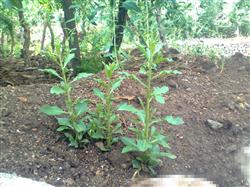
Trunk-establishing pruning: After the planted seedlings sprout, remove the sprouts below 30 cm above the base of the main trunk (the branching zone); above the branching zone, select and retain 3-5 lateral buds or lateral branches growing in different directions with a spacing of 3 cm-5 cm as the scaffold branches forming the small tree crown (the first layer of the tree crown), and cut the top at a plant height of 40 cm-50 cm.
Summer pruning: From late May to late July, remove the sprouts below the branching zone of the main trunk every 15 days; shorten the retained lateral branches above the branching zone by cutting at a branch length of 20 cm to promote the sprouting of secondary branches for fruiting; from the vigorous branches (intermediate branches) growing upward on the lateral branches, select and retain 2-3 branches in different directions close to the main trunk (each with a spacing of 10 cm) as the main branches of the small tree crown, and cut the top at 30 cm to promote secondary branching for autumn fruit.
Soil fertilization: For newly built goji berry orchards, apply 100 g of nitrogen-phosphorus compound fertilizer per plant in early July; for 2-4 year old goji berry plants, apply 100 g-150 g of urea per plant in mid-April, 150 g-200 g of nitrogen-phosphorus compound fertilizer in early June, and 150 g-200 g of nitrogen-phosphorus compound fertilizer in mid-July. The method is to dig a trench 10 cm-15 cm deep at the outer edge of the tree crown, with a trench length of 30 cm, apply the measured chemical fertilizer into the trench, mix well with soil, then close the trench and irrigate. Autumn application of base fertilizer is carried out from late September to early October; dig symmetrical pits along the outer edge of the tree crown, with a pit length of 30 cm-50 cm (depending on the size of the tree crown) and a pit depth of 30 cm; apply 2 kg-5 kg of cake fertilizer, 5 kg-15 kg of sheep manure (varying with tree age), and 150 g of diammonium phosphate per plant, mix well with soil, then close the pits and prepare for winter irrigation.
Foliar fertilizer spraying: For 2-4 year old goji berry plants, spray growth regulators (Yemianbao, Penshibao, Fengchansu, etc.) once each in May, June, July, and mid-August, with 30 kg-50 kg of aqueous solution per mu. Timely pest control: For aphid control, use 50% monocrotophos 1000-2000 times solution or 40% omethoate 1000 times solution for crown spraying; for negative mud beetle control, use 20% fenvalerate 2000-3000 times solution for crown spraying; for rust mite control, use sulfur suspension concentrate 500 times solution for crown spraying. Timely irrigation: During the annual growth period (April-September), irrigate 5 times, with a water intake of 50 cubic meters per mu; winter irrigation (early November) with a water intake of 70 cubic meters per mu. Cultivation and turning of the orchard: From May to August, cultivate and weed 4 times at a depth of 15 cm; in September, turn and sun-dry the orchard once at a depth of 25 cm, and 15 cm under the tree crown, without injuring the base stem of the plants. Autumn pruning: In September, remove the vigorous shoots sprouting from the root crown, main trunk, and canopy layer of the plants.