Control Methods and Technical Key Points for Black Fruit Disease of Goji Berry
Black fruit disease is one of the major diseases of goji berry (Lycium barbarum). The pathogen damages the green fruit, flowers and buds of goji berry, and also damages young shoots and leaves. After the green fruit of goji berry is infected, small black spots or black patches or black net-like patterns begin to appear. On cloudy and rainy days, the lesions expand rapidly, turning the fruit black and producing orange-red conidial masses, making it unfit for medicinal use. ...
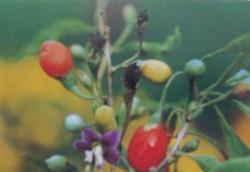
Black fruit disease is one of the major diseases of goji berry. The pathogen damages the green fruit, flowers and buds of goji berry, and also damages young shoots and leaves.
After the green fruit of goji berry is infected, small black spots or black patches or black net-like patterns begin to appear. On cloudy and rainy days, the lesions expand rapidly, turning the fruit black and producing orange-red conidial masses, making it unfit for medicinal use. On sunny days the lesions develop slowly, the lesions turn black, and the unaffected parts can still turn red. After flowers are infected, black spots first appear on the petals; in mild cases the corolla falls off and the plant can still bear fruit, while in severe cases the flowers become black, the ovary shrivels, and no fruit can be set. After buds are infected, small black spots or black patches appear at first, and in severe cases they become black buds that cannot open. After branches and leaves are infected, small black spots or black patches appear.
The pathogen overwinters in diseased fruit, and conidia can also overwinter on the surface of black fruit. It is mainly transmitted by wind and rain to nearby healthy flowers, fruit, buds and other parts, infecting the host and causing damage; temperature plays a promoting role in disease development. Goji berry can be infected by this disease from the early fruit stage in early May to the late fruit stage in mid-October. In the early stage (May-June), when the daily average temperature is above 17°C, the relative humidity is around 60%, and there are 2-3 rainy days per ten-day period, the disease can occur in the field. In the peak stage (July-September), when the daily average temperature is about 17.8-28.5°C, there are more than 4 rainy days per ten-day period, and the average humidity for two consecutive ten-day periods is above 80%, the disease incidence increases sharply. In the late stage (October to the first frost), when the ten-day average temperature is 9.2-14.6°C, as long as there is more than one rainy day in the field, the disease can still occur severely.
The control methods are: in winter, clean up the goji berry orchard, remove and burn diseased fruit, leaves, branches and so on; spray a 600-fold dilution of 50% Tuzet wettable powder; spray a 100-fold dilution of equal-amount Bordeaux mixture.