Identification Methods and Control Measures for Ginseng Diseases
Ginseng damping-off disease 1. Symptoms. Caused by infection with Rhizoctonia solani and Fusarium species. It prevents young seedlings from emerging, or after emergence attacks the stem of the seedling at the boundary between dry and moist soil 3-5 cm below the soil surface. The affected part is light yellowish-brown, gradually turning dark yellowish-brown, forming sunken elongated lesions that penetrate deep into the stem and cause rot; after enlargement the diseased...
Ginseng damping-off disease
1. Symptoms. Caused by infection with Rhizoctonia solani and Fusarium species. It prevents young seedlings from emerging, or after emergence attacks the stem of the seedling at the boundary between dry and moist soil 3-5 cm below the soil surface. The affected part is light yellowish-brown, gradually turning dark yellowish-brown, forming sunken elongated lesions that penetrate deep into the stem and cause rot; after enlargement the diseased part becomes dark brown, ring-shaped and constricted, cutting off the vascular tissue and causing the ginseng seedling to lodge and die. White mycelium can be seen wrapping around the diseased part and adhering to soil particles.
2. Control methods. First, select loose soil with a sand content of 15-20%, good aeration, strong water permeability, easy warming of the soil, and avoid excessive soil moisture to reduce conditions for disease development. Second, use land that has been rested for a year. After plowing, leave it fallow for one year so the soil fully decomposes and disease resistance improves. Third, seed treatment. Treat each kilogram of seed with 1-1.5 g of 95% Lüheng No. 1. Fourth, seed and seedling soaking. Before sowing, soak seeds and seedlings in 800 times dilution of 80% Lüheng No. 2 for 10-15 minutes. Fifth, soil disinfection. Before sowing, spray the bed surface with 3000 times dilution of 95% Lüheng No. 1. Sixth, after disease onset, spray with 600-800 times dilution of 80% Lüheng No. 2 to control the disease.
Damping-off
1. Symptoms. Caused by infection with Pythium species. In the early stage of the disease, water-soaked dark lesions appear on the young ginseng stems, spreading upward and downward from the soil surface; dark brown soft rot quickly expands, the affected area shrinks and softens, and finally the plant suddenly collapses and dies. If the ginseng bed is too moist, dense white cottony mold grows on the diseased part. After the dead plant rots, a layer of grayish-white mold-like material, namely mycelium, appears on the surface of and in the surrounding soil.
2. Control. First, ensure the ginseng bed drains well, the soil is loose, and there is ventilation and light penetration; prevent rain leakage from the ginseng shed and avoid excessive soil moisture to reduce conditions for disease development. Second, pull out diseased plants immediately to reduce transmission. Third, pour 3000 times dilution of 95% Lüheng No. 1 onto the roots of diseased plants. Fourth, after disease onset, spray with 800-1000 times dilution of 80% zineb to control it.
Phytophthora blight
1. Symptoms. Caused by infection with Phytophthora species. In the early stage, leaf lesions are water-soaked, without distinct margins, and dark green. When air humidity is high, a yellowish-white mold layer, namely conidia, appears on the diseased part; infected stems become water-soaked, gradually expand, soften and rot; after root rot, bacteria often invade and there is a fishy odor; in the later stage, white mycelium often appears on the outer epidermis. This disease spreads very quickly; 3-5 days after the central diseased plant is found, surrounding plants can be seen to be infected.
2. Control. First, strengthen field management. Prevent rain leakage from the ginseng shed, cover the bed surface with fallen leaves, create good ventilation and drainage conditions, and prevent the occurrence of Phytophthora blight. Second, promptly pull out the central diseased plants. Spray the diseased holes with 3000 times dilution of 95% Lüheng No. 1 to kill the pathogens. Third, during the rainy season, spray every 10 days with 1500-2000 times dilution of Shigao or 800-1000 times dilution of 58% metalaxyl-mancozeb wettable powder. Spray the front and back of leaves, stems, fruits, and the bed surface to prevent disease occurrence.
Black spot disease
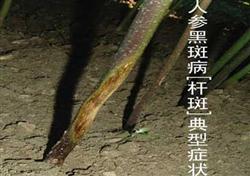
1. Symptoms. Caused by infection with black spot pathogens. In the early stage, nearly circular or irregular water-soaked spots appear on leaves, gradually expanding into large brown or dark brown lesions; in the later stage the center becomes pale yellowish-brown and easily ruptures after drying. They often merge with each other, causing the leaves to wither and die. Lesions on stems, leaves, and flower stalks are initially dark green elongated oval spots, gradually turning yellowish-brown and extending rapidly upward and downward; the center becomes sunken and black, and when air humidity is high, a layer of black mold-like material, namely the fruiting bodies of the pathogen, grows on them.
2. Control. First, promptly remove diseased leaves and fruits; burn diseased residues to eliminate sources of inoculum. Second, after ginseng leaves unfold, spray with 600-800 times dilution of 80% Lüheng No. 2 every 10 days to prevent disease onset. After disease onset, spray with 800-1000 times dilution of 58% metalaxyl-mancozeb wettable powder, spraying 2-3 times consecutively. Stem lesions can be cut off with a blade, and Lüheng No. 2 can be mixed into a paste and applied to control the spread of the disease. Anthracnose
1. Symptoms. Caused by infection with anthracnose pathogens. In the early stage, dark green small circular or nearly circular lesions appear on leaves, gradually expanding and turning brown, with a yellowish-white center and clear margins; sometimes the margin is reddish-brown and the center is light brown, with concentric rings, and small black dots form on them. When dry, they easily break and perforate; when rainy, they easily rot. Severely affected leaves have dense spots, and leaves often fall from the plant together with the petiole.
2. Control. First, promptly remove diseased residues to reduce sources of inoculum. Second, before seedling emergence, spray the bed surface with 3000 times dilution of 95% Lüheng No. 1 for disinfection. Third, after seedling emergence and leaf unfolding, spray with 600-800 times dilution of 80% Lüheng No. 2 every 10 days. After disease onset, spray with 800 times dilution of 80% zineb or 800 times dilution of 45% amobam, spraying 2-3 times consecutively to control the spread of the disease.
Rusty root rot
1. Symptoms. Caused by infection with rusty root rot pathogens. It damages the roots of ginseng. In the early stage, the lesions are small yellowish-white spots, gradually expanding and merging into irregular rust-like yellowish-brown lesions with slightly raised margins and a slightly sunken center, clearly demarcated from healthy tissue. In severe cases it causes dry rot and soft rot, making ginseng roots rot, so they cannot be used medicinally or produce no yield. After ginseng roots are infected, the aboveground part shows stunted plants, unexpanded leaves, and reddish-brown or yellowish-brown spots on the leaves, until the whole plant turns red, withers, and dies.
2. Control. First, select plots with high terrain, a slightly steeper slope, and good drainage to reduce conditions for disease development. Second, spray the bed surface with 3000 times dilution of 95% Lüheng No. 1 for soil treatment. Third, when replanting, select disease-free and injury-free seedlings; before planting, soak the seedlings in 800 times dilution of 80% Lüheng No. 2 for 10-15 minutes, let them dry slightly, and then transplant. Fourth, when shaping and trimming roots, mix 80% Lüheng No. 2 into a paste and apply it to the wounds to prevent disease onset.
Sclerotinia rot
1. Symptoms. Caused by infection with Sclerotinia species. It mainly damages the roots. In the early stage of infection, a small amount of white downy mycelium grows on the outside, while the inside becomes soft-rotted; later, irregular black mouse-dropping-like granules form, which are sclerotia. This disease spreads extremely quickly; in the early stage the aboveground part is almost the same as healthy plants and is difficult to identify early. When the aboveground stems and leaves show wilting, the ginseng roots are already badly rotted.
2. Control. First, select plots with high terrain and good drainage, loosen the soil early and frequently, and increase soil aeration. Second, before planting, apply 10-15 g each of dimethachlon and carbendazim per 1 sq m of bed surface for sterilization. Third, after disease onset, spray with 500-800 times dilution of dimethachlon or 800 times dilution of 80% zineb to control the spread of the disease.