-
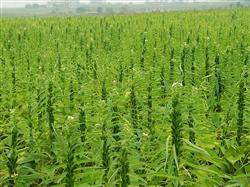
How to fertilize sesame for high yields? These key tips you need to know
To achieve high quality and high yields in sesame, scientific and rational fertilization is key. Production practice has proven that fertilizing sesame depends mainly on getting the timing and method right: the seedling fertilizer should be "early," the bud fertilizer should be "clever," and the flower fertilizer should be "heavy." The specific methods are discussed below for reference. Applying seedling fertilizer early: because sesame seeds are relatively small, plus...
-
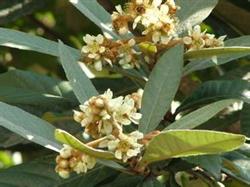
How to apply pre-flowering fertilizer to loquat? Only with proper application can high yields be achieved
The flowering period of loquat trees lasts as long as 3 months, with flowers blooming from October to February of the following year. Generally, the flowering period of loquat trees is divided into 3 stages. The first flowers open from October to November, and the fruit they bear is larger with good quality, but is susceptible to cold; the second flowers open from November to January of the following year, and the fruit quality is inferior to that of the first flowers, but the cold resistance is stronger, and the fruit-setting rate...
-
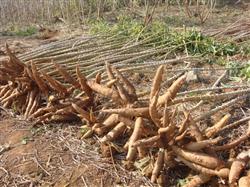
Cassava has a sure-fire trick for high yields: good seed stock produces good seedlings
Apply plenty of base fertilizer. Many people plant cassava on hillsides and dry land without applying any base fertilizer, letting it grow wherever it lands, so yields end up very low. To improve the returns from growing cassava, the land should first be plowed well, with a plant spacing of 1 m, holes dug, and plenty of mixed fertilizer such as chicken manure, plant ash and garbage sludge applied, one large bowl per hole, to lay a solid foundation for sprouting and tuber growth. Select good improved...
-
Want high yields from bayberry? Apply spring fertilizer in winter instead
1. The water chestnut bayberry gets its name because its fruit ripens to a purple-black color resembling a water chestnut. It is a famous superior variety in China, originating in Yuyao, and is the main cultivar of bayberry in Yuyao City, hence it is also called Yuyao bayberry. It has now been promoted throughout the province and in various southern provinces and regions. In Guizhou it is called science and technology bayberry, in Jiangxi it is called hybrid bayberry, and in Yunnan it is also known as large-tree bayberry...
-
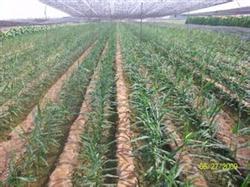
How to Grow Ginger in Northern China for High Yields? A Detailed Guide to Cultivation and Management Techniques
I. Pre-planting Preparation 1. Fine soil preparation and adequate basal fertilizer. It is advisable to choose a plot with fertile soil, good irrigation conditions, and no ginger blast disease, and to avoid continuous cropping as much as possible. On the basis of winter ploughing, carry out fine soil preparation early in spring, so that the soil is free of visible and hidden clods, loose on top and firm below. Increase the application of organic fertilizer, using high-quality chicken manure, manure from livestock pens free of diseased residues, cake fertilizer, and plant ash in combination; along with soil preparation, broadcast 4 cubic meters of high-quality decomposed chicken manure or 5000-10000 kg of high-quality pen manure as basal fertilizer. In high-fertility and high-water plots, open furrows at a row spacing of 60-65 cm ready for sowing, and apply 100 kg of soybean cake, 50 kg of ternary compound fertilizer, 50 kg of potassium sulfate, 2 kg of zinc fertilizer, and 1 kg of boron fertilizer in the furrows as seed fertilizer.
-
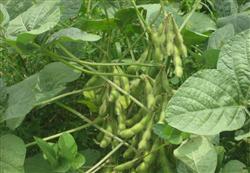
Spring planting fertilization tip: Effective potassium application boosts high yields in spring corn
Delayed senescence (staying green and late-maturing) refers to soybeans that, when they should be maturing, still have green branches and leaves with vigorous growth and seeds that are not yet plump, though not shriveled pods or shriveled seeds. The main cause of delayed senescence is excessive application of nitrogen fertilizer or application too late, causing excessive vegetative growth, delaying maturity, and affecting yield. To prevent delayed senescence in soybeans, it is necessary to timely...
-
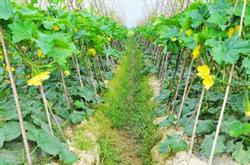
Master the fertilizer and water management methods for winter melon to easily achieve high yields
Fertilization: After planting, apply fertilizer once every 7 to 10 days on sunny days (10% to 15% human feces and urine, or 0.5% to 1% urea), with light applications in the early stage and heavier applications in the later stage. The key topdressing for winter melon should be carried out from vine training onto the trellis until the young fruit reaches 4 to 5 kg. During this period, in addition to drenching with human feces and urine, apply decomposed... per mu
-
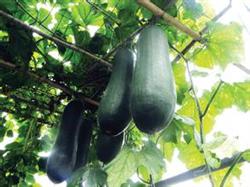
How to Grow Winter Melon for High Yields? Focus on Three Key Steps
Agricultural experts point out that to achieve high yields of winter melon, you should plant at a reasonable density, control diseases and the number of dead seedlings so that the final number of fruit-bearing plants is sufficiently large but not too dense; you should also fertilize reasonably and control various diseases, especially fungal diseases, so that the plants grow vigorously and the winter melon's expansion rate increases; and you should extend the lifespan of the winter melon plants as much as possible, thereby...
-
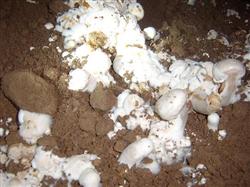
How can button mushrooms be cultivated to produce mushrooms in two flushes and achieve high yields?
Brown rot, also known as white rot, wet bubble disease, blister disease, etc., infects mushroom buttons when they are young, and the disease is caused by a fungus called Mycogone perniciosa. In the later stage, it forms irregular grayish-white "lumps" or deformed mushrooms, and a layer of "white fuzz" grows on the surface. That is, when the temperature of its pathogenic mycelium is above 20°C, in just 4-5 days...
-
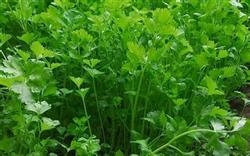
How to grow summer-sown coriander for high yields? Key techniques explained
Coriander prefers cool conditions; its growth slows when the temperature is above 20°C, and stops when it is above 30°C. Therefore, cultivating coriander in summer is quite difficult, and the following supporting cultivation techniques must be mastered. 1. Choice of variety: choose varieties that are drought-tolerant, fast-growing and slow to bolt, such as purple-stem coriander, Beijing coriander, North China large-leaf...
条件筛选