How to Grow Ginger in Northern China for High Yields? A Detailed Guide to Cultivation and Management Techniques
I. Pre-planting Preparation 1. Fine soil preparation and adequate basal fertilizer. It is advisable to choose a plot with fertile soil, good irrigation conditions, and no ginger blast disease, and to avoid continuous cropping as much as possible. On the basis of winter ploughing, carry out fine soil preparation early in spring, so that the soil is free of visible and hidden clods, loose on top and firm below. Increase the application of organic fertilizer, using high-quality chicken manure, manure from livestock pens free of diseased residues, cake fertilizer, and plant ash in combination; along with soil preparation, broadcast 4 cubic meters of high-quality decomposed chicken manure or 5000-10000 kg of high-quality pen manure as basal fertilizer. In high-fertility and high-water plots, open furrows at a row spacing of 60-65 cm ready for sowing, and apply 100 kg of soybean cake, 50 kg of ternary compound fertilizer, 50 kg of potassium sulfate, 2 kg of zinc fertilizer, and 1 kg of boron fertilizer in the furrows as seed fertilizer.
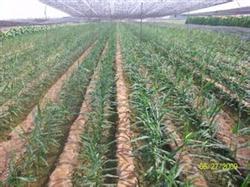
I. Pre-planting Preparation
1. Fine soil preparation and adequate basal fertilizer. It is advisable to choose a plot with fertile soil, good irrigation conditions, and no ginger blast disease, and to avoid continuous cropping as much as possible. On the basis of winter ploughing, carry out fine soil preparation early in spring, so that the soil is free of visible and hidden clods, loose on top and firm below. Increase the application of organic fertilizer, using high-quality chicken manure, manure from livestock pens free of diseased residues, cake fertilizer, and plant ash in combination; along with soil preparation, broadcast 4 cubic meters of high-quality decomposed chicken manure or 5000-10000 kg of high-quality pen manure as basal fertilizer. In high-fertility and high-water plots, open furrows at a row spacing of 60-65 cm ready for sowing, and apply 100 kg of soybean cake, 50 kg of ternary compound fertilizer, 50 kg of potassium sulfate, 2 kg of zinc fertilizer, and 1 kg of boron fertilizer in the furrows as seed fertilizer.
2. Carefully select ginger seed and cultivate strong sprouts. About 30 days before sowing, take the ginger seed out of the cellar, remove the soil from the ginger pieces, and select healthy ginger pieces that are plump, full, bright in skin color, fresh in flesh, not shriveled, not rotten, not frost-damaged, hard in texture, and free of pests and diseases as seed. Strictly discard seed ginger pieces that are thin and weak, shriveled, or whose flesh has turned brown or become soft. Each individual seed ginger piece is required to weigh 50-75 g, and generally 400-500 kg of seed ginger is used per mu.
3. Sunning and resting the ginger. In early March, choose a sunny day, at around eight or nine o'clock at noon, place the carefully selected ginger seed on ground with ample sunlight to dry, and in the evening bring it indoors and cover it with straw curtains to maintain moisture and darkness, promoting the decomposition of nutrients in the ginger pieces. Sun the ginger for 2-3 days and rest the seed for 8-9 days, maintaining the temperature at 10-15°C. During this period, the focus is on nutrient decomposition and promoting bud differentiation.
4. Sprout forcing. For the carefully selected and sunned ginger seed, soak the seed for 10 minutes in a 200-fold dilution of pesticides such as Jiangwensan, Shengjiangbao, and Lüba to achieve a sterilizing and disinfecting effect, then dry it and force sprouts. Place the ginger pieces in a basket lined with wheat straw for warmth, and force sprouts in a shed or a sunny seedbed, etc., maintaining air humidity at 80-85% and temperature at 22-25°C, keeping it higher first and lower later. After 20 days, when the ginger sprouts have grown to 0.5-1 cm, sow in batches according to sprout size.
II. Key Management Points from Sowing to Emergence
1. Sowing and film mulching. According to local air temperature, soil temperature, and the timing of late frost, film-mulched cultivation can be sown 20-30 days earlier than conventional sowing. In the central region of our province, sowing begins around May 1, and in the southern part of our province, sowing can be done from April 25-30. Before covering with film, apply 100-150 g per mu of a dedicated herbicide diluted in water and sprayed to eliminate weeds under the film. For the film, a film with a thickness of 0.005-0.006 mm and a width of 120 mm can be selected.
2. Appropriately sparse planting to enlarge ginger pieces. Appropriately reduce planting density to increase per-plant yield and promote large and uniform ginger pieces. The suitable planting density for high-yield plots is about 6500 plants/mu, with a row spacing of 50-55 cm and a plant spacing of 25 cm. For medium-fertility and medium-water plots, keep the row spacing at 45 cm and the plant spacing at 20 cm, with about 8000 plants per mu; the seed rate is generally kept at about 500 kg per mu.
3. Timely shading to promote growth. When 50% of the ginger has emerged, shade the ginger field in time to promote robust growth of the ginger seedlings. Using a shade net for shading provides even shading, does not damage the integrity of the film, and facilitates field management; the ginger seedlings grow vigorously. The specific method is as follows: make the shade net into strip-shaped panels and stretch them between the ginger rows, fixing both ends with bamboo poles, with a panel width of 60-65 cm; a shade net with a shading rate of 40% can be selected. Try to avoid shading with firewood and grass. This is because firewood and grass often carry diseased and pest-infested residues; in particular, corn borers overwintering in corn stalks are brought into the ginger field, increasing the base population of borers in the ginger field and making pest and disease control more difficult.
III. Key Management Points for the Mid-to-Late Growth Period
1. Apply a light seedling-promoting fertilizer and a heavy branching fertilizer. Apply an autumn supplementary fertilizer in early to mid-June along with watering, flushing 25 kg of urea per mu with the water to promote ginger seedling growth. In early to mid-July, remove the film and apply 50 kg of ternary compound fertilizer per mu. Before August 20, apply a supplementary 30 kg of potassium sulfate per mu, and water promptly after topdressing. In mid-September, according to the growth of the ginger seedlings, apply an appropriate amount of potassium fertilizer or nitrogen fertilizer as topdressing, and carry out foliar topdressing on the aboveground part, choosing potassium dihydrogen phosphate and spraying once every 7-10 days for 3-4 consecutive sprays, which serves to treat disease and prevent premature aging, extending the functional period of the leaves in the late growth stage.
2. Scientific watering. Because ginger likes a moist environment, there must be sufficient moisture in the field. To ensure smooth emergence of ginger, on the basis of thoroughly watering the bottom water before sowing, generally do not water before emergence, but wait until 70% of the ginger seedlings have emerged before watering; the specifics should be flexibly controlled according to the weather, soil texture, and soil moisture conditions. If the first watering is done too late, the ginger seedlings suffer drought and the sprout tips are prone to drying up. Because the film has a good moisture-preserving effect, it is not advisable to water too frequently during the seedling stage, and it is best to apply small amounts of water under the film. In summer, watering in the morning and evening is best; do not water at noon. At the same time, pay attention to timely drainage after rain. Around the Beginning of Autumn, ginger enters a period of vigorous growth and its water requirement increases; during this period, water once every 4-5 days, always keeping the soil in a moist state. To ensure that the ginger sticks to less soil after harvest and is easy to store, the last watering can be done 3-4 days before harvest. After applying the branching fertilizer, according to the growth of the ginger, timely carry out earthing up in 2-3 separate rounds to ensure the growing parts do not emerge above the soil surface and to promote rapid growth of the ginger pieces.
IV. Control of Major Pests and Diseases
1. Ginger blast disease. It is a devastating disease and also a major factor restricting the development of ginger. Integrated control measures should be the main approach; crop rotation can be used; drainage ditches can be dug for drainage and waterlogging prevention; or chemical control can be used, soaking the roots with a 1500-2000-fold dilution of medicines such as Yaofeisu, Shengjiangbao, Jiangwensan, and Lüba. When diseased plants are found, pull them out promptly, treat the soil with the above medicinal solutions, and mark the spot with lime, then after the ginger harvest, deeply bury the soil from that spot.
2. Insect pests. During the growth period, the main pests include ginger stem borers, beet armyworm, and ginger thrips, etc. Do a good job of timely monitoring of pest conditions and carry out chemical control before major outbreaks. Spray control can be done with pesticides such as Yee Bisha, Kuaishaling, and imidacloprid, applying once every 7-10 days.
V. Timely Harvest When the temperature in late autumn is 8-18°C, with clear autumn skies, ample sunlight, and a large diurnal temperature difference, this is precisely the key period for yield formation; appropriately extending the growth period increases yield. According to experiments, after Frost's Descent, for each additional day of delayed harvest, the average yield increases by 30-60 kg per mu. In the central part of our province, the best harvest period for ginger in the field should be around October 20-25; in the southern part of our province, it can be appropriately delayed by 3-5 days. Harvesting ginger at this time will neither freeze-damage the ginger pieces nor fail to make full use of this golden period for late-stage yield increase. Therefore, the optimal harvest timing must be grasped, and harvesting too early must be avoided. To facilitate storage and the return flow of nutrients, about 3 cm of stem can be left.
To increase yield, the autumn-delay method can also be used. Before the first frost, set up an arched shed over the ginger field and cover it with agricultural film to protect and delay, extending the ginger growth period and harvesting 20-30 days later, which can increase yield by more than 1000 kg per mu, bringing the per-mu yield to more than 6000 kg.
VI. Deep-Well Cellar Storage Ginger storage mostly uses dug cellars, which is a method with low investment, easy management, and simple operation. To store 20,000 jin of ginger, the cost is only 200-300 yuan. Generally 5-7 m deep, dig 2-3 ginger storage caves, maintain the cellar temperature at 11-13°C, and keep the relative air humidity above 90%. Before putting the ginger into the cellar, thoroughly clean the ginger caves and the bottom of the cellar; if it is too dry inside, sprinkle an appropriate amount of water to keep it moist. When putting it into the cellar, keep the ginger roots facing downward, and after everything is put in, cover the top with a layer of white sand to preserve moisture. To prevent ginger maggots and keep the ginger pieces and ginger heads fresh, sterilizing agents such as chlorothalonil and carbendazim can be applied in advance to treat the cellar caves. After the ginger is put into the cellar, keep the opening open, and seal it before Minor Snow.