How to apply pre-flowering fertilizer to loquat? Only with proper application can high yields be achieved
The flowering period of loquat trees lasts as long as 3 months, with flowers blooming from October to February of the following year. Generally, the flowering period of loquat trees is divided into 3 stages. The first flowers open from October to November, and the fruit they bear is larger with good quality, but is susceptible to cold; the second flowers open from November to January of the following year, and the fruit quality is inferior to that of the first flowers, but the cold resistance is stronger, and the fruit-setting rate...
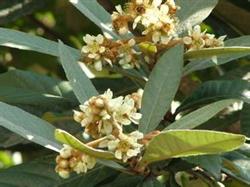 Loquat is a fruit tree unique to China, and a single mature loquat tree can yield as much as 200-350 kg. From late July to late August is exactly the period for promoting vigorous shoots and flower formation in loquat. Because the summer shoots are its main fruit-bearing mother branches, after the summer shoots sprout, they must be accelerated to grow robust and mature so they become excellent fruit-bearing mother branches. In terms of habit, the flower bud differentiation of loquat begins in early August, and applying pre-flowering fertilizer well is an important measure for preserving fruit and striving for a bumper harvest.
For a long time, fruit growers have been accustomed to fertilizing loquat in four applications, namely fruit-picking fertilizer, flower-promoting fertilizer, fruit-preserving fertilizer and fruit-sizing fertilizer. Now, in some places where labor-saving cultivation is adopted, should the pre-flowering fertilizer (that is, the flower-promoting fertilizer) for loquat still be applied? Based on the experience of high-yield orchards, for loquat fertilization, apart from the fruit-picking fertilizer being the most important application of the year, the pre-flowering fertilizer plays a major role and cannot be ignored. If the post-harvest fertilizer and pre-flowering fertilizer are both applied properly, the effect on increasing yield and fruit quality is significant.
The pre-flowering fertilizer for loquat has many functions. First, it replenishes the nutrients needed for flowering, because after the tree body has sprouted summer shoots and undergone flower bud differentiation in July-August, it has already consumed a relatively large amount of nutrients; in addition, each loquat panicle has many flowers, and the flowering period lasts more than 4 months, and flowering also requires the consumption of a relatively large amount of nutrients. Therefore, applying the pre-flowering fertilizer well is to replenish the nutrients needed when loquat blooms. Applying the pre-flowering fertilizer well helps delay flowering. In the southern loquat production areas, in most places the loquat flowers and fruit encounter low-temperature frost, and the flowers are more frost-tolerant than young fruit. Therefore, delaying the flowering period helps avoid the early low-temperature damage, enabling the late-opening loquat flowers to increase the fruit-setting rate, thereby ensuring stable yield and a bumper harvest. If the pre-flowering fertilizer is applied in a timely manner, it can promote a strong tree vigor, dark green leaf color, and improve the freezing resistance of the fruit tree.
When applying the pre-flowering fertilizer, seize the most suitable time from early September to early October. The amount applied should account for about 20% of the total annual fertilizer application. For loquat orchards with biological mulching, because the mulch can provide a large amount of organic matter and other nutrients, and avoids rain erosion, so fertilizer loss is also small, therefore applying urea and compound fertilizer for the pre-flowering fertilizer is sufficient. For orchards without mulching, because rain erosion causes greater nutrient loss, in addition to increasing the application of the three elements nitrogen, phosphorus and potassium, attention should also be paid to increasing the application of organic fertilizer, potassium fertilizer and lime. Generally, apply per tree barn
fertilizer 30-50 kg, urea 0.25-0.5 kg, plant ash 15-20 kg, calcium magnesium phosphate fertilizer 2-2.5 kg. In addition, for those red soil orchards with high clay content and soil that is too acidic with a pH value below 4.5, an additional 2-2.5 kg of lime can be applied per tree, which can neutralize the acidity, avoid deficiency symptoms caused by calcium deficiency, and help improve flower quality.
Foliar topdressing to supplement nutrients also has a significant effect. Among these, the most effective is spraying with 0.3%-0.5% urea solution or 10% human urine. If it can be sprayed 5-6 times consecutively, the effect is even better. In addition, 0.3% potassium dihydrogen phosphate solution, or 0.2% potassium sulfate solution, or 0.3%-0.5% superphosphate extract, or 10% plant ash extract can also be sprayed to supplement the tree's nutrients and improve freezing and cold resistance. For some orchards where only shoots grow but no flowers form, or where there is no fruit after flowering, paclobutrazol can be used to control shoots and promote flowering. The application methods include soil application or canopy spraying. For soil application, choose October, calculate according to the projected area of the canopy, and apply paclobutrazol at an effective content of 0.6-0.8 g per square meter, which can achieve the effect of controlling shoots and promoting flowering.