-
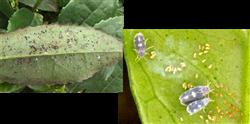
What are the control methods for the tea black spiny whitefly?
How to control the tea black spiny whitefly? Please advise. The tea black spiny whitefly causes obvious damage to the tender buds and tender leaves of tea. Generally, what is found causing damage on tea garden leaves is the nymph of the tea black spiny whitefly, and most tea farmers do not recognize the adult of the tea black spiny whitefly. The feeding damage of large numbers of adults directly affects the quality and yield of tea processing. ...
-
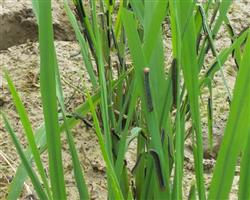
Main Pests and Control Methods for Rice in the Mid-to-Late Growth Stage
Which pests should be controlled in the mid-to-late growth stage of rice? Please provide an introduction and control methods. The pests to be controlled in the mid-to-late growth stage of rice are: 1. Control of rice planthopper: Rice planthoppers mainly inhabit the base of rice clumps, suck plant sap, causing rice plants to turn yellow and affecting yield. The control agents selected are: ① 25% Youlede wettable powder at 30 grams per mu: ② 25% sumicidin wettable powder at 100 grams per mu, mixed with 45 kg of water for spray control; ③ 20% yamailing emulsifiable concentrate at 100 mL per mu mixed with 45 kg of water for spray control; ④ saiqinone or 10% imidacloprid at 30 grams/mu mixed with 45 kg of water for spraying.
-
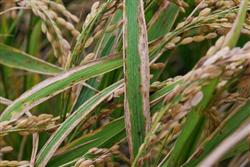
What are the control methods for the three major rice diseases?
How do you control the three major rice diseases? Please explain the control methods. The three major rice diseases can be controlled by referring to the following methods: 1. Rice blast (1) Leaf blast: dark green, nearly round or oval lesions, which later become slightly pointed at both ends; generally, when acute-type lesions appear or an infection center develops, especially in rice fields with high nitrogen fertilizer rates and tender, lush green growth, when the total number of leaf blast lesions occurring on 20 hills of rice during the entire growth period before heading reaches more than 400, spraying must be carried out, with an interval of 3 to 5 days, and continuous spraying 2 times.
-
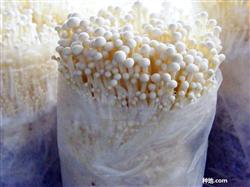
Control Methods for Black Spot Disease and Rust Spot Disease in Enoki Mushrooms
What to do when enoki mushrooms develop black spot disease and rust spot disease? Please advise. 1. Black spot disease: a bacterial disease caused by Pseudomonas bacteria. After infection, oval brown or dark brown spots appear on the caps of enoki mushrooms, initially needle-tip sized, expanding to 2-4 mm in diameter, with neat edges, and sometimes the caps crack. Control methods...
-
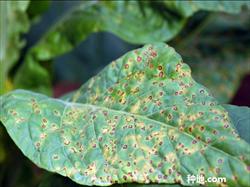
Control methods for tobacco wildfire disease and angular leaf spot
How to control tobacco wildfire disease and angular leaf spot? Tobacco wildfire disease and angular leaf spot are important diseases of tobacco. The two diseases are very similar in terms of pathogen characteristics, infection patterns and control methods. In the field, these two bacterial diseases often occur together and are relatively common in tobacco-growing areas across the country. Wildfire disease in...
-
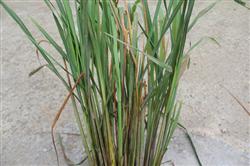
What are the control methods for bacterial leaf streak of rice?
How do you control bacterial leaf streak of rice? Please provide guidance methods. Symptoms of bacterial leaf streak of rice damage: it can occur from the seedling stage to the ear stage of rice. The lesions are yellow, initially yellow, then turning yellow-brown, until completely rotted. If the disease occurs before the heart leaf emerges, it cannot continue to grow upward and dies within the heart, forming a false dead heart, hence it is also called heart rot disease....
-
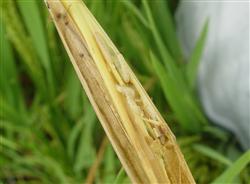
What are the control methods for the rice stem borer (Chilo suppressalis)?
How do you control the rice stem borer? Here are the control methods. The rice stem borer, also known as the stem maggot, can damage rice from the tillering stage to the milk-ripening stage, posing a threat to rice production and affecting both yield and quality. Doing a good job of controlling the rice stem borer is of great significance for promoting high rice yields and increasing farmers' income. The control methods are as follows:...
-
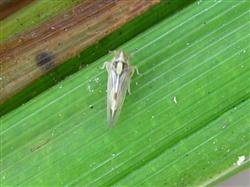
How to control rice planthoppers? A detailed guide to practical methods
How do you control rice planthoppers? Please provide an introduction to control methods. To control rice planthoppers, you can refer to the following methods: 1. Plant at a reasonable density, improve the field microclimate, and increase the rice plant's disease resistance. 2. Fertilize reasonably, control nitrogen fertilizer, increase phosphorus and potassium fertilizer, and apply topdressing skillfully, so that the rice grows and develops early and quickly,...
-
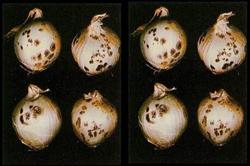
What are the control methods for onion anthracnose?
What control methods are there for onion anthracnose? Please introduce them. Onion anthracnose can be controlled by referring to the following methods: (1) Agricultural measures. In severely affected fields, rotate with non-allium crops and cultivate disease-resistant varieties. (2) Chemical control. Spray fungicides at the early stage of disease onset and before the rainy season. You can use 25% Shibaike emulsifiable concentrate at 1000 times dilution, or 50% prochloraz manganese salt (Shibaogong) wettable powder at 1500 times dilution...
-
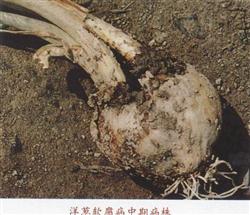
What are the control methods for onion soft rot?
How do you control onion soft rot? Please provide guidance. Onion soft rot can be controlled by referring to the following methods: 1. Early-stage control (1) Seedling preparation: choose disease-resistant varieties for raising seedlings in the nursery, eliminate diseased and weak seedlings, and cultivate healthy and strong seedlings. (2) Crop rotation selection: choose plots with good ventilation and light transmission, with relatively good previous crops such as corn and wheat; avoid continuous cropping, carrot stubble, and stubble of Liliaceae vegetables such as garlic, and try to avoid stubble such as autumn cabbage and potato that easily leaves soil-borne disease residues. (3) High-ridge planting: in areas where conditions permit, ridge planting is recommended, with onions transplanted on high beds, which can reduce waterlogging and lower the chance of pathogen infection. (4) Strengthen field management: timely cultivation and weeding, increase soil temperature, promote onion development, and help the onion population resist invasion and infection by soft rot pathogens.
条件筛选