What are the control methods for the three major rice diseases?
How do you control the three major rice diseases? Please explain the control methods. The three major rice diseases can be controlled by referring to the following methods: 1. Rice blast (1) Leaf blast: dark green, nearly round or oval lesions, which later become slightly pointed at both ends; generally, when acute-type lesions appear or an infection center develops, especially in rice fields with high nitrogen fertilizer rates and tender, lush green growth, when the total number of leaf blast lesions occurring on 20 hills of rice during the entire growth period before heading reaches more than 400, spraying must be carried out, with an interval of 3 to 5 days, and continuous spraying 2 times.
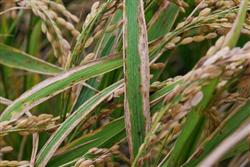
How do you control the three major rice diseases? Please explain the control methods.
The three major rice diseases can be controlled by referring to the following methods:
1. Rice blast
(1) Leaf blast: dark green, nearly round or oval lesions, which later become slightly pointed at both ends; generally, when acute-type lesions appear or an infection center develops, especially in rice fields with high nitrogen fertilizer rates and tender, lush green growth, when the total number of leaf blast lesions occurring on 20 hills of rice during the entire growth period before heading reaches more than 400, spraying must be carried out, with an interval of 3 to 5 days, and continuous spraying 2 times.
(2) Neck blast: occurs on the panicle neck; the lesions are initially light brown, then a brown or dark brown discolored area forms around the panicle neck, causing white heads or unfilled grains. Control of neck blast is mainly carried out at the late booting stage and initial heading stage of rice, and the initial heading stage (when the rice panicle has just emerged from the flag leaf sheath) is especially important. Currently, commonly used agents for controlling leaf blast and neck blast include: ① 20% tricyclazole wettable powder, 100 grams per mu, add 50 kg of water and spray. ② 40% isoprothiolane wettable powder, 75 milliliters per mu, add 50 kg of water and spray. ③ 50% carbendazim wettable powder, 75 grams per mu, add 50 kg of water and spray.
2. Rice false smut
The main disease on rice panicles, damaging some grains on the panicle, mostly one infected grain per panicle, with the maximum reaching several dozen grains. At first, a pale yellow mass appears at the seam of the glumes, gradually swells, and develops until it wraps the entire glume; the diseased grain is 3 to 4 times larger than a healthy grain and becomes a dark green fungal mass with a smooth surface. Finally it cracks open and releases dark green powder. Infection mainly occurs before the rice breaks open and heads, so the key timing for control is about 5 days before breaking open and heading. Commonly used control agents include: ① 5% validamycin aqueous solution, 400 milliliters per mu, dilute with 40 to 50 kg of water and spray. ② 25% triadimefon wettable powder ①, 50 grams per mu, dilute with 40 to 50 kg of water and spray.
3. Rice bacterial leaf blight
It damages leaves. The disease generally starts from the leaf tip or leaf margin, initially appearing as dark green short lines, then rapidly spreads upward and downward along the leaf margin or midrib, and can extend along the veins to the leaf sheath, forming deep yellow long stripe-shaped lesions, and finally the leaves wither and turn white. The disease can occur at the seedling stage, but because early symptoms develop slowly, severe cases are often seen only around heading. Therefore, control should be carried out before rice heading, especially when acute-type lesions appear, under weather conditions favorable to the disease, and after long periods of cloudy and rainy weather, strengthen control in diseased fields and adjacent rice fields. Commonly used control agents include: ① 20% yeqinghuang wettable powder, 100 grams per mu, add 50 kg of water and spray. ② 50% xiaojunling water-soluble powder, 40 grams per mu, add 50 kg and spray. ③ yekusan 500-fold solution spray.
When using agents, try to use pesticides with low residues to reduce non-point source pollution of Erhai Lake.
Click to get more rice cultivation techniques
Click to get more grain crop cultivation techniques