Control methods for tobacco wildfire disease and angular leaf spot
How to control tobacco wildfire disease and angular leaf spot? Tobacco wildfire disease and angular leaf spot are important diseases of tobacco. The two diseases are very similar in terms of pathogen characteristics, infection patterns and control methods. In the field, these two bacterial diseases often occur together and are relatively common in tobacco-growing areas across the country. Wildfire disease in...
How to control tobacco wildfire disease and angular leaf spot?
Tobacco wildfire disease and angular leaf spot are important diseases of tobacco. The two diseases are very similar in terms of pathogen characteristics, infection patterns and control methods. In the field, these two bacterial diseases often occur together and are relatively common in tobacco-growing areas across the country. Wildfire disease occurs more severely in Heilongjiang, Liaoning, Shandong, Yunnan, Sichuan, Shaanxi and other provinces, while angular leaf spot is more severe in Shandong, Fujian, Henan, Guizhou, Jilin and Yunnan. Below is a brief introduction to the occurrence and control of these two bacterial diseases.
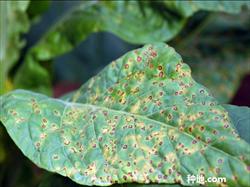
I. Occurrence characteristics: Wildfire disease mainly occurs in the late vigorous growth stage of tobacco plants. It sometimes also occurs at the seedling stage. When leaves are damaged, brown water-soaked small round spots first appear, surrounded by a very wide yellow halo. After the lesions expand, they merge into irregular large spots with concentric rings. When the weather is humid, a thin layer of bacteria can form on the diseased parts; after drying, the lesions rupture and fall off, and the leaves are destroyed. In Yunnan, wildfire disease in field tobacco plants generally begins in late June to early July, after which the disease progresses rapidly, reaching the first epidemic peak in mid-July. In late July the disease declines, and in early August it rises again to a second peak, with a lower increase in disease severity than the first peak. In mid-August the disease declines and spreads slowly, until the top leaves of the tobacco plants mature. Under rainy conditions in late August, field disease severity rises rapidly, causing damage to the upper leaves of the tobacco plants.
Angular leaf spot is more severe in the late growth stage of tobacco plants. The diseased leaves form small angular dark brown spots with distinct edges and no obvious yellow halo around them. When mature plant leaves are severely affected, the lesions are polygonal or irregular, dark brown or with dark brown edges and grayish brown or dirty white centers, and often show concentric ring patterns; when developing along the leaf veins, they appear as streak-like arms. The epidemic pattern of angular leaf spot is similar to that of wildfire disease.
II. Disease conditions: The pathogens of tobacco wildfire disease and angular leaf spot overwinter not only on seeds and diseased plant residues, but can also survive near the root systems of many crops and weeds. The pathogens spread by wind and rain and insects. The pathogens enter through the stomata of the leaves. When leaves are moist and there is water in the stomata, it is easier for them to invade the interior. With limited moisture, the bacteria can only form a small black spot on the leaf. Leaves filled with water are most favorable for bacterial growth. High air and soil humidity, especially after storms, leads to severe disease. Excessive application of nitrogen fertilizer and insufficient potassium fertilizer, with excessive vigorous growth in the late growth stage of tobacco plants, make the plants susceptible to disease.
III. Control methods: Since there is currently no ideal disease-resistant high-quality variety, the control approach is to adopt "prevention first, integrated control." Implement reasonable crop rotation; continuous cropping fields suffer more severe disease than rotation fields. Destroy diseased residues in tobacco fields to reduce sources of infection, which can effectively reduce damage. Use nitrogen fertilizer appropriately, pay attention to increasing phosphorus and potassium fertilizer, and improve the disease resistance of tobacco plants. Timely remove susceptible bottom leaves to improve the field microclimate and reduce pathogen infection damage. In the early vigorous growth stage of tobacco and after topping, spray 1:1:160 Bordeaux mixture or 200 units/ml agricultural streptomycin, once every 7-10 days, for 2-3 consecutive sprays.
Click to get more tobacco cultivation techniques
Click to get more flower cultivation techniques