-

How to Identify Orchid Roots? A Few Practical Identification Methods
The roots of orchids in the genus Cymbidium are relatively thick and fleshy. Generally, there is no distinction between a main root and lateral roots. The internal structure of orchid roots is a typical monocotyledonous type. Its cortical cells are relatively well developed, and it has symbiotic fungi called root fungi. Those growing underground are called terrestrial roots, and those growing in the air are called aerial roots. Whether terrestrial roots or ae...
-
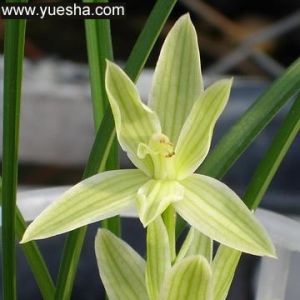
Orchid Identification Tips: Learn to Easily Recognize Common Orchid Varieties
Biyu Qisu Suliu Banlian Orchid
-
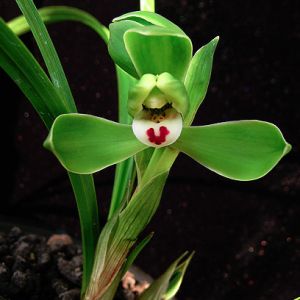
How is the Cymbidium goeringii 'Xizi'? A detailed explanation of the first-bloom pictures and identification methods
Also known as Wenpin. Selected in the early years of the Republic of China by Shen Yuanru, the owner of Qianlan Studio in Wuxi. Semi-drooping leaves, leaf tips slightly blunt, plant form closely resembles Wanzai. The flower shape of this variety varies considerably, and plum-form narcissus and lotus-form narcissus often appear. When it blooms as plum-form narcissus, the three outer petals are round and tight, the tips slightly convex and pointed, with tight edges, long legs and contracted bases, thick petal flesh, soft silkworm-moth-held petals, separated chambers, small...
-
How to Distinguish Orchids from Hui Orchids? A Detailed Explanation of Traditional Identification Methods
Traditionally, people call the flower spikes that orchids send up (or "push out") "lan" when a single stem bears a single flower, and "hui" when a single stem bears multiple flowers. That is why Chinese orchids are also known as "lan-hui." Huang Tingjian of the Song Dynasty wrote in "Record of the Secluded Fragrance Pavilion": "A single stalk with one flower and lingering fragrance is lan; a single stalk with five to seven flowers and insufficient fragrance is hui,"...
-
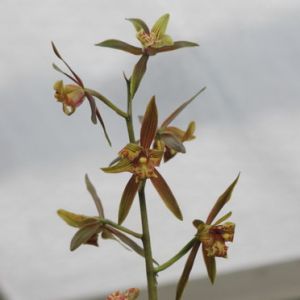
A Complete Guide to Cymbidium faberi Classification and Appreciation
When faced with a rare flower like Cuixiang (Jade Fragrance), one cannot help but marvel at nature's craftsmanship. In order to preserve the plant's strength so that it might soon produce a robust shoot, the flower stalk was cut off. Although we can no longer continue to admire her loveliness, the nine blooms already open are enough for you to appreciate and experience the wonder of "Cuixiang."
-
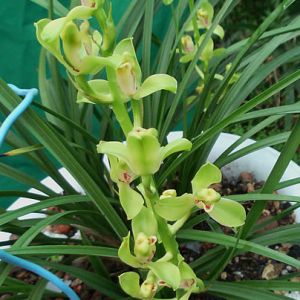
A Complete Analysis of Leaf Identification Methods for Chengmei Orchid
Origin: Collected from the wild in Hubei in 2001. Leaf posture: slanting upright, medium-wide. Flower appearance: outer tepals diamond-shaped and lively, petal tips slightly tilted backward, semi-hard column, small ruyi tongue, standing out from traditional varieties with a distinctive taste.
-
Identification and Control Methods for Soft Rot and Stem Rot
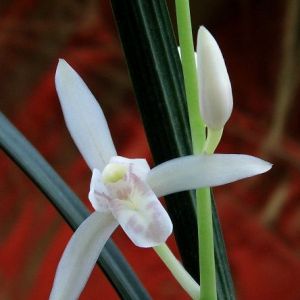
A newly collected white-flowered variety (collected in Pingyuan, Meizhou), with snow-white outer petals and a faint red blush on the petals and lip, like a shy young girl~~
-
Poultry infected with avian influenza or Tembusu virus? Identification and prevention and control methods
The symptoms of avian influenza and Tembusu virus are easily confused. This article introduces the pathogen characteristics, typical symptom differences and differential diagnosis approaches of these two poultry diseases, and provides comprehensive prevention and control points for farms, including biosecurity, mosquito elimination, immunization and outbreak reporting.
-
What are the identification standards for the old-growth Dafugui (Lao Zhong Da Fu Gui)? Understand it all in one article
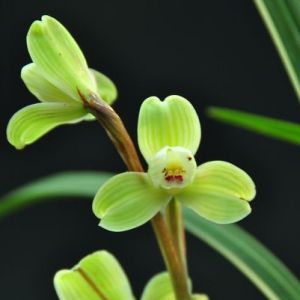
A newly discovered plum-petal variety of Sichuan Chunjian (Cymbidium goeringii subsp. longibracteatum) from the wild; its outer three petals can compare with Yu Haitang (Jade Begonia), and its center is a soft rounded lip.
-
Complete Identification Guide to Cymbidium goeringii Flower Colors, Petals, and Leaf Colors
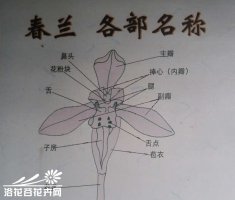
Cymbidium goeringii is a common original species of terrestrial orchid, mostly produced in temperate zones, mainly distributed in China, and is a specialty of China. Those produced in Jiangsu and Zhejiang are considered the most valuable, while Fujian, Guangdong, Sichuan, Yunnan, Anhui, Jiangxi, Gansu, Taiwan, China and other places also produce it....
条件筛选