A Complete Analysis of Leaf Identification Methods for Chengmei Orchid
Origin: Collected from the wild in Hubei in 2001. Leaf posture: slanting upright, medium-wide. Flower appearance: outer tepals diamond-shaped and lively, petal tips slightly tilted backward, semi-hard column, small ruyi tongue, standing out from traditional varieties with a distinctive taste.
Author: Qingshuiwu
ChengmeiActually, among traditional Huilan (Cymbidium faberi) varieties, it is one with relatively distinctive leaf surface characteristics. If no wild-collected plants are mixed in and all are old varieties, then combined with leaf posture and other factors, Chengmei should be identifiable at a glance! Below are two close-up photos for your reference!
According to historical records, Chengmei has dark green leaf color, prominently coarse serrations on the leaf margins, and the first marginal leaf is short with a rounded tip in a spoon shape; the leaf texture is thick, and the leaf posture is semi-arching and pendulous.
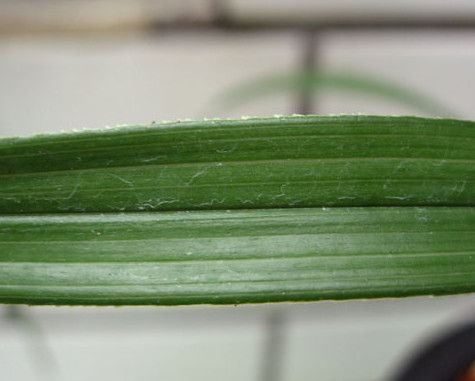
Through long-term cultivation experience, among Huilan, the one with the flattest leaf surface is Dayipin, and Chengmei's leaves are also very flat, which is one of its characteristics;
Secondly, Chengmei's leaf color is relatively darker green than other varieties, mostly dark green, and it is almost difficult to see on the upper surface the crystal-clear prominent veins like those of Lao Jipin, which makes it the opposite extreme from Lao Jipin; of course, Huilan cultivated under insufficient sunlight all tend to be fairly dark green, but compared with Chengmei, the difference is still quite significant;
Thirdly, regarding the coarse serrations, Chengmei's leaf margins among Huilan are relatively similar to those of Xishen among Chunlan (Cymbidium goeringii), being quite distinctive;
Fourthly, Chengmei's leaves are relatively blunt and rounded, which may correspond to the description that the marginal leaf (first leaf) is mostly blunt-tipped;
Fifthly, although Chengmei's leaf surface is flat, the leaf underside is extremely uneven, mainly because the midrib (central vein) protrudes sharply and is extremely cutting to the hand, and together with the two edges on either side of the leaf margin, it creates a feeling of "three mountains flanking two valleys," which is quite obvious when you run your hand along it;
Sixthly, for identifying Chengmei, there is also a relatively popular saying about barbed hooks, namely that within 3 cm below the leaf tip, the midrib vein feels relatively snagging (cutting) to the hand when stroked, as if there were a barb, which is the so-called barbed hook spoken of in common lore;
In addition, combining the majestic bearing of strong Chengmei plants (1.5 cm leaf width, length of over 90 cm), the overall leaf shape formed by arching and pendulous leaves, and finally looking at its seedling-producing structure like soldiers lined up (Chengmei does not easily produce double growths, mostly advancing in a single direction), then it can almost be confirmed!
Of course, the above identification methods apply under two preconditions:
1 No wild-collected plants are mixed in, because among wild-collected plants one can find almost any combination of leaf texture, leaf posture, and other characteristics of all traditional famous varieties;
2 The specimen being identified should be a strong plant. If the plant is a weak growth produced by an old pseudobulb or a thin, feeble plant, many characteristics will not be obvious, and even if it is a genuine specimen, it may be misjudged as a "fake" because it lacks distinctive features!