-
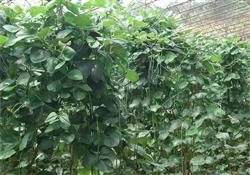
What to Do About Spindly Overgrowth in Greenhouse Beans? Detailed Analysis of Causes and Control Methods
The causes of spindly overgrowth in summer vegetables differ at each stage. Practice has proven that greenhouse beans are most prone to spindly overgrowth during the summer, and the main causes can be grouped into two major categories: 1. Seedling-stage overgrowth. The main cause of spindly overgrowth in seedlings is excessively high temperature, especially when nighttime temperatures are too high and respiration consumes too much...
-
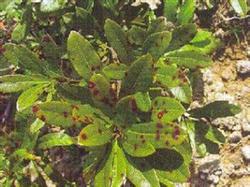
A Detailed Guide to the Main Diseases of Chinese Bayberry (Yangmei) and Their Control Methods
I. Chinese Bayberry Crown Gall Disease 1. Symptoms: Chinese bayberry crown gall disease is a bacterial disease. It mainly affects the branches and trunks of 2-3 year old fruiting trees, mostly forming tumors on the branches and trunks. The tumors are nearly spherical, vary in size, are very hard and corky, and range in color from brown to dark brown. Generally, the tumors on the branches and trunks begin to enlarge in early April, and from July to August...
-
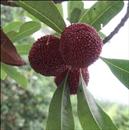
What to Do About Copper Deficiency in Waxberry? Causes and Control Methods Explained
Waxberry twig blight is caused by boron deficiency, so planned boron supplementation can eliminate the harm of this disease. Spraying a 0.1 to 0.2 borax solution 2 to 3 times during the waxberry growing period can effectively control the disease. Root application can also be used; for mild boron deficiency, use 0.3 to 0.6 kg of borax per mu, and for severe boron deficiency, use 1.3...
-
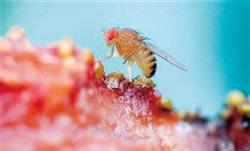
How to control fruit flies on Chinese bayberry? Introduction to practical control methods
In recent years, the occurrence of fruit flies has reduced the yield and quality of Chinese bayberry, seriously affecting the economic development of the Chinese bayberry industry. In order to explore the occurrence patterns and control techniques of fruit flies on Chinese bayberry, the author has observed this pest since 2008, and has now basically clarified its occurrence situation in our county and summarized the corresponding control techniques. Fruit flies...
-
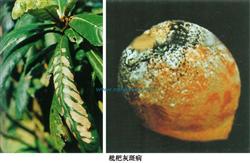
Comprehensive Control Methods and Key Technical Points for Loquat Gray Leaf Spot
Loquat gray leaf spot, also known as "ring spot." It is the most important disease of loquat. It attacks branches, leaves, flowers, and fruit. There are two types: acute and chronic: in the chronic type, leaf spots are initially light brown circular spots; later they join into irregular large spots, with small black dots scattered on them. On young shoots, the disease starts as small water-soaked brown...
-
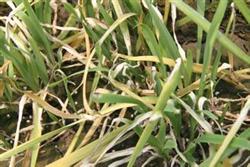
Control Methods and Technical Key Points for Chive Blight
Treat seeds with 25% metalaxyl at 0.3% of the seed weight. After disease onset, use 64% oxadixyl mancozeb at 600 times dilution, 69% dimethomorph mancozeb at 600 to 800 times dilution, 50% iprodione at 500 times dilution, and 77% copper hydroxide at 600 to 700 times dilution, applied alternately, once every 5 to 7 days, for 2 to 3 treatments.
-
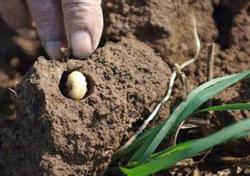
How to treat white grubs in chives? Detailed control methods
Drench the roots with a 1000-fold dilution of 50% phoxim, a 1000-fold dilution of 80% trichlorfon, a 4000-fold dilution of 50% phoxim-cypermethrin emulsifiable concentrate, a 300-fold dilution of 20% fenvalerate, or a 3000-fold dilution of 2.5% deltamethrin. Alternatively, before sowing or transplanting, mix the above pesticides with poisoned bait and broadcast it, or use a seed coating agent for coating.
-
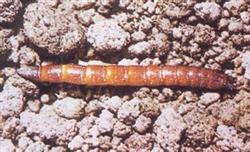
What are the control methods for wireworms in Chinese chives?
Apply a root drench with 50% phoxim at 1000x dilution, 80% trichlorfon at 1000x dilution, 50% phoxim-cypermethrin emulsifiable concentrate at 4000x dilution, 20% fenvalerate at 300x dilution, or 2.5% deltamethrin at 3000x dilution. Alternatively, before sowing or transplanting, mix the above agents with poisoned bait and broadcast it, or use a seed dressing agent for coating.
-
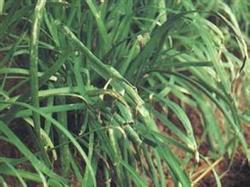
What are the control methods for gray mold in Chinese chives?
In protected cultivation, fumigate with 10% Procymidone smoke agent at 250 g per mu; for foliar spraying, use 50% Procymidone wettable powder at 1000 times dilution, 2% Wuyimycin (BO-10) at 150 times dilution, 40% Huimeiwang at 500 to 800 times dilution, 10% Polyoxin at 500 to 700 times dilution, and 50% Vinclozolin at 1200 to 1400 times dilution.
-
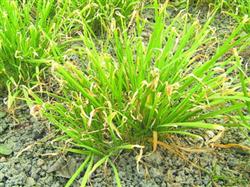
Diagnosis, Identification and Control Methods of Gray Mold in Chinese Chives
How to control gray mold in greenhouse Chinese chives. Gray mold in Chinese chives, also known as "white spot leaf blight" and "white spot rot", is the main disease of greenhouse Chinese chives. It should be controlled early to reduce losses and increase profits. The occurrence conditions and control methods of gray mold in Chinese chives are briefly summarized as follows: 1. Occurrence conditions 1. Chi...
条件筛选