A Detailed Guide to the Main Diseases of Chinese Bayberry (Yangmei) and Their Control Methods
I. Chinese Bayberry Crown Gall Disease 1. Symptoms: Chinese bayberry crown gall disease is a bacterial disease. It mainly affects the branches and trunks of 2-3 year old fruiting trees, mostly forming tumors on the branches and trunks. The tumors are nearly spherical, vary in size, are very hard and corky, and range in color from brown to dark brown. Generally, the tumors on the branches and trunks begin to enlarge in early April, and from July to August...
I. Chinese Bayberry Crown Gall Disease
1. Symptoms: Chinese bayberry crown gall disease is a bacterial disease. It mainly affects the branches and trunks of 2-3 year old fruiting trees, mostly forming tumors on the branches and trunks. The tumors are nearly spherical, vary in size, are very hard and corky, and range in color from brown to dark brown. Generally, the tumors on the branches and trunks begin to enlarge in early April, and enlarge most rapidly from July to August. After November they stop expanding.
2. Occurrence pattern. The pathogen overwinters as bacteria in the tumor tissue of diseased branches and trunks. The following spring, when the weather is humid, bacterial fluid exudes from the tumor surface, spreads through wind and rain, and invades the branches and trunks through wounds and leaf scars. During the growing season, it can cause multiple infections, resulting in an epidemic of the disease.
3. Control measures. Choose disease-resistant varieties. Such as the Litchi variety, Ding'ao Mei, and Water Chestnut variety, etc. Scrape off the tumors before the pathogen spreads from them, and apply 402 antibiotic at 700 times dilution, or use copper sulfate at 100 times dilution for sterilization, which helps new cortex grow and restores tree vigor. Promptly cut off diseased trees and diseased branches and burn them in a centralized manner to eradicate the pathogen. Try to avoid damaging branches and trunks during fruit harvesting to reduce wounds. In winter, in conjunction with pruning, cut back diseased and weak branches, and at the same time thin out overly dense branches and water sprouts, and remove all dead branches, fallen leaves, weeds, and fruit pits in the orchard and burn them in a centralized manner.
II. Chinese Bayberry Brown Spot Disease
1. Causes: Chinese bayberry brown spot disease is a fungal disease, and it is the disease with the widest harm range and the greatest degree of harm in Shexian County. The causes of the disease are: (1) there is a lot of rain from May to June, and the humidity in the orchard is high, which is suitable for the spread of the pathogen; (2) management is extensive, ventilation and light transmission conditions are poor, and the tree vigor is weak with poor disease resistance; (3) the soil is poor and compacted, and high temperature and dryness are unfavorable for Chinese bayberry to form root nodules, so the tree vigor is weak and the tree is prone to the disease.
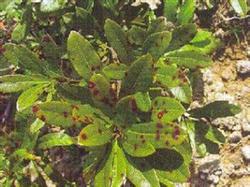
2. Symptoms. Around May, one to several brown spots form on the leaves, and then the leaf areas with spots rot and fall off, forming holes, which affects vegetative growth, causes tree vigor to decline, and turns the tree into half-dead branches, dead branches, or even death.
3. Control measures. Strictly quarantine seedlings to prevent the pathogen from entering; choose well-drained red soil or yellow soil plots containing gravel, on semi-shaded gentle slopes; avoid continuous cropping; strengthen soil and fertilizer management, and in conjunction with deep plowing to improve the soil, apply more organic fertilizer and plant ash, etc.; prune rationally to improve ventilation and light transmission conditions; sweep up fallen leaves and dead branches in the orchard and burn them in a centralized manner; for chemical treatment, use 1:2:100 Bordeaux mixture or 65% mancozeb at 500 times dilution, spraying once each in mid-to-late April, mid-May, and after fruit harvest, which can effectively control the occurrence of the disease.
III. Chinese Bayberry Dry Blight Disease
1. Symptoms: Chinese bayberry dry blight disease occurs relatively commonly, and generally trees after entering full fruiting age are more affected, harming branch growth. The initial symptoms are irregular dark brown spots, and later the spots continuously expand as the disease develops. The spots spread along the branches and trunks up, down, left, and right, and may even encircle the branches and trunks for 1 full turn. The surface of the spots loses water and becomes slightly sunken, dries up without falling off, and afterward the xylem gradually dries up. The leaves on the upper part of affected branches become smaller and wrinkled, growth is slow, and leaves and fruit drop.
2. Control measures: Choose varieties with strong disease resistance, and plant different varieties in a reasonable mix. Strengthen cultivation management and keep the orchard well ventilated and exposed to light. After entering full fruiting age, a large amount of organic fertilizer and plant ash, etc. should be supplemented to help restore tree vigor and enhance the disease resistance of the tree. Before the pathogen may invade, spray 70% thiophanate-methyl at 1000-1500 times dilution, or 50% carbendazim at 600-800 times dilution, or use 1:0.5:100 Bordeaux mixture, spraying 2-3 times continuously for prevention. Promptly detect spots, scrape them off directly, and brush on Bordeaux mixture, 2 times continuously, which can effectively prevent the invasion of the pathogen.