-
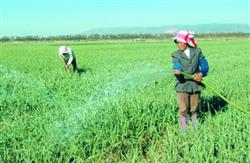
The Correct Methods for Watering and Fertilizing Garlic
How should garlic be watered and fertilized? What should be noted? We ask experienced readers to help explain. Because garlic has a long growing period and has relatively low water requirements but a high fertilizer requirement, Zhongdi Network has compiled the methods for watering and fertilizing during garlic cultivation. These are listed in detail below for readers' reference...
-
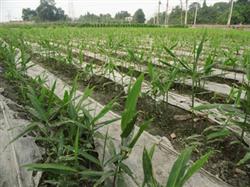
Ginger Summer Watering Methods and Technical Key Points
Ginger has different watering requirements at different growth stages. When sowing, the bottom water must be watered thoroughly, and usually the first watering is not started until about 70% of the seedlings have emerged. After this watering, the soil must be kept constantly moist to prevent the soil surface from crusting, which would affect seedling emergence. In the early seedling stage, light watering is preferable, and after watering, while the soil is still...
-
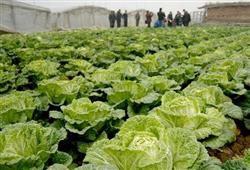
Fertilizing and Watering Chinese Cabbage This Way Makes the Heads Firmer
From the perspective of the entire growth period of Chinese cabbage, it goes through three stages: the seedling stage, the rosette stage, and the heading stage. During the seedling stage, Chinese cabbage absorbs few nutrients, accounting for only 10%, and the rosette stage accounts for 30%. During this period, production should control water and fertilizer, especially nitrogen fertilizer, so that the cabbage leaves grow slowly. This is also called the seedling hardening period. Do not let too much water cause...
-
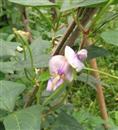
What are the reasons for avoiding watering during the flowering period of common beans?
Some vegetable growers planted common beans this year. Because the soil in the greenhouse had not been watered for more than 10 days and was rather dry, they watered once during the flowering period of the common beans to ensure the water supply for the beans. As a result, a large number of common bean flowers and newly grown tender pods dropped, which made the farmers very troubled. So when the soil is rather dry during the flowering period of common beans, how should...
-
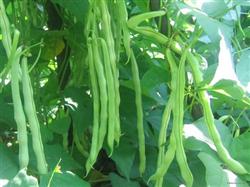
Effectiveness of first supplementing then regulating when watering kidney beans
Vegetable growers often say, "Water kidney beans at the pod stage, not at the flower stage." Based on several years of experience and theoretical exploration, the author believes that "water kidney beans at the pod stage, not at the flower stage" should become a thing of the past. The reason is: with the advent of humic acid foliar fertilizer, it can be directly absorbed by the leaves and stems, and high concentrations of humic acid foliar fertilizer can inhibit vegetative growth and promote...
-
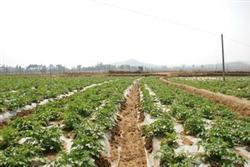
Potato watering has its own rules
During the growth of potatoes, which stage should be watered less, which stage should be watered more, and which stage should not be watered at all are matters of great particularity. This issue is discussed below. Potatoes are generally not watered from the time the seedlings push through the soil until flowering, and are subjected to moisture stress to promote root development; only in cases of extreme drought should a small amount of water be given. Cultivation experts, in loam soil with good water retention...
-

Wheat drought conditions will worsen further; experts advise watering as soon as possible
In the second half of this month, our province will remain dry with little rain, and relevant experts advise promptly irrigating wheat fields in drought-affected areas to minimize the reduction in the summer grain harvest. In early May, temperatures in most parts of our province were on the high side, and precipitation continued to be below normal. Varying degrees of drought disaster occurred in Linzhou, Puyang, Lushi, Luanchuan, Yichuan, Xuchang, Xiangcheng, Shangqiu and other places, and soil moisture was lost relatively quickly, which had a certain adverse impact on the grain filling of winter wheat and the sowing of spring-sown crops and seedling growth. The meteorological department forecasts that by May 18, except for some local areas in northern Henan, eastern Henan and southern Henan where soil moisture is suitable,
-
The key "three waterings and three fertilizations" technical points for garlic cultivation
Water and fertilizer management after garlic turns green is the key to a bumper garlic harvest. As the weather warms up, water and fertilizer uptake gradually increases after greening, especially during the bolt-bearing stage and the bulb swelling stage, which are the peak periods of water and fertilizer demand for garlic. Therefore, throughout the entire growth period of garlic, timely watering and topdressing should be carried out according to soil moisture conditions and soil fertility and seedling conditions, with special emphasis on doing well the "three waterings" and "three fertilizations." 1. Water the greening water well and apply the greening fertilizer well. By the Spring Equinox, the garlic seedlings begin to turn green and grow. Because the early spring soil temperature is low, it is best to water the greening water at noon
-
What are the water requirements for garlic growth? A detailed explanation of watering methods
Garlic leaves are strap-shaped, with a small leaf area and a waxy surface, and its root system is small, shallow in the soil, narrow in distribution, and has very few root hairs, giving it a weak ability to absorb water. As a result, garlic shows strict and highly sensitive water requirements in its roots, while its leaves show drought tolerance. Based on the morphological characteristics of garlic, its water requirements are as follows: from sowing to emergence, an adequate water supply is required, but the soil must not be too wet. If the soil tillage quality is poor at sowing, the soil moisture is unfavorable, and the soil cover is too shallow, the "jumping garlic" phenomenon can occur. However, if too much water is applied,
-

What to pay attention to when watering button mushrooms
Points to note when watering button mushrooms
条件筛选