-
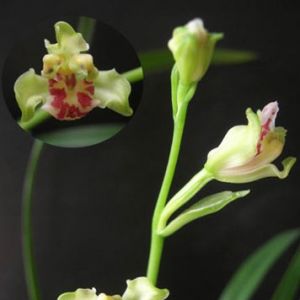
Introduction to the characteristics of the Cymbidium ensifolium variety Caiyun Zhuiyue
Caiyun Zhuiyue is a Cymbidium ensifolium (Jianlan) narcissus-petal variety originally from Sichuan. Its place of origin is Meishan, Sichuan. A few years ago, an orchid enthusiast in Meishan, Sichuan, gambled on a dragon-root grass and won a fine "piaomen" flower of Sijilan (four-season orchid), hailed as the best gamble grass in the Meishan area over the years. It was later collected by Dr. Li of Sichuan. When Mr. Chen Xutong, an orchid enthusiast from Chenghai, heard of it, he went to Dr. Li to seek...
-
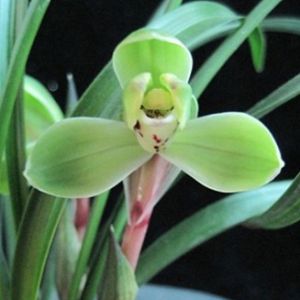
Introduction to the Chunlan 'Lao Shiyuan' (Jiyuan) Variety
New shoots are purple-green. The sheath leaves are light green, not reddish either, and on close inspection have extremely fine pink-purple vein lines. The leaf shape is somewhat similar to Song Mei, slanting upright and spreading, with the tip semi-drooping, tall-waisted and elegant; some outer leaves also semi-droop, with 1-2 narrow slender leaves in the middle. The leaf texture is thick and glutinous, feeling relatively soft to the touch, though some feel hard. The petiole is thick and strong, medium-long and broad, with deep veins, and the tip is slightly blunt, about 26-29 cm long and about 1.1-1.3 cm wide, deep green and glossy. The bract leaves are green with red coloring or purple-red mixed with green coloring; some have a red-green base with red-purple, and an upper part with a green ground marked by purple vein lines, while the green coloring gradually intensifies from outside to inside. The bracts are emerald green with a purple-red base, some with a white tip, and some with a purple-red tip bearing green coloring. The 3 sepals are rounded at the base, short, round, broad and large, hence the name Jiyuan; tightly edged, spoon-shaped, of plum-petal form, though sometimes they also open in plum-form narcissus-petal form. The two lateral sepals appear somewhat longer, tender emerald green tinged with yellow, with white edges, but not as pronounced as in Song Mei, and with hidden green vein lines; the petal base has a pale red blush and purple-red colored stripes, exceptionally gorgeous, and the lateral sepals form a single line. The silkworm-moth (can'e) hold, thin and soft in texture, almost transparent, tightly edged, gathered into a pocket shape, slightly rounded at the base, bluntly rounded at the tip, tender green, with a smooth surface; the pocket head sometimes shows a faint pale purple-red blush, and the two pieces are joined. The Liu Hai tongue, sometimes opening as a Ruyi tongue, is well-formed, with bright vermilion spots in a pin-shaped arrangement, though some have disordered red spots; the lip margin curls upward, with an upward pocket, extending flat, with the tip slightly plunging downward, so compared with Song Mei the lip is slightly looser and the spirit slightly inferior. Jiyuan blooms a few days later than Song Mei, with a long flowering period; the flower scape is slender and long, about 15-20 cm tall, and perhaps due to light or soil composition, the scape color shows two variations: green-green and purple-red. The flower shape is sometimes as variable as Song Mei, and can have five petals separated at the base, with a flower diameter over 5 cm. With a dignified and graceful flower appearance, the Jiyuan orchid stands tall above the leaves, elegant and freely open, full of charm.
-
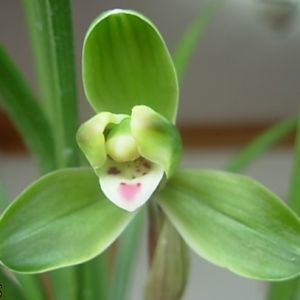
Introduction to the Characteristics and Care Methods of the Xiaoda Mei Chunlan Variety
The leaf posture is a mix of semi-drooping and slanting-drooping, the leaves are narrow and slender, the leaf groove is V-shaped, the leaf color is emerald green with a slight luster, the leaf stalk is slender and tapered, the leaf tip is pointed and long, and the leaf buds are purplish-red and slightly pale. The flower bud is pale red, with green color on the tip and reddish-purple veins. The flower stalk is pinkish-purple, with the top node turning green. The three outer petals are short and ovate, with the edges curling inward, shaped like a shallow soup spoon; the silkworm-moth stamen is held in the center, with a liu-hai tongue and red spots...
-
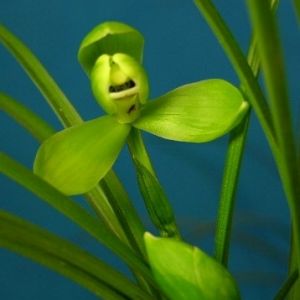
Introduction to the Characteristics and Appreciation Points of the Green Ying Chunlan Variety
Green Ying - selected and bred by Gu Xiangxiao of Suzhou in 1902. Leaves semi-drooping, thick and glossy. Flower scape tall, almost level with the leaf surface, blue-green. The flower is a narcissus-form plum-petal type, the staminal column petals form a hood, slightly open, the lip is short and small, a large ruyi tongue, with a red spot in the middle. New shoots purple-green, the shoot tips slightly tinged with purple-red blush and red streaks. Leaf texture...
-
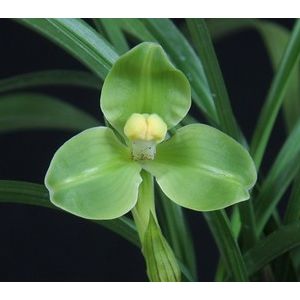
Introduction to the Characteristics and Care Points of the Cuitao Chunlan Variety
The three outer sepals are exceptionally wide, with a constricted base forming a diamond shape, thin in texture, emerald green in color, resembling peach blossom petals, hence the name. The petals (petaloids) fold back against each other, hardening into a yellow hard mass. The lip is thick and small, shaped like "three petals and one nose." The scape is tall and purplish-red, and the leaves are broad and arching. When the scape is tall and emerald green, the leaves are narrow and slanting upright. The leaf texture is hard.
-
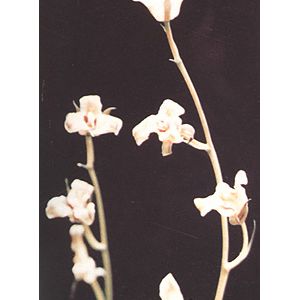
Introduction and Appreciation of the Yellow-White Holding-Butterfly Cold Orchid Variety
This plant is a butterfly-type Cymbidium kanran, specifically a winter-flowering Cymbidium kanran holding-butterfly flower, produced in Sichuan. Most of its sepals are short and slender, with a few having become lip-like; the holding petals are equal in size to the lip and fully lip-like, and the column also shows fission. The flower color has a white base with a yellow tinge. Its fine leaves stand obliquely, beginning to arc and droop from the middle. The leaf surface is smooth and yellow-green, the veins are raised and crystal-bright, and the leaves often show...
-
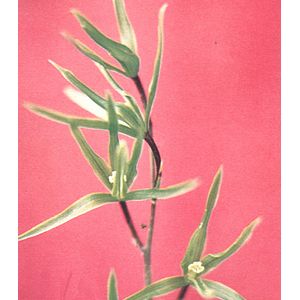
Introduction to the characteristics of the rare green-and-white qisu variety of Cold Orchid
This plant is a strange-flower type Cold Orchid (Cymbidium kanran), a purple-stemmed sushi (pure-centered) strange flower that blooms in winter, produced at the southern foot of the Daiyun Mountains in Fujian. The sepals, petals, and lip are all emerald green, edged with white. Its uniqueness lies in: the sepals are polymorphic, some wavy and curved as if flying, some with double-curled margins in the middle, some slanting upward like arrows; the petals are polymorphic, either short and small, turning and tilting up like a dragon...
-
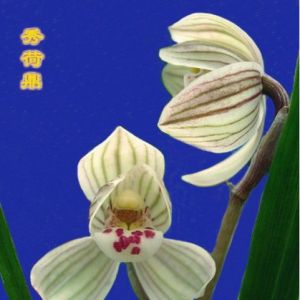
Introduction to the 'Qun Die Zheng Chun' (Swarm of Butterflies Racing for Spring) Variety of the Spring Sword Orchid
Both 'He Zhi Guan' (Crown of the Lotus) and 'Xiu He Ding' (Elegant Lotus Tripod) were bought from the same person. 'He Zhi Guan' cost 700 yuan at the time, and 'Xiu He Ding' cost 900 yuan. Both were dragon-root seedlings, and 'He Zhi Guan' was bought one month earlier than 'Xiu He Ding'. Judging by timing, they were certainly different dragon-root seedlings; judging by seedling type, they were probably just plants from the same mountain.
-
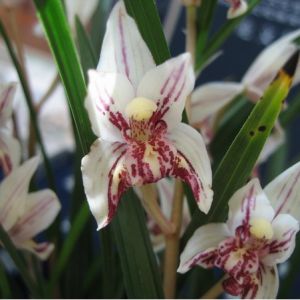
Introduction to the Characteristics of the Cymbidium lianpan 'Baolian Die' Variety
Baolian Die, also known as "Zhongyi Caidie", was selected and named by Mr. Chen Qiwen. It was discovered in the semi-mountainous area on the border with Guizhou, northeast of Zhaotong City. It has won awards continuously at exhibitions and earned high praise from veteran figures in the orchid world. A few years ago it was registered in the journal of the China Orchid Society. Characteristics: Baolian Die's petals have a very high degree of butterfly transformation (petaloidy), and the flower...
-
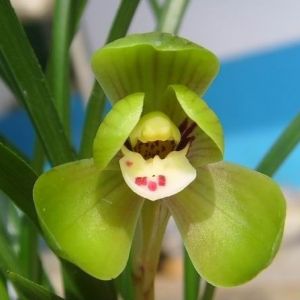
Cymbidium goeringii 'Huanqiu Hedding' (also known as Huanqiu Huanhe) Variety Introduction
New shoots are purplish-red, leaves slant upright, leaf bases tight, deep green, glossy, flesh extremely thick, leaf veins fine and supple, leaf margin serrations relatively fine and dense. Bracts are mercury red, with a transparent quality, purplish-red vein lines extending to the tip, bright green sand-like mottling vivid. Sepals short and broad, flesh extremely thick, narrow at the base and flared at the corners, shaped like a large soup spoon, predominantly amber in color, with green,...
条件筛选