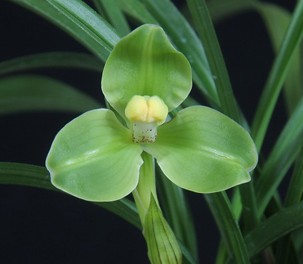
Introduction to the Characteristics and Care Points of the Cuitao Chunlan Variety
The three outer sepals are exceptionally wide, with a constricted base forming a diamond shape, thin in texture, emerald green in color, resembling peach blossom petals, hence the name. The petals (petaloids) fold back against each other, hardening into a yellow hard mass. The lip is thick and small, shaped like "three petals and one nose." The scape is tall and purplish-red, and the leaves are broad and arching. When the scape is tall and emerald green, the leaves are narrow and slanting upright. The leaf texture is hard.
Cuitao (Pinlian, Changlian)
During the Qing Dynasty Xianfeng era, the "Cuitao" produced by Zhu Changliang of Fuyang, Zhejiang, had three sepals with red streaks, mussel-shell-shaped petals (petaloids), and a ruyi-shaped lip, but unfortunately it was lost during the chaos of war. According to Mr. Zhang Peiyuan, the flower master at the home of Yang Zuchen of Ningbo, the Cuitao that circulates today was found during the Qing Dynasty Tongzhi era (1867) by Xu Baoguo, a major orchid grower in Pujiang County, Zhejiang, on a mountain near Changlian Rock (a place name) in Pujiang County, and later sold to Lin Hanzhi of the "Lin Tianyi Ginseng Shop" in Shanghai. Because its sepals are diamond-shaped, it was commonly called peach petal (somewhat similar to a peach shape), and because the flower is pale emerald green, Mr. Lin Hanzhi named it Cuitao. Also, because the place of origin is Changlian Rock, some people also call it Pinlian or Changlian. Lin Hanzhi was a friend of Yang Zuchen's father's generation, and they also had business dealings with each other. At that time, Yang Zuchen and Master Zhang Peiyuan were both still very young and called Lin Hanzhi "Uncle," and they were all well acquainted and often exchanged orchids. Therefore, the history of Cuitao provided by Yang Zuchen and Master Zhang Peiyuan is generally reliable. Also, according to Mr. Xu Ji of Xiushui, Jiaxing, Zhejiang, in his "Lan Hui Tong Xin Lu," it is recorded: "Cuitao: also called Pinlian, a new variety. It comes from the mountains of Pujiang and was cultivated by Mr. Hanzhi of the Lin Tianyi Ginseng Shop in Shanghai. The flower is eight fen wide and one cun long, with a pointed tip and green color, and the stem is as thin as a lamp wick. The leaves are narrow; truly a rare variety." The book "Chinese Orchids," published in Japan in the 1950s, also records in detail the place of origin and characteristics of the current Cuitao orchid, basically consistent with the above.
The leaves are semi-drooping and mixed with dew-holding leaves, thin in texture, broad and wide in the middle, flat, with the petiole tightly constricted and fine, and the leaf tip short and blunt. The leaves are about 1-1.2 cm wide and about 23-26 cm long, with fine dense serrations along the leaf margins, emerald green, and glossy. The leaves are prone to brown spot disease, so attention should be paid to prevention. The flower buds are large and round-bulging in shape. The bracts are pale purplish-red with green variegation, and red-purple veins run through the tip. The bracteoles are very pale purplish-red with an emerald green flush. The three sepals are round and broad, thick in flesh, well-formed, tightly constricted at the base, pale emerald green and delicate, sometimes with a notch at the tip bearing peach-shaped ruffling, and the side sepals always extend in a single straight line, extremely noble and graceful. The petals (petaloids) fold back against each other, hardening into two yellow round masses. The lip has a base and is small and pointed at the front end, commonly called "pierced-cheek lip." The column is tightly contracted between the two, and in Jiangsu and Zhejiang orchid circles, "three petals and one nose" is often used to describe the characteristics of Cuitao. However, upon careful observation, one will find that Cuitao, like other orchids, does not lack petals; they are simply clustered together. The Cuitao flower scape is crimson red, called red-stem Cuitao, with a fine, short, round stem only 6-8 cm tall. The flowers open below the leaves or level with the leaves, and rarely rise above the leaf surface to bloom. The outer ring is broad and large while the center is tightly small; this is one of the basic characteristics of Cuitao. Perhaps due to soil quality and light intensity, the Cuitao flower scape may appear green mixed with pale purplish-red, and the petals are also somewhat larger than those of red-stem Cuitao, with a greener flower color, called green-stem Cuitao. If the red-stem Cuitao orchid is compared with the typical Chunlan plum petal, there are many differences. However, because the Cuitao flower shape has certain distinctive features, it is also another kind of appreciated character. Cuitao was introduced to Japan in 1931.