Introduction to the Chunlan 'Lao Shiyuan' (Jiyuan) Variety
Orchids0 views
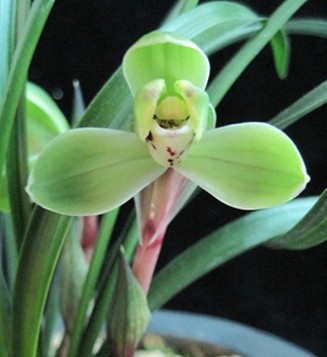
New shoots are purple-green. The sheath leaves are light green, not reddish either, and on close inspection have extremely fine pink-purple vein lines. The leaf shape is somewhat similar to Song Mei, slanting upright and spreading, with the tip semi-drooping, tall-waisted and elegant; some outer leaves also semi-droop, with 1-2 narrow slender leaves in the middle. The leaf texture is thick and glutinous, feeling relatively soft to the touch, though some feel hard. The petiole is thick and strong, medium-long and broad, with deep veins, and the tip is slightly blunt, about 26-29 cm long and about 1.1-1.3 cm wide, deep green and glossy. The bract leaves are green with red coloring or purple-red mixed with green coloring; some have a red-green base with red-purple, and an upper part with a green ground marked by purple vein lines, while the green coloring gradually intensifies from outside to inside. The bracts are emerald green with a purple-red base, some with a white tip, and some with a purple-red tip bearing green coloring. The 3 sepals are rounded at the base, short, round, broad and large, hence the name Jiyuan; tightly edged, spoon-shaped, of plum-petal form, though sometimes they also open in plum-form narcissus-petal form. The two lateral sepals appear somewhat longer, tender emerald green tinged with yellow, with white edges, but not as pronounced as in Song Mei, and with hidden green vein lines; the petal base has a pale red blush and purple-red colored stripes, exceptionally gorgeous, and the lateral sepals form a single line. The silkworm-moth (can'e) hold, thin and soft in texture, almost transparent, tightly edged, gathered into a pocket shape, slightly rounded at the base, bluntly rounded at the tip, tender green, with a smooth surface; the pocket head sometimes shows a faint pale purple-red blush, and the two pieces are joined. The Liu Hai tongue, sometimes opening as a Ruyi tongue, is well-formed, with bright vermilion spots in a pin-shaped arrangement, though some have disordered red spots; the lip margin curls upward, with an upward pocket, extending flat, with the tip slightly plunging downward, so compared with Song Mei the lip is slightly looser and the spirit slightly inferior. Jiyuan blooms a few days later than Song Mei, with a long flowering period; the flower scape is slender and long, about 15-20 cm tall, and perhaps due to light or soil composition, the scape color shows two variations: green-green and purple-red. The flower shape is sometimes as variable as Song Mei, and can have five petals separated at the base, with a flower diameter over 5 cm. With a dignified and graceful flower appearance, the Jiyuan orchid stands tall above the leaves, elegant and freely open, full of charm.
The new shoots are purple-green. The sheath leaves are light green, not light red either, and on close inspection have very fine pink-purple vein lines. The leaf shape is somewhat similar to Song Mei, slanting upright and spreading, with the tip half-drooping, tall-waisted and graceful; there are also side leaves that half-droop, with 1-2 narrow slender leaves in the middle. The leaf texture is thick and glutinous, feeling rather soft to the touch, though some feel hard; the petiole is thick and strong, medium-long and broad, with deep veins, and the tip is slightly blunt, about 26-29 cm long and about 1.1-1.3 cm wide, deep green and glossy. The bract leaves are green with red coloration or purple-red mixed with green, and some have a red-green base with purple at the base and a green background on the upper part with purple vein lines, while the green coloration gradually intensifies from the outside inward. The bracts are emerald green with a purple-red base and a white tip, and some have a purple-red tip with green coloration. The 3 sepals are round at the base, short, round, broad and large, hence the name Ji Yuan (Collected Round); with tightly rolled edges, spoon-shaped, of the plum-petal form, though sometimes they also open in the plum-form narcissus-petal form. The two lateral sepals appear slightly longer, tender emerald green with a yellow tinge, with white edges, but not as pronounced as in Song Mei, and with hidden green vein lines; the petal base has a light red blush and purple-red color streaks, exceptionally gorgeous, and the lateral sepals form a single line. The silkworm-moth hold-heart (the inner petals) is thin and soft in texture, almost transparent, with tightly rolled edges, forming a pouch shape, slightly round at the base, bluntly round at the tip, tender green, with a smooth surface; the pouch tip sometimes shows a faint light purple-red blush, and the two pieces are connected. The Liu Hai tongue, which sometimes opens as a ruyi tongue, is well-formed, with bright vermilion markings in a pin-shaped arrangement, though some have disordered red spots; the lip edges curl upward, with an upward pouch, extending flat, and the tip slightly swoops downward, so compared with Song Mei the lip is slightly looser and the expression somewhat inferior. Ji Yuan blooms a few days later than Song Mei, with a long flowering period; the flower scape is slender and long, about 15-20 cm tall, and perhaps due to light or soil composition, the scape color shows two variations: blue-green and purple-red. The flower shape is sometimes as variable as Song Mei, able to split into five separate petals, with a flower diameter of over 5 cm. With a dignified and elegant flower appearance, the Ji Yuan orchid stands tall above the leaves, graceful and freely poised, full of charm.