-
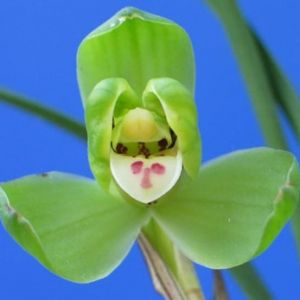
Guiyuan Mei Cymbidium goeringii Variety Introduction and Care Tips
Also known as Saijinxuan, selected by Zhu Xiangbao of Shaoxing in the early years of the Republic of China. It gets its name from its shape, which is round and upright like a longan. The leaves are deep green; the basal leaves are broad with shallow longitudinal veins, the middle leaves are narrow with V-shaped leaf grooves, the leaf margins have medium serrations, and the leaf texture is thick, hard and elastic. The leaf tips taper sharply, forming a dew-catching shape, the leaf base narrows inconspicuously, the leaf posture is a mix of semi-pendent and semi-upright, and the basal leaves have a fish-belly shape...
-
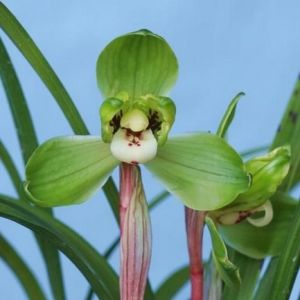
An Introduction to the Characteristics of the Cymbidium goeringii 'Laotianxingmei' Variety
Selected in 1885 in Jiaxing, the outer three petals are short-stalked and round-tipped, the petals are especially broad and wide, the texture is glutinous, the color is not a pure green, the shoulders are level, the lip is large (triangular in shape), and the red spots on the lip are irregular, numbering 1-4. When this flower blooms, it should be kept in shade, otherwise the outer three petals easily develop scorched edges. The flower grade of this flower is unstable, and it is relatively difficult to see a very good bloom. The leaves are relatively broad, semi-arching, the leaf surface is glossy, and the leaf color is green with a hint of light yellow; the leaf tips are blunt, and the second secondary leaf at the center often shows a hooked phenomenon, while the bud sheaths are purplish red with green markings.
-
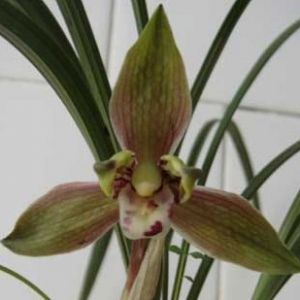
Red Dragon Character Cymbidium goeringii Variety Characteristics and Care Methods Introduction
It spread to Japan in the early years and has recently been reintroduced to China. The leaves are semi-arching, the leaf width is relatively broad, and the leaf color is emerald green without gloss. The bud sheaths are purplish red. The three outer petals of the flower are broad and large, with a contracted base and rounded angles, broad mid-petal width, pointed petal tips, tightly rolled edges, thick texture, and level shoulders. The semi-hard hooded column has purplish red veins, and the lip has bright red block spots. The flower color is green, and the two sides of the mid-petal width...
-
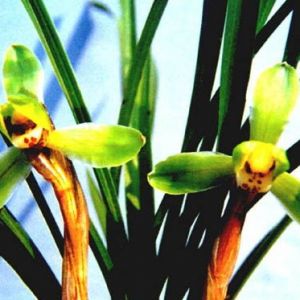
What kind of orchid is the Kui-zi Chunlan? A cultivar introduction
The leaves are strongly upright in posture, with blunt-tipped ends, thick substance, broad shape and deep green color. The bud sheaths are bright red, the three outer petals are long-stalked with rounded tips and tightly rolled edges, the inner petals (pouch) resemble a silkworm moth, the tongue is in the ruyi shape, and the flower color is emerald green; the flower stalk of this flower is extremely short.
-
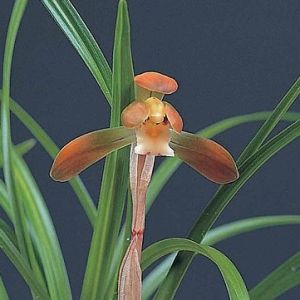
Introduction to the Characteristics and Care Methods of the Dongzhiguang Cymbidium goeringii Variety
Produced in Ibaraki Prefecture, Japan. The leaves droop, the flower scape rises above the leaves, the flowers are red with flat shoulders, and the lip is white with red spots.
-
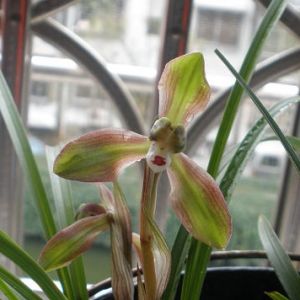
An Introduction to the Characteristics and Appreciation of the Chunlan 'Hongmeixian' Variety
Produced in Chiba Prefecture, Japan. The leaves droop, the flower scape rises above the leaves, the flowers are red, and the lip is white with 2 rows of red dots.
-
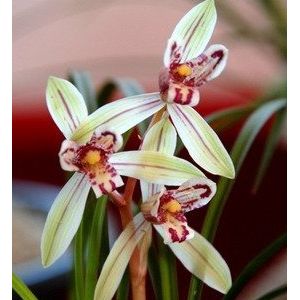
Introduction to the Xinghai Die Cymbidium Lianban Variety and Its Cultivation Methods
Xinghai Die, also known as Xinhai Die, is a famous three-star butterfly variety of the fine-leaf Cymbidium lianban. The leaves are 20-30CM long and about 0.6CM wide, with a fine, glutinous and glossy leaf texture, semi-pendant leaves, and relatively fewer leaves than other Cymbidium lianban, generally 5, with twisted leaf tips; the young shoots are purplish red, and the color remains basically unchanged from emergence to opening. After the young shoots of this variety open...
-
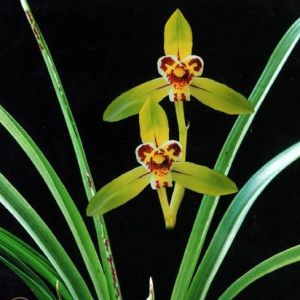
Introduction to the 'Hanxue Baoma' Cymbidium tortisepalum var. longibracteatum Variety
'Hanxue Baoma' originated in 2002 from Jiuzhou, Yunlong, Yunnan Province. It is a natural hybrid of Cymbidium tortisepalum var. longibracteatum (Lianban Lan) and Cymbidium goeringii var. serratum (Douban Lan), combining the delicate elegance and subtle fragrance of the former with the thick petals and large flowers of the latter. It can be said to gather the strengths of both; the biological "hybrid vigor" is perfectly embodied here. It has seven leaves; the leaf blades are curled, with deep grooves and thick texture, 30-40 cm long and 0.5-0.8 cm wide; most of the leaves that emerge after the fifth leaf show butterfly-like variegation, the green leaves paired with red coloration truly making one marvel at the wonder of nature's creation! It bears two or three flowers, the blooms are large, and it is a standard three-star butterfly type, with three complete lips distributed in a "pin" character arrangement, the red spots on the lip surface bright and eye-catching, with a high degree of butterfly-like transformation; the petals are thick and substantial, yellow-green in color. Such a yellow-flowered three-star butterfly is truly a masterpiece never before seen in the orchid world!
-
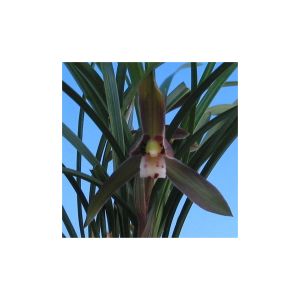
Introduction to the Variety Characteristics of Tang Zibao Chunlan
Also known as Tiansihuang. The leaves are semi-erect, hard in texture, and dark green. The flowers are of the bamboo-leaf petal type, purplish-red, with a white lip that is revolute and bears two red patches in the center.
-
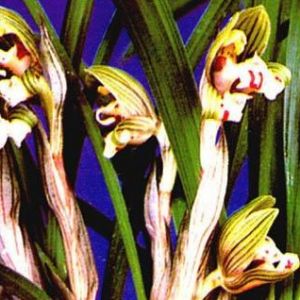
Introduction to the Little Butterfly Cymbidium goeringii Variety and Key Care Points
Leaves are slender and semi-pendant. The flower is a lotus-form butterfly-petal type: the lower half of the lower sepal (the lateral petal) is lip-like and curled backward; the lip is short and round, curled backward, and bears three red patches.
条件筛选