-
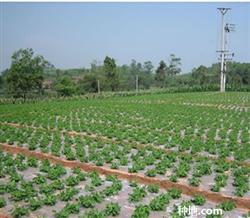
Detailed Explanation of Key Points of Peanut Cultivation with Plastic Mulch
How to cultivate peanuts with plastic mulch? Looking for methods. I. Pre-sowing preparation 1. Seed selection: Yuanza 9102, 8908, Yuhua 14. 2. Sun-drying pods: sun-dry pods for 2-3 days before shelling. 3. Mulch preparation: buy 60 cm micro-mulch film, 3-4 kg per mu. 4. Underground pest control: (1) per mu use 3-4 liang of isofenphos-methyl or phoxim mixed with 0.5-1 kg of water and 20-30 kg of soil, broadcast before plowing; (2) per mu use 1 liang of isofenphos-methyl or phoxim mixed with 2.5 kg of water and 25 kg of peanut seeds.
-
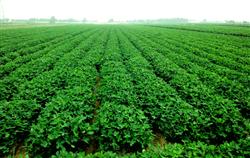
How to Grow Spring Peanuts for High Yield: Planting Methods and Key Technical Points
How to grow spring peanuts for high yield? Seeking guidance. Spring-planted peanuts are a major cash crop in our province, with a large planting area; yields are high but uneven, and there are still many medium- and low-yield fields, leaving great potential for increasing production. To achieve high yields in spring peanuts, six technical steps must be mastered well: 1. Select excellent varieties. Good seed is the foundation for achieving high yields...
-
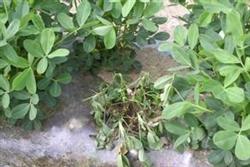
Comprehensive Control Methods for Peanut Wilt Disease in Early Spring Plastic Mulch Cultivation
Peanut wilt disease includes stem rot, root rot, southern blight, stalk rot and several other diseases, and it severely affects early spring plastic mulch peanut production. 1. Disease characteristics. Their common feature is that the peanut stem or leaf wilts and the affected part becomes discolored and necrotic. Generally, continuous cropping plots and plots with poor soil are more severely affected; rotation plots and plots with high fertility...
-
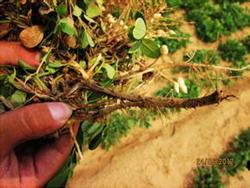
What are the benefits of applying organic fertilizer to peanuts for their growth and development?
What is peanut stem rot? Peanut stem rot is also called peanut stem rot disease or foot rot. Before the seedlings emerge, the affected cotyledons turn dark brown. The pathogen invades the base of the plant stem along the cotyledon stalk, first producing lesions that ooze yellow fluid, which later turn brown. As the lesions develop, they cause the tissue at the stem base to rot. When the lesions expand and encircle the stem base, the aboveground part wilts...
-
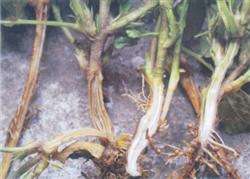
How to prevent and control peanut bacterial wilt? These methods you need to master
How to prevent and control peanut bacterial wilt? (1) Crop rotation: rotating between flooded and dry land for 1-2 years shows obvious results. On dry land, rotate with cereal crops; for lightly infected land 1-3 years, for heavily infected land 4-5 years. (2) Select disease-resistant varieties: currently promoted resistant varieties include Xiekangqing, Ehua No. 5, Zhonghua No. 2, You 92, Guiyou 28...
-
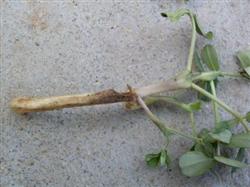
What are the control methods for peanut stem rot?
How to control peanut stem rot? (1) Keep good seed: choose summer peanuts for seed saving. Choose a sunny day to harvest early, sun-dry, and store in a dry place; before sowing, select healthy, large seeds. (2) Seed disinfection: 50% carbendazim wettable powder at 0.3% of the seed rate, 25% carbendazim wettable powder at 0.5% of the seed rate, mix with 5-10 times fine dry soil, and mix in layers onto peanut seeds soaked for 12 hours, or add 30 kg of water, soak 50 kg of seeds for 24 hours, stirring 2-3 times in between.
-
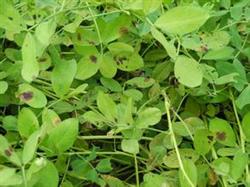
What are the control methods for peanut violet root rot?
How does peanut leaf spot occur? Both peanut black spot and brown spot are diseases caused by fungi. The sexual stage of the peanut black spot pathogen is Berkeley's Mycosphaerella; the stroma is hemispherical, brown to black, embedded beneath the host epidermis, with conidiophores densely clustered on the stroma; conidia are borne terminally, the conidia are olive...
-
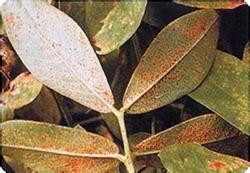
Analysis of the Causes of Peanut Rust Occurrence and Spread
What are the causes of peanut rust occurrence and spread? First, peanut rust is a fungal disease caused by Puccinia arachidis. The urediniospores are yellow, round or nearly round, with minute spines on the surface, and each urediniospore has one germination pore on each side of its middle section. Most urediniospores produce only one germ tube, and an appressorium forms at the tip of the germ tube, from which an infection hypha penetrates the peanut. Urediniospores can germinate only in the presence of water droplets or a water film. They have strong tolerance to low temperatures and poor tolerance to high temperatures. Under normal conditions, the germ tube penetrates the internal tissue after 65 hours, the hyphae continue to grow and produce haustoria, and after 7 days, pinpoint-sized white spots appear and begin to produce urediniospores; after 8 days, the white spots turn yellow-brown and form uredinia; after 10 days, the epidermis of the uredinia ruptures and releases urediniospores to continue infection. During the peanut growing period, the expansion and spread of peanut rust are mainly from local inoculum sources, but in the northern peanut regions, there is also the issue of external inoculum sources for the pathogen in early spring. The main factors affecting the occurrence and spread of peanut rust: First, the amount of overwintering inoculum. If the amount of overwintering inoculum is large, peanut rust may occur severely the following year.
-
Causes and Control Methods of Peanut Sheath Blight
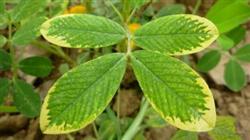
How does peanut sheath blight occur? How to control it? (1) Disease pattern: Peanut sheath blight is a disease caused by a basidiomycete fungus. Young hyphae are colorless, turning yellow-brown when mature; they are branched, with a distinct constriction at the branch point and a septum not far from the branch. Hyphae on the surface of diseased tissue can form sclerotia, which have a rough surface...
-
What are the main technical points for fertilizing peanuts?
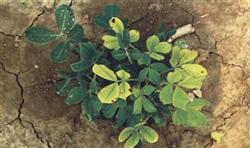
What are the symptoms when peanuts lack molybdenum? How can it be prevented and controlled? (1) Characteristics of the deficiency: When peanuts lack molybdenum, the plants are short and small, and the leaves are small and thin, appearing pale yellow-green, the same as the typical symptoms of nitrogen deficiency. If the above symptoms appear when nitrogen nutrition is sufficient, the possibility of molybdenum deficiency should be considered. (2) Control measures: ammonium molybdate...
条件筛选