Are Manganji sweet peppers spicy? Introducing the characteristics of Japanese red chili varieties
(Chili pepper) written in Japanese kanji is "" (togarashi), which means " (something spicy)" that came from " (not referring to China, but meaning foreign)". Simply put, togarashi is basically spicy, true red chili peppers. For example, the hawk's claw red chili looks extremely spicy, but in reality its spiciness is only ordinary at best, the fruit-setting rate of chili peppers is low. In addition, there is another variety in the world that completely suppresses the spiciness to "non-spicy", and it is called "Manganji sweet pepper".
"Manganji sweet pepper", what is its origin?
"Manganji sweet pepper" refers to chili peppers cultivated by specific farmers in areas neighboring Maizuru City, Kyoto Prefecture. Searching for "Manganji pepper" online returns about 520,000 related links, but most of them are not "Manganji sweet pepper", and some even mix in peppers produced in regions such as Miyazaki Prefecture.
On the other hand, searching for "Manganji sweet pepper" returns only about 39,000 related links. The reason for such a large difference in numbers is that this special name may only be used for products that have passed Kyoto specialty product certification.
About 100 years ago, the ancestor of "Manganji sweet pepper" was born in the Manganji area of Maizuru City, and from its outward characteristics it can be inferred that it was bred and cultivated by crossing "Fushimi pepper" with large chili varieties native to foreign countries. It just happened that the peppers harvested in this area received widespread praise as delicious, so about 30 farming households in the area began continuously cultivating this pepper variety.
Later, the locally grown "Manganji pepper" met a major turning point. In 1983, the Nakasuji Agricultural Committee of Maizuru, Kyoto Prefecture asked local farmers whether they were willing to brand the vegetable. The local farmers accepted this proposal, so they renamed "Manganji pepper" to "Manganji sweet pepper", and established a specialized "sweet pepper" division within the agricultural committee. This division regulated cultivation and shipping rules, established a common screening system and standards, and formally carried out production and shipping.
"Manganji sweet pepper" received extremely high praise from the very beginning of its supply, not only selling well but even selling out of stock. The branding goal expected by Kyoto Prefecture was a great success, and in 1989 it obtained the first certification as a "Kyoto Specialty Product" from the Kyoto Hometown Products Association. Therefore, even if other production areas can barely allow themselves to call their products "Manganji pepper", the product name "Manganji sweet pepper" alone is not allowed to be used without permission.
Big, straight, and delicious
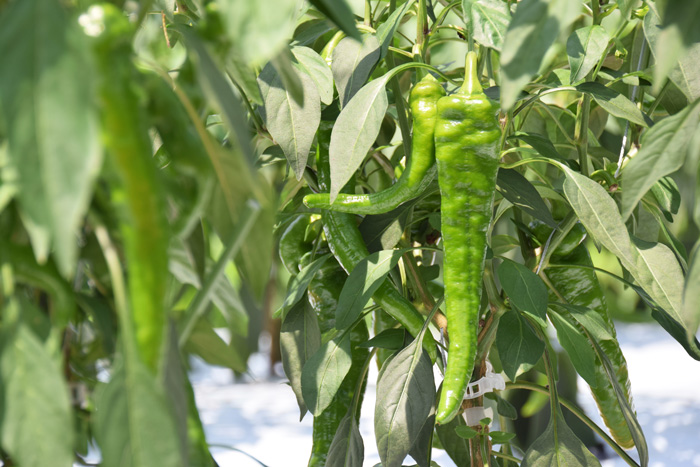
If "Manganji sweet pepper" is compared with other pepper varieties, the difference can be clearly seen. It is completely different in appearance, and its volume is larger than other varieties. According to length judgment at the screening site, it is divided into 3 grades: "Excellence", "Superior", and "Good", and excluding the stem end (the part connected to the branch), the shortest must not be less than 10 cm.
The condition for the highest grade, "Excellence", is a length between 13 and 23 cm with no excessive curvature. Therefore, even if the length meets the standard, overly curved sweet peppers will still be classified as "Superior" rather than Excellence. Under the strict inspection of the staff of the "Maizuru Manganji Sweet Pepper Division" who handle screening, no compromise is allowed. Moreover, only the "Excellence" grade can be shipped as a "Kyoto Specialty Product". Only large and straight products are recognized as "Manganji sweet pepper".
There are also other appearance characteristics. Manganji sweet pepper is not only large and thick-fleshed, but also has a vivid deep green color. It has a firm, resilient texture when eaten. If you have the chance, please be sure to compare and taste it against other peppers.
Next comes the most important part: the taste. Although this variety is large and thick-fleshed, it has very few seeds and is quite easy to swallow and eat. It is also tender and juicy, with a slight sweetness, and this is what creates its unique flavor. Of course, precisely because it is "Manganji sweet pepper", it has no spicy taste at all when eaten.
Completely suppressing the spicy taste through the power of science
By this point in the article, people who study plants may perhaps hold a skeptical attitude. Chili peppers are mainly wind-pollinated flowers that achieve pollination through wind, but at the same point they can also cross-pollinate through insects. In this process, how can "Manganji sweet pepper" be kept pure and absolutely non-spicy?
This secret lies in science. "Manganji sweet pepper" belongs to a fixed variety (after seeds are sown and grow, the variety characteristics are the same as the previous generation), and it is highly valued locally. Later, the Kyoto Prefectural Agriculture, Forestry and Fisheries Technology Center promoted variety improvement, and in 2007 registered the variety as "Kyoto Manganji No. 1".
However, at this stage, peppers with a spicy taste still remained, occurring at a rate of about 3 to 6%, and the spicy taste could not yet be 100% completely suppressed. After repeated research, the "Kyoto Manganji No. 2" variety was finally introduced for cultivation in 2012. This time, a gene marker technique was used to successfully and perfectly remove the gene carrying the spicy taste. In other words, in the future, as long as it is this variety, in theory no peppers with a spicy taste will be produced.
Mr. Jun Soeda: "Building a production area that can continue farming for 100 years"
Through the power of science, "Manganji sweet pepper" achieved a dramatic breakthrough in quality. But even so, simply sowing improved seeds and letting them grow freely will not produce good results. As a "Manganji sweet pepper" with specialty product certification, until the time of shipping, it must be accumulated through farmers' down-to-earth cultivation and bit-by-bit hard work.
"If I had to say which part is the hardest, it would be maintaining the mood of the plants themselves." This is what Mr. Jun Soeda, chairman of the Maizuru Manganji Sweet Pepper Division of JA Kyoto ni no Kuni (Kyoto Tan no Kuni Agricultural Cooperative), said. The expression "the mood of the plants" is rather unusual; to explain it simply, it means keeping the crops you grow healthy and vibrant.
"Kyoto Manganji No. 2 tends to bend because its shape is thinner in the middle. Once the whole thing bends, it cannot be shipped as Excellence grade, so in order to keep the plants themselves full of vitality, we pay especially careful attention during the harvest period." Mr. Jun Soeda emphasized that this is a necessary condition when reclaiming and expanding land and preparing to begin production.
In reclaiming land for farming, the most important thing is drainage. In order to create soft soil, all producers participating in the division have put in a great deal of effort.
"There are currently about 420 producers in the division, so there are about 420 proposals each year as well. If there are successful cases among them, they will continue to be adopted the following year. And these adopted cases are further improved and refined by each producer. By constantly revising and adjusting like this, the quality gradually improves every year, and the harvest volume is also continuously increasing."
Producers not only unite and comply with production standards, but also cultivate and improve bit by bit, and whether they succeed or fail, they share the results together, all in order to produce better products. This process, carried out with all producers working as one, is also the greatest strength of "Manganji sweet pepper".
"Growing Manganji sweet peppers for our descendants to eat, and raising children with them so they grow up strong, that is our determination. We vow that for this goal, no matter what, we will keep this land farmable for 100 years."
Miracles do not happen by chance. All of this is an achievement made possible only through people's arduous efforts and the accumulation of all kinds of experience.